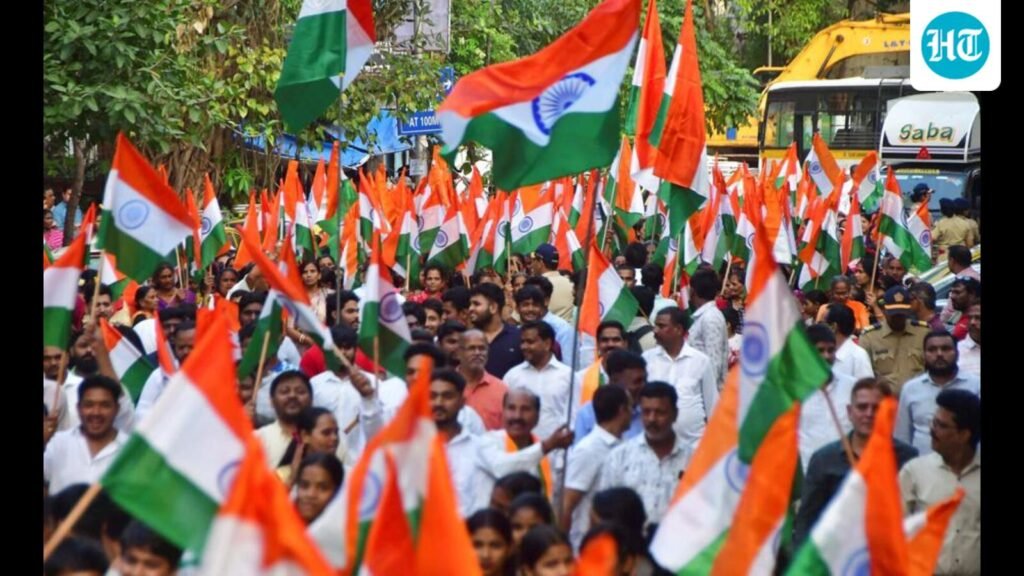
This year, marking the 150th anniversary of Vande Mataramit would be of interest to revisit the parliamentary history of the national song of the nation. Vande Mataramcomposed by Bankim Chandra Chatterjee in the late 19th century, became one of the most stirring expressions of patriotism during the freedom struggle. Its vision of the motherland as a source of strength, nourishment and moral purpose created a shared emotional vocabulary for courage and sacrifice.

Before Independence, it traveled from public meetings and marches into formal political spaces. In 1937, when Congress ministries took office in several provinces, Vande Mataram began to be sung inside legislative chambers. This marked one of the earliest moments when a symbol of the national movement entered the institutions of governance.
The relationship between Jana Gana Mana and Vande Mataram was clarified on January 24, 1950 during the final session of the Constituent Assembly. Rajendra Prasad, presiding as President of the Assembly, announced a formulation that balanced India’s constitutional identity with its historical memory. He said: “The composition consisting of the words and music known as Jana Gana Mana is the National Anthem of India, subject to such alterations in the words as the government may authorize as occasion arises; and the song Vande Mataramwhich has played a historic part in the struggle for Indian freedom, shall be honored equally with Jana Gana Mana and shall have equal status with it.”
Through this declaration, the Constituent Assembly affirmed Jana Gana Mana as the national anthem of the republic; while recognizing Vande Mataram as the national song with an equal claim to honor due to the role it played in the freedom movement.
A later development came during the 10th Lok Sabha. In 1994, the general purposes committee of the lower house, chaired over by Speaker Shivraj Patil, considered how national symbols should be incorporated into parliamentary adjournment ceremonies. After consultation and agreement among party leaders, the lower house adopted a practice whereby Vande Mataram would be played before the lower house was adjourned sin dieThe Speaker of the Lok Sabha, who chairs both the general purposes committee and the rules committee and appoints chairpersons of other parliamentary committees, played a central coordinating role in this decision,
Interestingly, India’s federal system allows the legislative proceedings to vary across states. Tamil Nadu follows a distinctive tradition in which the state anthem (Tamil Thai Vazhthu or Prayer to Mother Tamil) is played at the beginning of the governor’s address and the national anthem at the end. This convention has been in place since 1991. Nagaland did not play the national anthem in its assembly for many decades, and it was only in 2021 that it was played there for the first time. Tripura’s assembly first played the national anthem in 2018. These differences show how each state adopts its own rhythm of ceremonial expression, shaped by local histories and political cultures.
The singing of Jana Gana Mana and Vande Mataram in legislations reflects more than ceremony. Together, they connect India’s constitutional identity with the emotional energy of the national movement. One represents the sovereign republic; the other preserves the memory of collective struggle. From the provincial legislatures of 1937 to Parliament and the diverse practices of state assemblies today, these symbols continue to evolve within the living tradition of Indian democracy.
Ravindra Garimella is a former joint secretary (legislation), Lok Sabha Secretariat, and Priyank Nagpal is an independent researcher and LAMP fellow (2024-25). The views expressed are personal