It’s easy to miss the paragraphs on trade, buried as they are in the procedural thicket of the UNFCCC’s COP30 decision text. But paragraphs 55 and 56 of the Mutirão outcome have quietly shifted the institutional architecture of global climate governance. COP30 has, for the first time, intertwined trade and climate cooperation in a way that makes their connection formally visible — and politically contestable — within the UN system. For developing countries this is a strategic inflection point.

The European Union (EU)’s Carbon Border Adjustment Mechanism (CBAM), which will enter full effect in January 2026, is the clearest signal of the shifting terrain. Presented as a climate measure to prevent carbon leakage, CBAM imposes costs on imports of carbon-intensive goods — steel, aluminum, fertilizers — from countries with weaker climate regulations. What it really does, however, is shift the costs of Europe’s green transition onto other countries — without offering the finance, support, or flexibility they were promised. And this comes at a time when developed countries still haven’t delivered on their climate finance commitments under Article 9 of the Paris Agreement.
The Global South had little choice but to bring trade into the climate talks. The World Trade Organization (WTO) wasn’t helping — CBAM was moving ahead without clear rules, and when countries raised it there, the talks stalled. In the climate space, the EU insisted CBAM was a climate tool, not a trade measure. China pushed hard at the WTO to challenge CBAM, and India led the fight at the climate talks for the BASIC group. With Brazil, South Africa, and others alongside them the team of developing nations created space to discuss CBAM at COP30.
But creating that space doesn’t guarantee change. Dialogue fatigue is real. We’ve seen it before on finance and technology discussions. COP30’s closing days showed how hard things could get.
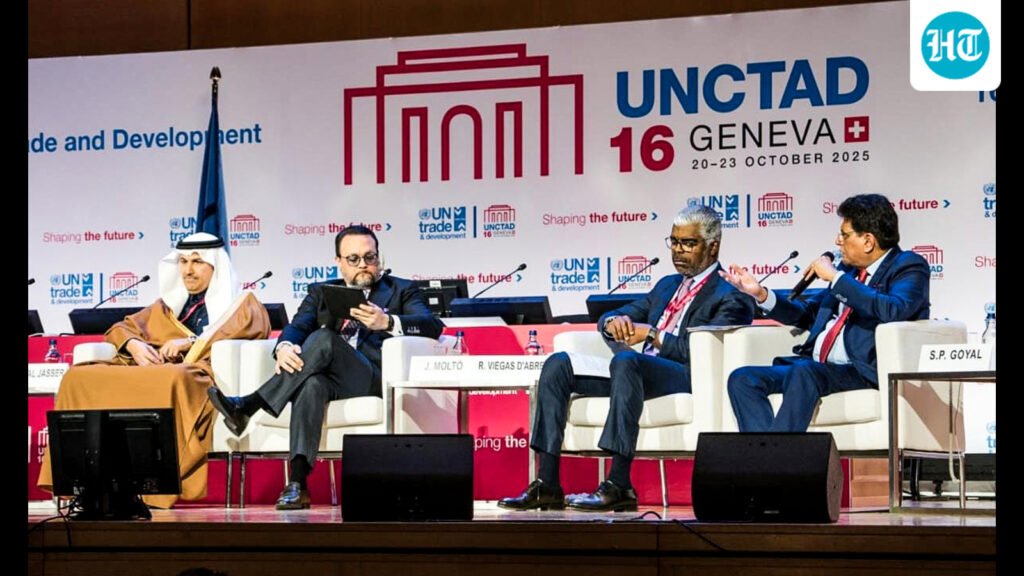
The decision to anchor trade within the UNFCCC through three high-level formal dialogues at SB64, SB66, and SB68, and a high-level event in 2028 with participation from WTO, UNCTAD, and ITC does not reverse CBAM. The EU trade measure will already be in force by the time these discussions convene. Yet, this decision means that climate-related trade measures including CBAM can now be discussed in a space where fairness and equity actually matter — unlike the WTO, where the focus is mostly on rules and market access. The UN climate talks are where developing countries have a stronger voice to view policy through the lens of justice, shared responsibility, and who have historically caused the problem.
Also, this isn’t the first time developing countries have had to fight to get the system to see things differently.
The creation of UNCTAD in the 1960s was a direct challenge to GATT’s liberalization paradigm as it positioned development as a legitimate goal of trade policy. In the climate sphere, similar strategic persistence led to adaptation, technology transfer, and eventually loss and damage to be recognized as policy pillars and not just secondary concerns. None of these gains came easily. In each case, developing countries moved the conversation from economics to justice, from rules to norms. Paragraph 56 does exactly that. It signals that trade measures are not technical fixes and instead need to decide who carries the cost as a matter of justice. Because if border taxes arrive before transition finance, then the transition isn’t fair. That’s exactly the tension that the Just Transition decision at COP30 was meant to confront.
The decision is technically aimed at ensuring that climate policies don’t push costs onto countries that haven’t been given the tools to decarbonise. Yet even as a Just Transition Work Program is being set up, trade measures like CBAM are already taking effect, with no finance or flexibility attached. If trade, finance, and equity aren’t aligned, then the idea of a just transition could be ineffective for countries that are already under pressure and have limited resources to manage the shift.
For many exporters in the Global South, CBAM isn’t a policy debate but a pricing problem. Costs are already rising for sectors like steel, aluminium, and fertilisers. Smaller firms have limited capacity to track emissions, let alone meet EU reporting rules. If more countries roll out similar measures, the compliance burden will grow — especially without support to adapt.
By 2028, that disconnect will be even harder to ignore. If India hosts COP33, it won’t just run the summit — it’ll be right at the center of the fault line. What matters isn’t what the paragraphs say today, but whether they’ve opened real space for fairness and shared rules in a world shaped by carbon-linked trade.
Archana Chaudhary is associate director at Climate Trends, a Delhi-based think tank. The views are personal