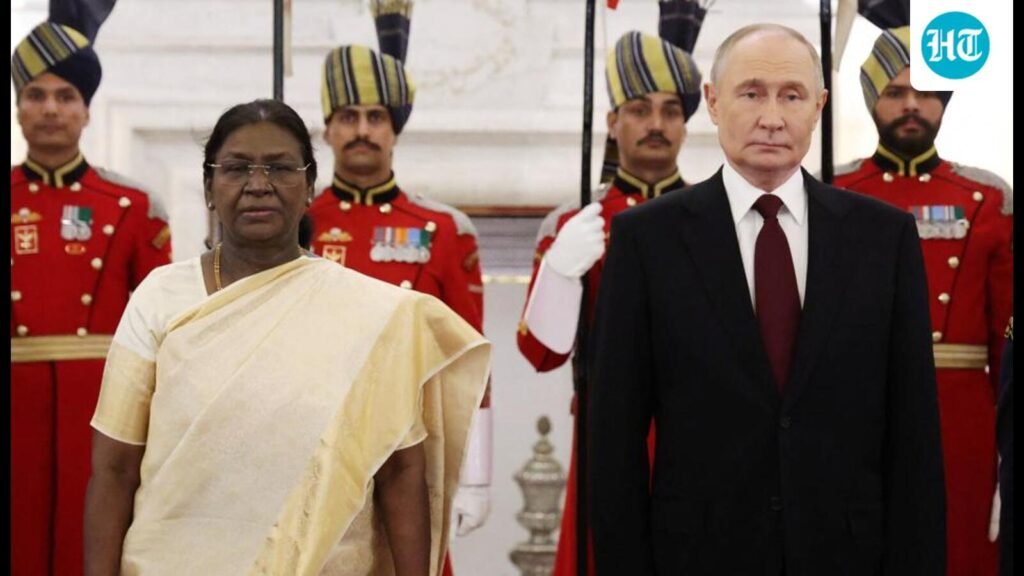
President Vladimir Putin has returned to Moscow very satisfied by his whirlwind 30-hour State visit to India. Incorporating the 23rd India–Russia Annual Summit, it stood out for its symbolism and substance, and injected fresh momentum into the Special and Privileged Strategic Partnership that uniquely defines India–Russia relations.

Discussions between Prime Minister Narendra Modi and President Putin were warm and candid, reflecting a quarter century of personal rapport and mutual respect. Putin candidly briefed Modi on the Ukraine peace push since the Alaska summit last August, led principally by Washington and Moscow. Having met President Donald Trump’s Special Envoy in Moscow shortly before arriving in India, Putin shared his impressions of the ongoing diplomatic track. Modi reiterated that India stands on the side of peace and that dialogue and diplomacy are the only credible path to resolving the Ukraine conflict. This stance aligns naturally and entirely with the peace efforts now underway by Russia and the US. Indeed, moves by Trump and Putin to end the Ukraine conflict and normalize their relations squarely serve India’s interests.
The Delhi summit joint statement underlined continuity and political trust and a commitment to strengthen coordination on global issues — from advancing a multipolar world order to supporting India’s growing role in global governance. Rather than emitting geopolitical signals, the visit focused on consolidating economic cooperation in trade, technology and people-to-people exchanges. Indeed, both were at pains to emphasize that they sought to enhance their bilateral ties and wished no harm to others.
A looking forward joint vision document and 16 agreements testify to the vitality of this partnership. A highlight was the Program for the Development of Strategic Areas of India-Russia Economic Cooperation till 2030, a concrete roadmap to diversify trade, close imbalances, and expand collaboration in many priority sectors.
The ambitious target of $100 billion in bilateral trade by 2030 will be pursued through greater Indian exports, mutual settlements in national currencies, and secure non-western payment and logistics channels. Indian pharmaceuticals, frozen shrimp, textiles and apparel, farm products and autos have strong export potential. The licensing of Sberbank to export gold to India and enable Russians to invest in Indian securities is noteworthy. Nearly two dozen banks can now facilitate Rupee Vostro accounts. Boosting connectivity remains vital. Expeditious finalization of a Bilateral Investment Protection Agreement and a long-delayed free trade agreement with the Eurasian Economic Union would boost business confidence.
The agreements on labor mobility will enable the safe and regulated movement to Russia of skilled Indian workers, particularly engineers, IT specialists, and construction personnel. This will open fresh employment opportunities abroad for Indians, while strengthening joint action against irregular migration.
Both sides expressed satisfaction with ongoing defense projects and an intent to resolve delivery delays while expanding joint development, manufacture, technology transfer and localisation. No new arms deals were signed before the leaders, which is consistent with longstanding tradition. Nuclear energy will remain a key pillar of the relationship. Units 3 and 4 of the Kudankulam nuclear power plant are to soon go on stream, while construction of Units 5 and 6 progress steadily. A second project site is under finalization, probably on India’s east coast. Collaboration on Small Modular Reactors would be pursued.
As regards oil and gas, India seeks stable prices and assured supplies to meet its growing energy needs, guided by affordability and security, rather than geopolitics. Diversifying suppliers and routes ensures resilience against disruptions, market volatility and external pressures. Within this framework, Indian private firms and public sector units weigh commercial and other considerations, including sanctions-related constraints, before making purchase decisions. Putin reiterated Russia’s readiness to “continue uninterrupted fuel shipments to support India’s fast-growing economy”. Close cooperation is envisioned in sectors like space exploration, science and technology, shipbuilding, Artificial Intelligence, cyber security, counter-terrorism, and critical minerals supply chains, reinforcing the partnership in sensitive areas.
The growing attention to Arctic cooperation is noteworthy from a long-term scientific, business and strategic viewpoint. As the Northern Sea Route becomes navigable year round, training Indian seafarers for polar conditions gains clear strategic significance. Going ahead, the Chennai–Vladivostok maritime corridor needs to be stretched through the Bering Strait to Murmansk to become a connectivity conduit linking the Indian, Pacific and Arctic Oceans.
The visit reaffirmed a partnership anchored in mutual respect, one that has endured shifting alignments and geopolitical turbulence. More than symbolism, the outcomes underscored a shared intent to keep the relationship adaptive, pragmatic and policy-relevant, rather than hostage to external pressures. The political signal was clear: Despite global churn and external pressures, India and Russia intend to pursue a balanced and forward-looking strategic partnership built on converging interests.
Putin’s visit came soon after Washington released a new US National Security Strategy that reshapes the geopolitical landscape. It signaled US openness to renewed engagement with Russia, even as China remained a principal concern. Its framing of India as a critical partner, rather than a camp follower or a regional balancer, suggests that current frictions in India-US ties — such as prohibitive tariffs or threats of secondary sanctions on our energy imports — are likely temporary irritants.
India’s multi-alignment is not a reflexive hedge, but a deliberate assessment that relations with Washington and Moscow are not a zero-sum choice. As a re-emerging power with growing economic and strategic reach, India possesses both the confidence and ambition to simultaneously maintain productive relations with both Russia and the US. Managed with foresight, an India-Russia-America arrangement could indeed form a stabilizing “trident” in global affairs — grounded in dialogue, tempered by realism and oriented toward peace.
Ajai Malhotra is a former Indian ambassador to the Russian Federation. The views expressed are personal