To me, the question of whether a country is truly developed has little to do with its GDP. It can be answered far more simply: Can I drink water straight from the tap in my hotel room?

By that measure, development is rare. Just about two dozen countries in the world can credibly claim that their tap water is universally safe to drink. India is nowhere close. More strikingly, this is not even articulated as a national goal. Viksit Bharat — India’s goal of being a developed country by 2047 — is framed almost entirely around income growth and aggregate GDP, as if prosperity alone will deliver the things that make life secure, healthy, and dignified.
Sadly, it will not. GDP growth does not automatically produce potable water, clean air, safe neighborhoods, or reliable public transport. Without these foundations, higher incomes merely push people with money into private substitutes — gated colonies, diesel generators, air and water purifiers, bottled water, and private cars. The vast majority will have to just fend for themselves. The result is a fragmented society where basic public goods are replaced by costly individual coping mechanisms — inefficient, unequal, and ultimately unsustainable.
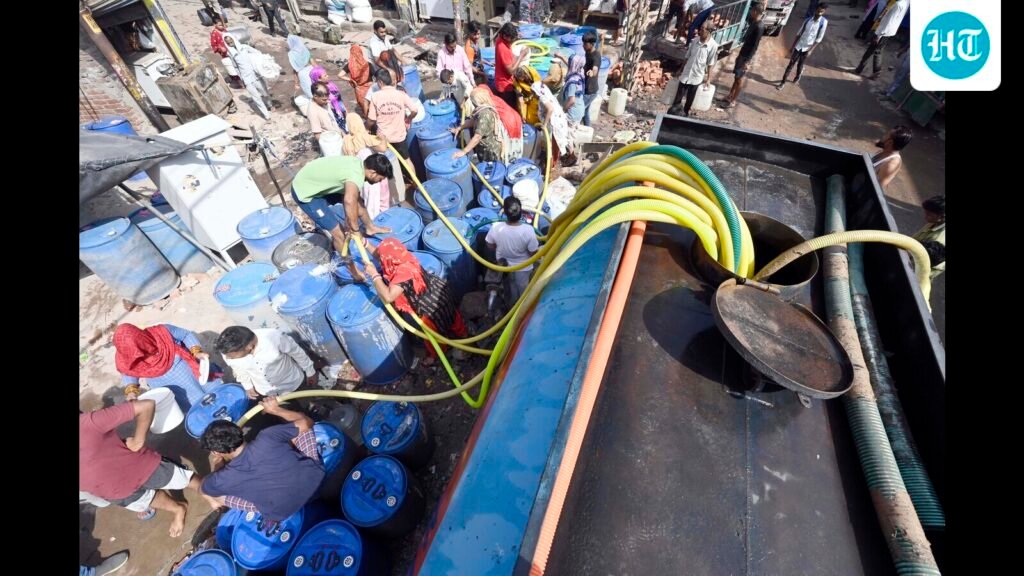
In the case of water, the first requirement of any modern city is a continuous, uninterrupted supply. Yet, every Indian summer brings the same ritual: tankers lining up, resident welfare associations negotiating contracts, and households rationing a resource that should never be rationed in an urban economy. Publicly available data show that roughly three-quarters of households now have piped water connections, but they do not measure whether water is safe to drink, continuously supplied, or trusted enough to use without boiling or filtering. The available statistics track plumbing rather than availability, potability, or reliable access, all of which remain poor.
The more consequential step is to ensure that piped water is actually drinkable. This is not a technological fantasy. It already exists in pockets of India, such as Jamshedpur, where high-quality treatment, continuous pressurized supply, and disciplined maintenance have made potable tap water routine rather than aspirational. The government’s Jal Jeevan Mission aims “to provide safe and adequate drinking water through individual household tap connections by 2024 to all households in rural India” — but the water is not safe yet and adequate drinking water is not available even in most homes in urban India.
The challenges of achieving universal access to potable table water are well known: consistent chlorination and quality control at the source; maintaining pressurized supply so that when water and sewer lines run alongside each other, sewage does not leak into drinking water; systematic pipe renewal; and regulation of last-mile storage tanks that often undo everything achieved upstream. None of this is easy—but none of it is new.
By the late 1800s, countries such as the United Kingdom, the Netherlands, Germany, Switzerland, and parts of the United States had already figured out how to ensure that ordinary citizens could reasonably expect to drink from their household tap. This single innovation did more to reduce infectious diseases and improve life expectancy than almost any subsequent medical breakthrough.
In India, by contrast, potable tap water has not been central to the idea of development. Instead, an entire industry of household filters, purifiers, and bottled water has grown to compensate for a public failure. Millions of households spend time, energy, and money boiling or purifying water — an inefficiency that should never exist at scale. Diarrheal disease, especially during the hot summer months, would be widespread but for the efforts we make to ensure the usability of our water. And many households simply get a home-delivery service for water for cooking and drinking, ensuring that there is more drinking water traveling on the roads than under the road in pipes where it belongs. Water treatment is most effective, safest, and cheapest when done centrally, not kitchen by kitchen.
As incomes rise without safe piped water, the default alternative becomes plastic. Mexico offers a reminder of the limits of income growth. With a per-capita GDP nearly five times that of India and near-universal piped access, Mexico is nevertheless among the world’s largest consumers of bottled water — because people do not trust what comes out of the tap. That is not development; it is an expensive illusion of it. And India is not far behind. The massive use of single-use plastic bottles for water is choking our streets, waterways, and eventually ends up in the ocean, where it kills marine life. Many years ago, I personally decided to never use single-use plastic, even if offered while traveling or in a meeting. But individual actions, while helpful, do not represent system-wide solutions since I can understand why many people rely on plastic bottles. But we are all witness to the massive use of single-use water bottles, a practice that simply can’t go on without making the country unlivable.
The $21,000 per-capita GDP India aspires to by 2047 will mean little if citizens cannot perform the most basic act of modern life — drinking water from a tap — without anxiety. And living in a country that is not drowning in plastic waste. When we speak of Viksit Bharat, this is what development should look like: invisible infrastructure that works so reliably we barely notice it.
That said, if India makes the availability of potable tap water in every household a promise, it can get there with careful planning and sustained focus. But only if we first stop mistaking income for progress — and start measuring development by the quality of everyday life.
Ramanan Laxminarayan is president, One Health Trust. The views expressed are personal