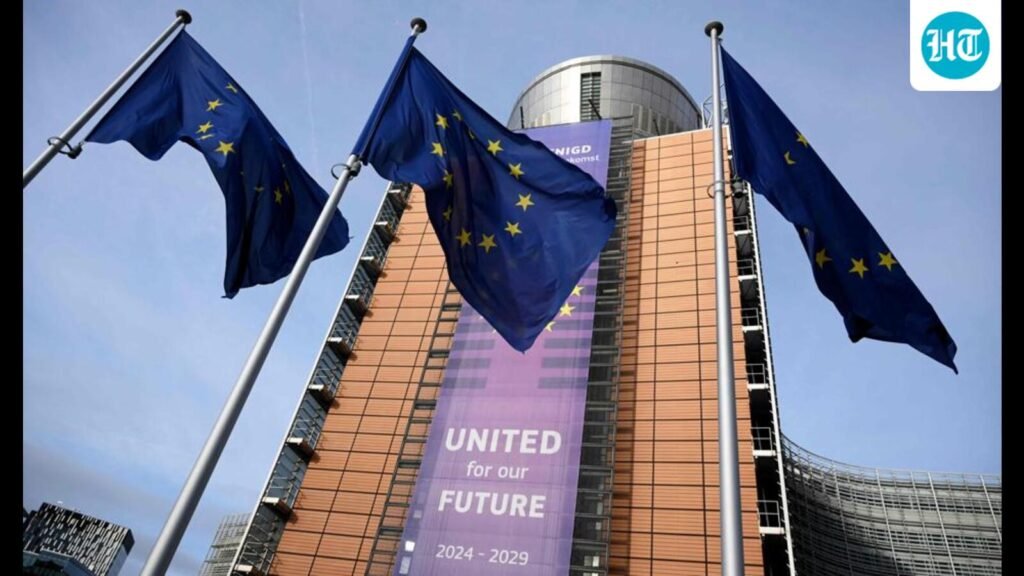
Such is the shock of the geopolitical bank run on Europe today that it is easy to forget that liberal peace on the Old Continent itself is a historical accident. Enabled by the balance-of-power between the US and the erstwhile Soviet Union and nourished by decades of strong industrial growth and the common market, building and sustaining the European Union (EU) required constant supervision. Things could have gone south earlier. But it took the troika of Russia’s military and political assault, China’s industrial and economic assault, and the US’s ideological assault for the EU to face a reckoning that seemed impossible but was not. Unsurprisingly, Ursula von der Leyen, President of the European Commission, who along with European Council President Antonio Costa will be the chief guests at India’s Republic Day celebrations on January 26, now views India as a “pillar of certainty for Europe in an increasingly uncertain world”. She means it.

India’s own troubles with the US, China, and Pakistan, make it tempting to argue for a pivot towards Europe. Strong India-EU ties could create pathways for stability in an international system under stress. It will afford Brussels and New Delhi more options as they diversify their international partnerships. The tempo, tenor, substance, and urgency of bilateral exchanges, deals, and official statements in recent years clarifies the positive trendline of this story. There is no shortage of sectors in which the two can work together and are indeed starting to open the proverbial files. From trade and tech to defense sales, quantum and Artificial Intelligence to renewables, climate action and counterterrorism to energy, the canvas of mutually beneficial cooperation is large.
But other than reasons of geopolitical circumstance, the logic of which must not be undervalued, why should India invest in Europe? This question is important in the light of India’s unceasing partnership with Russia and continuing dependence on the US. Add to it Europe’s internal political churn. Far-Right parties are either in power or waiting in the wings in most European capitals. The values and politics of parties such as the Alternative for Deutschland (AfD) in Germany, the National Rally in France, the Party for Freedom in the Netherlands, or the Reform UK does not bother New Delhi. But their avowed aim to undermine the union is likely to have consequences for an India that has expanded stakes in the EU. Then there is the question of Europe’s economic health. What if it fails to recover? To be clear, Germany’s industrial decline is not just China’s doing, Berlin’s policy misfires are equally at fault.
The answer is simple. Despite Europe’s disheartening balance sheet, its geopolitical revival is in India’s core strategic interest. Why? Because India’s vision of a multipolar Asia, somewhat counter-intuitively, depends on an economically strong and united, politically stable and moderate, and a militarily capable and assertive Europe. Before unpacking why this is the case, let’s rid the conversation of a red herring. There is an argument that Russia, for all its ills, is dominant in Ukraine, gaining territory every day, and has sufficient depth to outlast an exhausted Kyiv in a war of attrition. If this is the case, it makes sense to widen engagement with Moscow, as witnessed in the recent red carpet for President Vladimir Putin in New Delhi and prevent Russia from becoming more dependent on China. Russia’s long-standing mistrust of China offers a credible data-point to lubricate this argument.
Here’s the rub. Russia is already so dependent on China that Putin’s mistrust of Xi Jinping’s intentions has little value. This doesn’t mean that India should stymie ties with Moscow. But there is a case to be made that Russia cannot be a credible pole in Asia, while it incurs outsized capital and human losses in Europe for every inch of Ukrainian territory gained. Russia is losing the war in a strategic sense even if it may win some battles and cut a temporary deal with Trump’s support. There is also the reality that Europe, for all its bureaucracy, has unanimously passed several resolutions in support of Ukraine, has cleared a $90 billion loan for Kyiv, is not losing its political will to resist Russian aggression, is rearming at scale, and preparing for a wider war with or without the US.
The Europe of an imminent future is likely to be a different ballgame than what the world has seen till now. India would want that Europe on its side.
This brings us back to India’s other European dilemmas. Politically, Europe’s far-Right, despite playing up fear and nativism, is aware of the risks of overdoing the rhetoric on the union itself. Italian prime minister Giorgia Meloni is a case in point. She is committed to the European project while being true to her brand of conservatism. Even AfD remains split on Russia with its leader Alice Wiedel siding with Russia-critics. These movements are in the foothills of settling on an equilibrium i.e., to focus on culture wars and migration to keep the political pot boiling, but shy away from harming the union or dithering on Russia. The cost to be paid for the latter is exorbitant given public anxieties about Russian excesses.
Even if sluggish, the EU continues to grow. But Europe’s economic tumult is real and with few short-term solutions. But even a struggling EU will remain an economic heavyweight. If Europe can weather the Trump tariffs by diversifying its trade networks with India, Japan, and other middle powers, and invest in resilient sectors that promise medium to long term returns, then it will turn the tide.
Otherwise, there is a risk that Europe’s, and especially Germany’s, automobile manufacturers refashion their assembly lines toward defense production and join the likes of Rheinmetall to ignite Europe’s defense capabilities.
Berlin’s partnership with New Delhi, then, will be essential to procure critical defense metals and other raw materials when China is choking rare earth exports for its international clients. All of this is to say that the EU still has cards to play on defense and economy.
But Europe cannot liberate itself in isolation. It needs partners such as India to rebuild its capabilities and withstand the triple assault from the US, China, and Russia. Such a partnership will not only enable Europe, but also augment India’s economic, defence, and tech capabilities.
Europe’s revival will also focus Beijing’s mind on how far they can antagonize the Old Continent on Russia, and how much of a wedge they can drive between the EU and the US. It may not seem so now, but Europe’s rise will drastically reduce Russia’s value as an ally for China.
Thus, instead of waiting for Russia to escape the Chinese chokehold, partnership with Europe is more likely to make India the alternative Asian pole that it views itself to rightfully be.
Avinash Paliwal teaches at SOAS University of London and is the author of India’s Near East: A New History (London: Hurst, 2024). The views expressed are personal