Donald Trump won the US presidential election in November 2024 promising to crack down on illegal immigration. True to form, his second term has featured highly visible deportation operations targeting undocumented migrants. But nearly one year into Trump’s presidency, the Make America Great Again (MAGA) movement he created is spending as much energy aiming its guns toward a different target: the H-1B visa program, and, by extension, Indian immigrants more broadly.

For decades, the H-1B visa program was framed as America’s gateway for global talent: a technocratic instrument meant to keep the US competitive in science, technology, engineering, and innovation. It was imperfect and often controversial, but it occupied a relatively narrow policy lane, debated in terms of labor markets, wages, and skills shortages. Over the past year, that framing has changed.
The H-1B program has been recast in the American public imagination not as a talent pipeline, but as a symbol of job displacement, corporate abuse, and unfair competition. This shift did not happen overnight. It has been driven and amplified by politics, populist rhetoric, and a sustained campaign to associate the visa with economic insecurity among native-born workers.
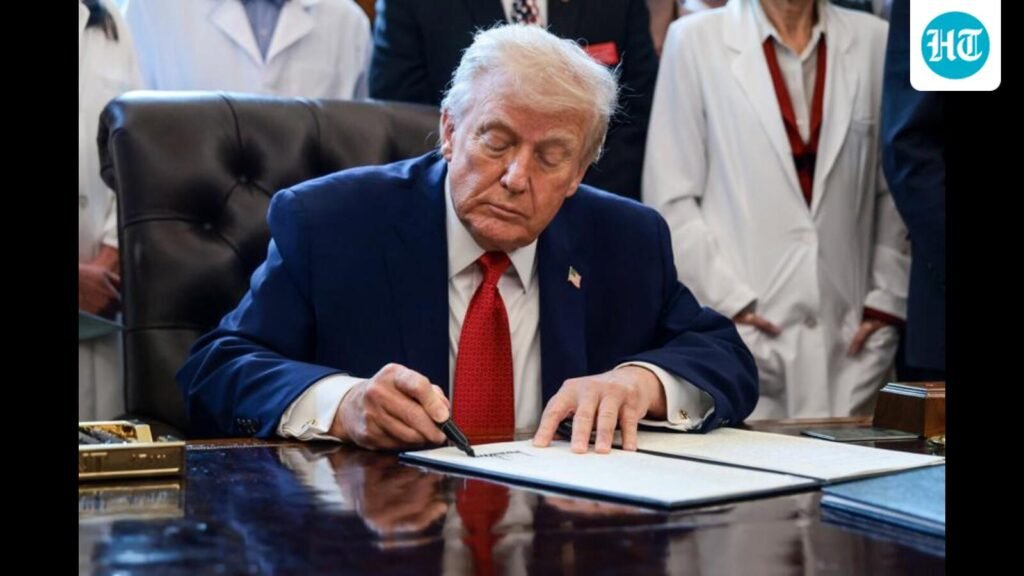
The turning point came in September, when Trump issued a presidential proclamation imposing a $100,000 fee to process new H-1B petitions. That marked a clear escalation. Since then, H-1B workers have found themselves squarely in the crosshairs of MAGA influencers, conservative media figures, and online activists.
What followed was not a single policy change, but a sequence of administrative and rhetorical actions that together signaled a broader crackdown.
First, US embassies and consulates adopted enhanced vetting measures, including expanded social-media screening and more detailed background checks. These changes, coupled with staffing constraints, have dramatically slowed interview scheduling, particularly in India. The result has been months-long delays, higher costs for employers, and thousands of H-1B workers stranded abroad, unable to return to their US jobs.
Second, earlier this month, the department of homeland security announced the end of the H-1B random lottery system. In its place, the administration introduced a weighted selection process that favors applicants who offer higher wages or demonstrate advanced skills.
Under the new framework, higher-paid candidates receive multiple entries in the cap selection, structurally reducing the odds for lower-paid foreign professionals. While framed as a merit-based reform, the policy fundamentally alters who can realistically access the visa.
These moves did not emerge in a vacuum.
The H-1B program has long enjoyed support from pro-business Republicans, but it has also faced sustained opposition within conservative circles. Critics have argued that the program was abused — particularly by Indian outsourcing firms — depressed wages, and disadvantaged American tech workers in their own labor market. What has changed is not the existence of these critiques, but their political salience and cultural resonance.
An aggressive public campaign against both the program and its beneficiaries has run parallel to the administrative crackdown. Because Indians receive more than 70% of all H-1B visas, Indian nationals, and even Indian Americans who are US citizens, have increasingly become targets of this backlash.
MAGA critics such as Laura Ingraham and Steve Bannon, along with a vast ecosystem of social-media influencers, have portrayed the visa as emblematic of elite betrayal. “STOP THE CHAOS: END THE H-1B SCAM NOW, SEND ALL THE VISA HOLDERS HOME, HIRE ONLY AMERICAN CITIZENS,” Bannon wrote on GETTR in response to an Indian media report about visa holders stranded abroad. His outburst was not an anomaly. Social media is saturated with similar rhetoric.
As this column reported in October, the attack on H-1B has increasingly morphed into an attack on Indians and Indian Americans more broadly. The community has become collateral damage in a broader cultural and political war, facing heightened suspicion, harassment, and overt racism. What is striking is how uncontested this narrative shift has been. Neither US companies nor Indian IT firms have mounted a meaningful public defense of the programme. Industry associations have largely retreated into quiet lobbying. The vacuum has allowed a simplified, and often distorted, story to harden into conventional wisdom.
Even when Indian American figures have attempted to push back, the consequences have been swift. When Vivek Ramaswamy, then a rising star in the Republican Party, defended the H-1B program in December 2024, he faced ferocious backlash from his own political base. That episode may ultimately cost him his bid for Ohio governor. In the US Congress, outside of a handful of voices such as Raja Krishnamoorthi, there has been little appetite to publicly defend the visa. The result is a profound shift in perception. The H-1B program may survive as a legal structure, but its reputational standing has been deeply damaged. This reputational collapse has enduring consequences that no executive order can easily reverse.
Once a program becomes politically stigmatized, enforcement hardens. Scrutiny intensifies. Public tolerance erodes. Employers grow cautious. Regulators assume bad faith. Even a future Democratic administration may find it politically difficult to robustly defend H-1B, unless economic conditions change dramatically. In that sense, the most enduring legacy of the past year may not be a specific rule or fee, but a narrative: that high-skilled immigration is a threat to the US rather than an asset. One can safely say that most of Trump’s controversial executive orders will be reversed instantly by the next Democratic president. Policies can be rewritten with the stroke of a pen. Narratives cannot.
The H-1B may continue to exist on paper, but its role in America’s innovation economy could be permanently diminished. Some argue that jobs will simply move offshore, particularly to India. That may happen, but for US companies, it would be a public-relations disaster, reinforcing precisely the story they have failed to contest. The question, then, is no longer whether the H-1B program survives. It is whether America still believes in what the program was meant to represent.
Frank F Islam is an entrepreneur, civic leader, and thought-leader based in Washington DC. The views expressed are personal