The modern rules-based international order emerged from the wreckage of World War II. Designed by the victors and led by the US, its institutions — from the United Nations system to Bretton Woods — were shaped to preserve western strategic and economic primacy. Yet despite their self-serving elements, these arrangements helped maintain a degree of global stability, predictability and prosperity for nearly eight decades. That order is now under strain.

This was evident even at Davos, where US President Donald Trump — despite deep differences with most western allies — framed western power and prosperity as the product of a shared and “very special” culture, which he argued must be defended and strengthened. The emphasis on cultural inheritance, rather than shared rules or institutions, underlined how far the language of the old order has shifted.
As China’s rise accelerates and Russia grows more assertive, the US appears increasingly skeptical of the very system it once championed. Convinced that multilateral institutions constrain American freedom of action, and that allies have grown complacent under the US security umbrella, Washington has begun to prioritize disruption over adaptation — seeking to reassert supremacy before its relative advantage diminishes further.
What remains unclear is what vision, if any, the US has for a successor order. Beyond a narrowly transactional pursuit of advantage, there is little articulation of a coherent alternative framework capable of delivering stability in a multipolar world.
The emerging great powers have not yet filled this void. India and China, despite their growing global weight and civilizational depth, have largely responded tactically to the erosion of the old order rather than advancing a compelling new one. Much of their diplomacy has focused on navigating uncertainty, rather than shaping the terms of a future settlement. Traditional middle powers — Japan, Germany, Australia, Canada and others — have also tended to react rather than lead. Even legacy great powers such as the United Kingdom and France, though still relevant, appear constrained by alliance dependencies and domestic pressures.
In contrast, in West Asia, countries such as Saudi Arabia and the UAE have begun to pursue more autonomous foreign policies, redefining their regional and global roles. The broader pattern is unmistakable. The international system is drifting toward fragmentation and narrow transactionalism, with diminishing regard for shared norms or institutional restraint.
Recent precedents in global diplomacy suggest a future in which arrangements are episodic and power-driven. If Thucydides articulated this logic in western political thought, the Mahabharata had warned that in an era of rupture, “the strong devour the weak like fish in water” unless a higher order is maintained. Absent such an order, the result is a world closer to Mad Max than to any sustainable model of global governance.
It is precisely this danger that Canadian Prime Minister Mark Carney alluded to in his speech at Davos on Wednesday. Warning that “if great powers abandon even the pretense of rules and values for the unhindered pursuit of their power and interests, the gains from transactionalism will become harder to replicate,” Carney articulated a concern shared by many middle powers. His remarks underscored a simple truth: Unrestrained power politics ultimately undermine even those who believe they benefit from them.
Carney’s intervention also highlights a larger opportunity. The next phase of the global order is unlikely to be shaped by a single hegemon. Instead, it will require a coalition — particularly of middle powers — that have a shared interest in stability, openness and predictability, and the credibility to engage across ideological and geopolitical divides. For many middle powers, the question now is not whether the old order is fraying, but who has the credibility and reach to help shape what comes next.
This is where India’s role becomes pivotal. India today is no longer merely a balancing power. It is increasingly recognized as a great power in its own right, with strong relations across Europe, the Indo-Pacific, West Asia, Africa and Latin America, and a demonstrated ability to mobilize the Global South. While India’s relationship with Canada has experienced periodic strains, there is now space for recalibration within a broader convergence among middle powers concerned about the direction of the international system.
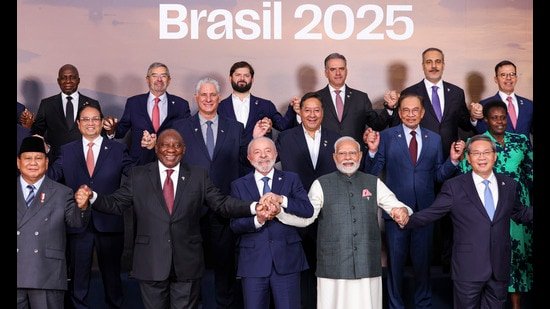
One available platform is India’s current chairmanship of BRICS — if approached with care. While often viewed through the prism of great-power rivalry, BRICS also brings together diverse emerging and middle powers with a shared interest in reforming, rather than dismantling, global governance. Used judiciously, it could complement existing institutions by helping articulate principles for a more inclusive and functional order.
More broadly, India is uniquely placed to convene an initial core group of like-minded States — middle powers, and possibly some open-minded great powers — to begin a serious conversation about what a new global order should look like. This would not be an exercise in bloc-building or institutional replacement, but an effort to restore legitimacy, balance and purpose to international cooperation. Such an endeavor will require political confidence and the willingness to step into uncharted territory. History suggests that moments of transition reward those prepared to invest early in ideas and institutions, rather than merely adapt to outcomes shaped by others. The challenge today is not to replicate Bretton Woods or San Francisco, but to reimagine their spirit for a multipolar age — one in which power is diffused, interdependence unavoidable, and legitimacy indispensable. In a world drifting toward fragmentation, India has the credibility, relationships and confidence to help anchor that effort — if it chooses to lead.
Milinda Moragoda is a former Cabinet minister and diplomat from Sri Lanka and founder of the Pathfinder Foundation, a strategic affairs think tank. The views expressed are personal