My wife and I spent two nights at Ganga Kutir, the new Taj Hotel built in collaboration with the Neotia Group, two hours beyond Kolkata, where the river appears to be as wide as the ocean it is about to merge in.

Among the others invited were Aparna Sen, Shabana Azmi and Javed Akhtar. On a balmy winter day, as Shabana and Aparna discussed their remarkable cinematic experience, I asked them whether, over the decades, audience tastes have changed, and how this has impacted the art of filmmaking?
Both of them said that the change was noticeable. Earlier, films could be made that were less melodramatic, more subtle and nuanced, and beautiful for the quality of their making and message. Today, most films are overloaded with simplistic and predictable sensationalism, reveling in inane visual flamboyance. This seriously limits the canvas for creative films.
Later that day, Javed spoke about poetry and literature, and the question I had asked Aparna and Shabana loomed large again. Is there an audience out there that wants to hear good poetry, memorable for its intrinsic content? Or are they happy with merely clever rhyming, on the same jaded subjects, the lyric quickly forgotten if the music is not instantly suited to gyrating?
The larger question is whether language itself is reducing itself to the lowest common denominator of just basic communication, instead of the elegance of literature? Communication is, of course, important, but can its necessity overwhelm beautiful literary expression, and pauperise the written word to the level of what suits the comprehensibility of those who seek little else?
This dichotomy — between literary sophistication and audience preference — is fast becoming a chasm. On returning from Ganga Kutir, I participated in the Jaipur Literature Festival, and as always, the venue was jam packed — particularly with the young. This made me happy, but I did get an inescapable sense that more readers now want neatly packaged, short, simplified, easily comprehensible, capsuled — and if possible, summarized — texts that can be read on a brief flight, rather than works of lasting literary value.
We see the same phenomenon in the classical arts too. Classical music, for instance, requires space for elaboration. It is a highly refined tradition, where each raga is meant to evoke a mood that gradually builds up to a crescendo. But increasingly, I have noticed that audiences don’t have the patience to let that unfold. They want the performance to quickly come to the drutthe fast-paced conclusion, where, to cater to audience taste, even accomplished classical musicians begin to perform like some adolescent pop-band.
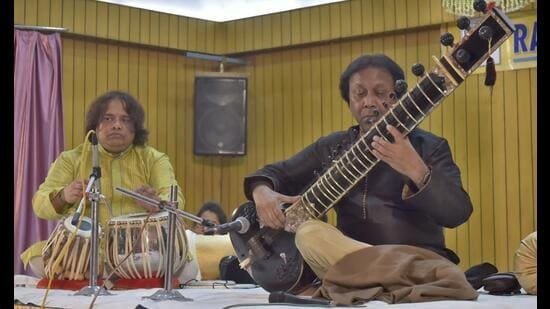
This was strikingly on display when Ustad Nishat Khan, a fine sitar player, performed at Ganga Kutir. It was a spectacular setting, with the Ganga as the backdrop to the stage. On my request, he began the concert with Raga Yamanbut given the shortage of time and audience preference, he delineated it but briefly, and then through a medley of other ragasmoved to the frenetic climactic duet with the tableeliminating the intricate evolution of the raga.
In film music as well, there seems to be an obsession with simplistic beats, loud and repetitive, without the enduring seduction of either melody or our timeless tradition of rhythm that languorously twins tune and meter to mathematical precision.
I understand that perhaps people have less time now. It is an age of instant gratification, where culture has become more like fast food, with little patience for the aromas and beguiling taste that comes with slow-cooking and age-old culinary expertise. Yet, it must remain a challenge, particularly for ancient civilizations like ours, how we preserve some of the traditions of the old in spite of the constraints of the new.
There are occasional glimmers of hope, but this is not enough; 3,500 years ago, we were the only civilization that had a compendium of 6,000 Sanskrit shlokas —Bharat’s Natya Shastra — on true art and aesthetics, and we must attempt to revive this legacy, otherwise what Saadat Hasan Manto said, will ring true: “Here the art is a pot filled with paint in which every man gets his clothes wet, but this is not the art. (Here, art is like a vessel full of colored water in which everybody just dips their clothes, but it is not art.”
Pavan K Varma is an author, diplomat, and former member of Parliament (Rajya Sabha). The views expressed are personal