Though we talk a lot of about chefs and their role in creating a modern cuisine in India, the truth is that the innovation universe is tiny and it was only a small group of men who changed all the rules.

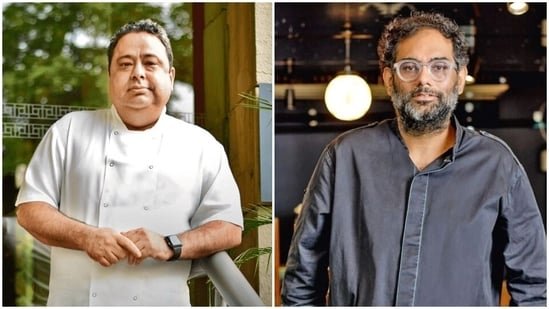
There is a whole Indian food subculture in London that I will deal with later, but for us in India, modern Indian cuisine only began with Manish Mehrotra at Delhi’s Indian Accent. That restaurant opened in March 2009 and perhaps because of its location in a corner of Friend’s Colony, never attracted the sort of attention it should have. The following year Gaggan Anand opened his restaurant in Bangkok and met with instant acclaim. Because India and Thailand are near each other, Gaggan’s fame spread and his dishes (especially the ones that used new techniques) soon became legendary in Delhi and Mumbai.
In 2011, when Manish Mehrotra won the Foodistan competition on NDTV Good Times, Indian Accent finally became a foodie destination. Around that time Gaggan made his first professional journey to India to cook for Sanjay Menon’s Food and Wine Society in Mumbai. He wowed the city’s top foodies who immediately lined up to book tables at his Bangkok restaurant. It took two years, but modern Indian food had arrived in India, thanks to the efforts of two chefs.
To be fair, a parallel revolution had already taken place in London. Such gifted chefs as Atul Kochar, Vivek Singh and, of course, Vineet Bhatia had already won acclaim for reinventing Indian food. Their innovations were aimed at the London market and remained broadly within the classical tradition though they finally broke down the prejudice that Indian food had to be cheap and restricted to ethnic ghettos.
But what Manish and Gaggan were doing was different. Manish was trained in Thai and Far Eastern cooking. Gaggan had worked with the Adria brothers of El Bulli, lived in Bangkok and was fascinated by Japan. None of them had much time for classical French cuisine or the presentation style of French nouvelle food. Their Indian food was very different from what the London chefs were doing.
If it had been just Indian Accent and Gaggan, I don’t think any modern food revolution would necessarily have resulted. But then Zorawar Kalra entered the fray. As the son of India’s leading foodie, Jiggs Kalra, Zorawar understood traditional Indian food. But he was fascinated by what was happening around the world. He managed to score a table at El Bulli in Spain and loved the food. He talked his way into Alinea in Chicago and got the chef Grant Achatz to explain his adventurous style of cooking to him.
Inevitably he opened his own modern Indian restaurant (Masala Library) in Mumbai after stealing two chefs — Himanshu Saini and Saurabh Udinia — from Indian Accent. The chefs were too honorable to pinch Manish’s dishes, but they suffered from no such compunctions about Gaggan’s creations. A (not very successful) version of Gaggan’s yogurt explosion turned up at Masala Library. But fortunately for Zorawar, both chefs were very gifted and created great dishes. Himanshu eventually left for a better paid job in New York, but before departing he worked on Zorawar’s dream project: Farzi Cafe.
The idea was to make Indian food cool and to extend the vocabulary of the Gaggan-Manish-Masala Library style of cooking so that it appealed to a younger demographic at a lower price point. It succeeded better than anyone had expected: There are around 20 Farzi Cafes today.
Then Zorawar took his concepts abroad. He partnered with Bhupendra Nath, a millionaire Dubai businessman, to open a Masala Library in that city. Saurabh was installed in the kitchen, and all went well till Nath and Zorawar had a messy falling out. Saurabh went back to India with Zorawar and Nath looked for a new chef.
In one of those right-man-at-the-right-time situations, Nath got a call from Himanshu. He had left his New York restaurant and was in Dubai. Nath hired him on the spot.
They turned the proposed Masala Library location into a restaurant called Tresind with Himanshu as chef. Himanshu also created Avatara, a vegetarian restaurant for Nath and installed one of his ciphers as chef. Nath had so much faith in Himanshu that he opened the super sophisticated Tresind Studio for him at a fancy location and told him not to worry about profits for three years.
All of the restaurants have done so well that last year Tresind Studio became the first and only Indian restaurant in the world to win three Michelin stars. Even Avatara won a Michelin star. When Michelin told Himanshu that he had made history by winning the stars, he first called Nath to inform him. And then he called Manish.
Himanshu is Manish’s most successful disciple but Indian restaurants all over the world have former Manish protégés in the kitchen. Saurabh eventually left Zorawar, found success in Singapore with Revolver, and now that he is back in India, is a much-in-demand consultant in the restaurant industry.
Gaggan has soared so high that it is almost impossible to keep track of him. His Bangkok restaurant is currently number one on the list of Asia’s Best Restaurants: An honor he has won four times before. Himanshu is working on opening a new Tresind Studio in the competitive, cut-throat London market. Manish has finally left Indian Accent and opened his own Delhi restaurant, Nisaba, which has more seats and lower prices than Indian Accent. It is already Delhi’s hottest restaurant and is so much in demand that the reservation software has already crashed once under the pressure of too many reservation requests.
None of these guys is sitting pretty. Zorawar is revamping the menu at the Farzi Cafes. I ate the new dishes at the original Farzi in Cyber Hub in Gurgaon, and the food was very good. Himanshu has to maintain his position in Dubai. There are persistent rumors that London’s Gymkhana will open in Dubai and that it has stolen one of Himanshu’s vegetable cooks from Avatara. Let’s see how long that works and how it plays out.
But in case you needed reminding of how small this world is, here’s some news. Gaggan will finally open a restaurant in Delhi this year. He will do it in partnership with Zorawar at the space Masala Library used to occupy on Janpath.
It does drive home how tight the circle of those driving the change is. There are global precedents. In France, many of the top chefs of the late 20th century (Paul Bocuse, the Troisgros brothers, Alain Chapel etc) all started out together at La Pyramide. And Ferran Adria trained everyone from Rene Redzepi to Massimo Bottura and the Roca brothers.
And we now have our own little gang of changemakers in India. They changed our restaurants forever and they made us proud of our food.