Under Prime Minister (PM) Narendra Modi, India’s foreign policy has advanced national interests through constructive engagement. The strengthening partnership with the EU stands out as a clear example. The India–EU Free Trade Agreement (FTA), coupled with accords on security, defence, and strategic cooperation, injects fresh momentum into India–EU ties — making the partnership not only mutually beneficial but also a pillar of global peace and stability.

India–EU relations, declared a strategic partnership in 2004, began with promise through the Joint Action Plan (2005) and BTIA talks (2007), but soon lost momentum amid Eurozone crises, stalled negotiations, and policy inertia under the UPA government. The Modi government reversed this drift, recasting Europe as a partner in India’s rise. The EU came to embody capital, innovation, markets, and technology — vital to India’s ascent in a multipolar order. With Europe’s €18 trillion GDP, renewed engagement became inevitable, driving high-level visits, revived trade talks, business summits, and deeper people-to-people ties.
India–EU trade has soared nearly 90% in a decade to $136 billion, with 6,000+ EU firms and 16% FDI in India. Beyond commerce, security and defense cooperation have strengthened, while connectivity has become crucial. Technology cooperation is increasing with the establishment of the 2022 Trade and Technology Council. Cooperation in green hydrogen, renewables, and resilient infrastructure reflects converging sustainability agendas. The visit of the EU College of Commissioners in February 2025, with over 20 ministerial dialogues, underlined the political maturity of the partnership.
Global turbulence has reinforced the logic of India–EU cooperation. Over the past decade, multilateralism has frayed under sanctions, unilateral provocations, airspace violations, and the weaponisation of critical technologies, casting doubt on the future of global governance.
Amid global volatility, Europe has sought dependable partners, India emerges as a trusted partner, combining demographic strength with scale, stability and strategic autonomy. The 2025 New Strategic EU–India Agenda reaffirmed convergence on sovereignty, multilateralism, and a rules-based order, elevating the partnership as a strategic priority and positioning both as co-architects of a stable multilateral world.
Despite being India’s largest trading partner, the EU sees under 2.5% of its trade with New Delhi — highlighting untapped potential and scope for deeper engagement in defence, strategy, technology, green transition, digitalisation, and people-to-people ties.
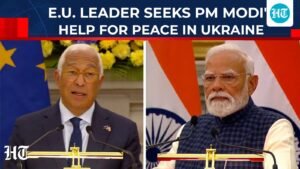
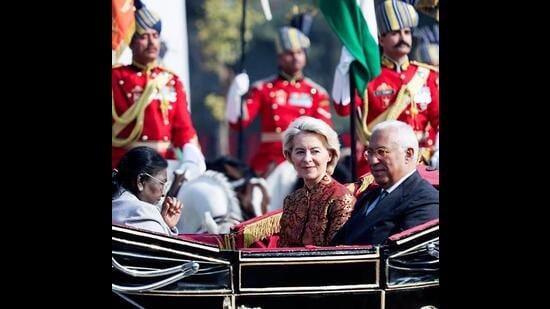
The presence of EU leaders Antonio Costa and Ursula von der Leyen as chief guests at India’s 77th Republic Day signaled New Delhi’s deliberate political recalibration, marked by the unprecedented parading of EU flags and Missions. Soon after, the 16th India–EU Summit advanced a substantive agenda on trade, strategic cooperation, security, defence, and mobility.
The ambitious India–EU Free Trade Agreement (FTA) marks a decisive leap in bilateral ties. It balances India’s protection of vulnerable sectors like agriculture with broad gains. In effect, the FTA is projected to unlock a $75 billion export engine — bolstering supply chain resilience, trade and investment, job creation, diversification, competitiveness, and regional presence for both powers. PM Modi hailed the FTA as “historic,” calling it a “blueprint for shared prosperity.” For India, it opens the EU single market, abolishes tariff on 9,425 lines of Indian exports, improves accessibility for Indian farmers and small businesses, boosts trade, particularly in textiles, gems and jewellery, pharmaceuticals, electronics, machinery, processed food, manufacturing and services sector. For the EU, it consolidates a durable economic and geopolitical footprint in India, diversification away from China and the US, with vast opportunities in manufacturing, transport, climate, energy sector (including exploration and refinery), Artificial Intelligence, critical technologies and business services. Touted by von der Leyen at Davos as the “mother of all deals,” the agreement creates a market of 2 billion people and nearly a quarter of global GDP while strengthening rules-based order and multilateralism.
New opportunities await Indian students, workers, and professionals in the EU under the mobility framework, while the landmark Security and Defense Partnership (SDP) is set to expand cooperation in maritime security, counterterrorism, cyber-defense and strengthening Indo-Pacific ties. Further, the adoption of the joint comprehensive EU–India strategic agenda for next 5 years charts a bold course: Guiding prosperity, driving innovation, strengthening defense ties, deepening people-to-people bonds, and expanding trilateral projects from the Indo-Pacific to the Caribbean, boosting sustainable farming, clean energy, connectivity and women’s empowerment.
In an uncertain and volatile world, this recalibration marks India’s strategic repositioning and affirms that the India–EU partnership is indispensable.
Shehzad Poonawalla is national spokesperson, BJP, and Vijeta Rattani writes on international development. The views expressed are personal