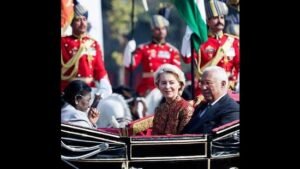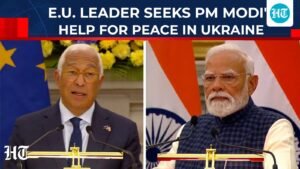
Few visits during a Republic Day parade (and few summits) have been as consequential in symbolism and substance as the visit of this year’s chief guests, European Union (EU) Council president Antonio Costa and Commission president Ursula von der Leyen (and the India-EU Summit the following day). A rare, clear, cool and sunny morning on Republic Day resembled an early spring morning in Europe. Amidst the dark geopolitical clouds, it might have well been a reflection of PM Narendra Modi’s description of the moment, as the “beginning of a new era”, and the repeated echo of a new beginning by the visiting leaders.
As the two EU leaders watched the marching military contingents, including from the EU, in the Indian Capital, they signaled a new EU recognition of the salience of power in the world, not just of rules. And that Europe, buffeted by three major powers, is prepared to build new partnerships, with India at the centre, not at the periphery. For India, the visit sent a message of preference for action over arguments. It was a high point in the evolving strategy of diversifying strategic and economic partnerships in response to geopolitical turmoil and trade disruptions.
The visit resulted in major outcomes and a roadmap. Political goals and defense and security partnerships will be important, but realism suggests limits to their global impact. Within the broad framework of convergences, both the EU and India face complex peripheries, major power challenges, and occasionally competing, if not conflicting, objectives.
However, the defining — indeed, the transformative — outcome is the India-EU Free Trade Agreement (FTA), the largest and the most comprehensive that India has so far signed. There is optimism because success has come after a long history of vast gaps in ambitions, rigid positions and multiple failures; it comes at a time of a hostile and disruptive trade environment; and it can bring significant economic benefits for both.
The data speaks for itself. The EU is India’s largest trading partner. The growth is rapid, fastest for the EU in the Indo-Pacific. India-EU trade grew 90% over the past decade; Indian exports at over 100%. Manufactures account for 81% of India’s exports. India enjoys a surplus in both goods and services. The EU’s FDI stock rose from €82 billion to €140 billion in just five years from 2019 to 2023. Besides the potential, it highlights the growing trade-investment linkages as markets adjust to geopolitics and concentration risks.
The India-EU FTA builds on these positive trends and synergies. No two FTAs are alike. Each FTA is a negotiated balance of interests in terms of coverage, exclusions, sectoral differences, concessions, rules of origin, time frames and more. This is a high-quality and comprehensive FTA that goes beyond trade issues to create a framework for economic partnership. It has ensured more favorable coverage and a phasing schedule for India. The FTA safeguards India’s sensitive sectors, covers 99.5% of India’s exports, and provides duty-free access to over 90% of the goods immediately upon entry into force. It improves market access and competitiveness in labour-intensive sectors, creates new opportunities in the industrial sector and gives unprecedented widening and easing of India’s access in the services sector. It will lower cost of EU imports for Indian consumers. It can accelerate investments, deepen India’s integration into the global value chain — the bulk of global trade — and foster collaboration in technology and innovation. Europe’s industrial and technological capabilities can aid India’s goal of becoming a manufacturing power and export hub, and create quality jobs for the youth. India’s scale and innovation can restore European global leadership in many areas.
The FTA is reinforced by agreements on mobility and migration, defense and security partnership, green hydrogen and clean energy transition, India’s association with EU’s €100 billion research and innovation programme, and the setting up of India-EU startup and innovation hubs in India. Together, they can help India and the EU co-develop self-sufficiency, sovereignty and competitiveness in the building blocks of the digital age — semiconductors, AI, quantum, clouds, communication and applications — and in leading the response to global challenges, from food and health security to a healthier planet.
The FTA does more. For India, it locks in predictability and stability in the world’s second-largest economy with a GDP of $22 trillion amid rapid changes in trade policies. It advances the longer-term policy of expanding FTAs at a time when multilateralism is yielding to plurilateral and bilateral agreements. With EFTA and UK agreements, it covers the whole of Europe. Overall, the share of FTA-covered trade for India will jump over 50%, more aligned with the estimated global trend. For India and the EU, it reflects a determination to counter the weaponisation of trade, pursue connections over barriers, agreements over coercion, and build bridges across the multiple layers of global fragmentation. At a time when trade, technology and investment flows are aligning with geopolitical trust, the FTA and allied agreements serve a strong global purpose.
Much work remains. The text will go through legal cleaning and the ratification process. In the EU, if this is in the exclusive competence of the EU, it will need the approval of the European Council alone, not of member States. But, in accordance with the Treaty of Lisbon, it may require the “consent” of member States by a simple majority in Parliament. There can be political or legal opposition to the process, as in the case of EU-MERCOSUR agreement. The India-EU text has been negotiated keeping sensitivities on both sides in mind and is likely to get quick approval. The EU could exercise the provision for provisional approval pending the vote. The FTA may take a year to come into force. The agreements on investment protection and geographical indicators will be taken up next. CBAM is on the table.
An FTA is an enabler. It opens the door. Gains are not automatic. External agreements are most effective when domestic policies are conducive. India will have to continue with domestic reforms to improve ease of doing business and trade, lower the cost of capital, expand access to finance, develop infrastructure, improve human skills, and strengthen the capacity of the small- and medium-scale exporters. A concerted government-industry partnership is needed for the full spectrum of activities needed to promote exports and support exporters in FTA markets.
Disputes also grow with trade. They will need to be managed and resolved.
As the anchor of the visit, the FTA reflects a shared commitment to transform their partnership for the benefit of their 1.9 billion people and assert their influence in shaping the new global order that secures their interests and mirrors their ideals.
Jawed Ashraf, a former ambassador, currently serves as chairman, ITPO. The views expressed are personal