By removing General Zhang Youxia, vice-chairman of China’s Central Military Commission (CMC), and General Liu Zhenli, chief of the CMC Joint Staff Department and member of the CMC — China’s senior-most military officials — Chinese President Xi Jinping has definitively set to rest rumors circulating for over a year that his position has been undermined and is threatened. The rumors pointed to opposition from the upper echelons of the People’s Liberation Army (PLA). The dismissals also confirmed more recent rumors that generals Zhang and Liu were being investigated.

The official confirmation on January 24, nevertheless, surprised observers. The announcement by the spokesperson of China’s ministry of national defense was categorical and crisp. It stated that generals Zhang and Liu “are suspected of serious violations of discipline and law” and that the Communist Party of China Central Committee (CPC CC) had decided to place them under investigation. There was no mention of corruption, implying that the charges could be considerably more serious. The PLA Daily editorial of January 24 clearly suggested this. There was no mention of Zhang continuing in the politburo. The gravity of their “crimes” will be known only after the results of the investigation are released, possibly before the major political plenary sessions in early March 2026.
With the removal of Zhang and Liu, the CMC is left with two members instead of seven. Xi Jinping continues as chairman. The other is Zhang Shengmin, who was appointed a vice chairman in November 2025 to replace General He Weidong after he was dismissed from the PLA and expelled from the CPC in October 2025. It is the first time since the CMC was reconstituted in 1982 that it has been decimated like this.
After Xi brought the military under the purview of the CPC’s anti-corruption watchdog body, the central discipline inspection commission (CDIC) in March 2013, nearly 200 officers up to and above the rank of major general have either been punished or dismissed. At least 80 senior PLA officials at the vice admiral or lieutenant general level and above have been removed. An additional 12 PLA Navy (PLAN) officers at the rear admiral level or above have been, or are rumored to have been, dismissed. But the removal in October of CMC vice chairman General He Weidong and now, generals Zhang and Liu, are significantly different. In addition to being the senior-most military officers, each was a handpicked personal appointee of Xi.
Zhang is a military princeling and a second-generation friend of Xi. Their fathers were friends and served as commanders in the Red Army, and both families traced their roots to Shaanxi province. Because of their friendship, Xi ignored the CPC’s age eligibility criteria and retained Zhang in the politburo and the CMC. He Weidong and Xi were also friends and drinking companions since Xi was posted in the Zhejiang and Fujian provinces, and He was posted at nearby military stations. After Xi was appointed president, he brought He to Beijing and helicoptered him into the CMC as vice-chairman and appointed him a member of the CPC politburo.
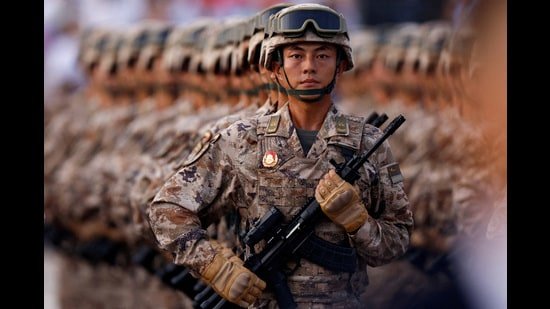
More importantly, Xi whittled down the PLA’s influence by drastically reducing the PLA’s representation in the CPC CC. With the removal of He and Zhang, the PLA currently has no representation in the politburo. Though Zhang Shengmin was elevated as vice chairman of the CMC in place of He Weidong, he was not appointed a member of the politburo. Furthermore, the PLA representation in the CPC CC that totaled 42 is now well under half! It is not clear whether Xi intends to fill these vacancies at the next party congress in 2027 or induct individuals in the interim. In any case, Xi has clearly signaled that the party is superior and the PLA must be “absolutely loyal” and obedient to the Chairman of the CMC and the party.
Also on January 24, the PLA Daily published a very strongly worded editorial that indicated Zhang and Liu faced serious charges. It declared they had “seriously betrayed the trust and expectations of the Party Central Committee and the Central Military Commission, severely trampled on and undermined the Chairman of the Central Military Commission’s accountability system … undermined the Party’s absolute leadership over the military and threatened the Party’s ruling foundation” and “seriously damaged the image and prestige of the Central Military Commission”. They were accused of having “an extremely negative impact on the Party, the country, and the military”. The editorial added that investigating and punishing generals Zhang and Liu will “further rectify the political situation, eliminate ideological poison and malpractices” and promote “the rebirth of the People’s Liberation Army, and inject strong impetus into the development of a strong military”.
The removal in quick succession of China’s top military leadership raises numerous questions, not least about political stability in China. The removal of Zhang and He Weidong, who shared a close relationship with Xi and had nothing to gain from his ouster, raises doubts about whether Xi has become less trusting with just a year to go before the 21st Party Congress and potential opposition to his continuing for a fourth term.
Jayadeva Ranade is president, Center for China Analysis and Strategy, and a former member of the National Security Advisory Board. The views expressed are personal