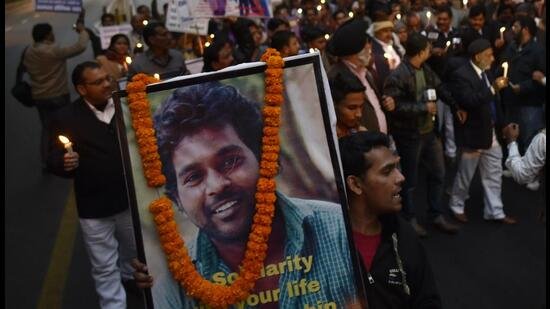
Recognizing the sad evidence on caste discrimination that had led to suicide by SC/ST students — at AIIMS in 2008 and, later, at other higher education institutions — the ministry of education had asked the UGC to frame regulations against discrimination. This led to the UGC (Promotion of Equity in Higher Education Institutions) Regulations 2012. Meanwhile, the mothers of Rohit Vemula, and Payal Tadvi who lost their children, filed petitions in the Supreme Court for strict implementation of the 2012 regulations. The Supreme Court asked the UGC to share the status of implementation. In response, the UGC informed the apex court that, among other things, it was revising the 2012 regulations to improve its provisions. It invited feedback on the revised regulations in January 2025, which were then notified this month. Unfortunately, the revised regulations, instead of making improvements, diluted the 2012 regulations. The regulator did make some improvements in the mechanism for sensitization against discrimination on education campuses, but it also left behind significant shortcomings that needed correction.
First, its definition of higher education institutions (HEIs) is confusing. At one place, it refers to all HEIs. But when it comes to the definition, it says “higher educational institutions are those universities and colleges which are covered under section 3 of the UGC Act 1956” — that is, about 1,168 universities and 45,473 colleges. By implication, it excludes the 23 IITs, the 21 IIMs and around 12,002 standalone institutions. Both IITs and IIMs are Institutions of National Importance; the former have been established under the Institute of Technology Act 1961, and the latter are governed by the 2017 IIM Act.
Similarly, the standalone institutes, namely polytechnics, teacher training, and nursing institutes, are independent bodies recognized by AICTE, NCTE, and INC. The IITs, IIMs and standalone institutes need not be recognized under section 3 of the UGC Act. They are directly funded by the ministry. This means that the revised 2026 regulations presumably exclude a vast section of educational institutions. Since all these are under the ministry of education, it would be better if all educational institutions in the country were brought under the ministry’s regulations.
The second-most serious limitation of the proposed regulations is that, unlike the 2012 regulations, these omit specifying the forms of discrimination. The 2012 regulations, imitating the Untouchability Offense Act 1955, and Atrocity Act 1989, list about 28 forms of discrimination related to admission, evaluation, teaching, sports, social life, hostel, and dining halls, among others. Given the deep-rooted nature of untouchability, the Untouchability Offense Act 1955 identified about 17 and the Atrocity Act 1989 about 40 forms of discrimination. Going against the spirit of the 2012 regulations, for reasons best known to it, UGC leaves this task to the equity committee, saying that it has “to prepare and disseminate an illustrative list of acts that shall be construed as discrimination”. It is difficult to imagine that the equity committee possesses adequate understanding of the deep-rooted discrimination embedded in untouchability.
The Supreme Court, while referring to this complexity at the time of the framing of the Atrocity Act 1989, observed, “The offenses of atrocities are committed to humiliate and subjugate the SCs and STs with a view to keep them in a state of servitude. Hence, they constitute a separate class of offenses and cannot be compared with offenses under the Indian Penal Code.” It involves deep contempt, hatred, most sickening, pernicious, and meanest behavior. One example from a survey at IIT Mumbai gives an idea of the sick minds of the caste discriminators. To Dalit girls, a high caste student asked, “quota Where have you come from or where have you come from?? (Are you here through quota or from a brothel?)”. Because of its wretched nature, the forms of discrimination are specified by the government in the two Acts. The equity committee in the education institution is not competent to specify the many forms of discrimination. Besides, if identifying these is left to individual education institutions, the forms of discrimination will differ and create legal confusion. Therefore, the UGC should follow the procedure adopted in the 2012 regulations and specify the forms of discrimination, which will be uniformly applicable to all educational institutions in the country.
Another limitation of the 2026 regulations relates to the composition of the equity committee, whose task will be to inquire into the complaint and recommend action to the head of the institute. Strangely enough, the head of the institute has been made ex officio chair of this committee. The head of the institute will, thus, sit on both sides of the table — as one who participates in making recommendations, and as the person who makes the decision based on these recommendations. This will cause a conflict of interest. The head of the institute, who takes the final decision, should not be part of the recommendation committee.
Lastly, about the SC/ST/OBC representation in the committee, it mentioned only about their “representation”, which is unfair. It should be at least 50% of the committee to enable them to have an effective say in decision-making.
The UGC must remove these anomalies in the new regulations for true promotion of equity in educational institutions and to deliver justice to the parents who lost their children to the evil of caste discrimination.
Sukhadeo Thorat is former chairman, UGC. The views expressed are personal