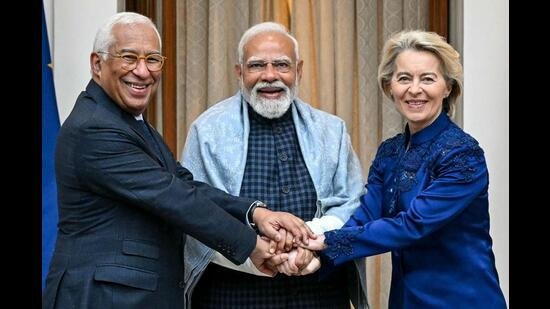
Whether in terms of symbolism, of outcomes, or of strategic significance, the visit of the President of the European Council, Antonio Costa, and the President of the European Commission, Ursula von der Leyen, to India — on the occasion of Republic Day and for the 16th India-EU Summit — was nothing short of historic. The camaraderie between Prime Minister (PM) Narendra Modi and the two presidents had a particular personal resonance: President Costa proudly recalled his family ties with India as he pulled out of his pocket his Overseas Citizenship of India card at the summit statements. President von der Leyen showed her fondness for Indian culture through her sartorial choice of bandhgala, zari,and bandhani scarf, honoring Indian handloom designs and designers.

The Indian textile industry — indeed, all Indian citizens — now have another reason to cheer EU-India ties: The conclusion of the negotiations on a Free Trade Agreement (FTA) between the EU and India and the memorandum on mobility signed by both sides will bring our economies and people closer, leading to a “new era of shared prosperity”, as highlighted by PM Modi.
The long-awaited EU-India Summit, the first in-person one since 2017, did not fail the high expectations of both sides. It delivered a consequential joint comprehensive strategic agenda that expands and deepens cooperation across a full spectrum — from clean energy to critical minerals, from water to agrifood, from the circular economy to disaster risk management, from semiconductors to Artificial Intelligence (AI), from research to space, from connectivity to security and defence. And this list is not exhaustive. We also chose to adjust our approach to make sure our partnership delivers at scale and at speed.
Think of it this way: As one of the most consequential FTAs in the world, the “mother of all deals” — along with the start-up partnership and hub innovations initiative agreed to at the summit — will lay the foundations for an “India-EU economic VPN”, a transformational connection of our systems. Our economic complementarities will be leveraged, and we will offer each other market and scale, generating mutual benefits and more investments and jobs. We will also be integrating our supply chains and research and innovation ecosystems in advanced manufacturing for clean tech, biotech, IT, and space, among others. Six-thousand companies from EU member-States that are established in India are already an integral part of the Indian growth story, representing, in production value, close to 5% of India’s GDP and generating 3.7 million quality jobs.
These are not just government talking points: European and Indian business communities alike have applauded the new perspectives offered to them, and the atmosphere was particularly upbeat at the EU-India Business Forum organized at the margins of the Summit.
Successful outcomes certainly owe much to our overriding converging strategic interests — but also to the willingness of both sides to accommodate each other’s concerns, such as the EU’s carbon border adjustment mechanism, and agriculture during the multiple rounds of negotiations and accept differences.
This is a sign of the political maturity of this partnership. It did not fall from the sky as divine providence: Both systems have increased engagement in the past years, learned about each other, and gained mutual comfort in taking the relationship to a new level. The EU and its member-States have worked in sync, with increased frequency of mutual visits and contacts between our two geographies. When India’s external affairs minister, S Jaishankar, characterized the EU and its member-States as “the fastest growing partnership” for India, he articulated a sentiment shared by Europeans about India. Both sides are fully cognizant of the stakes involved and the potential pitfalls. Hence, the fast-paced implementation of the partnership will be a matter of constant focus for the leaders of the two geographies and their respective systems.
The recent global economic turbulences and geopolitical turmoil have imparted deeper resonance to the central message of the summit: The EU and India, representing a quarter of the world population and the global GDP, are as much a stabilizing force, committed to a cooperative and rules-based global order, as they are reliable, complementary, and stable partners for each other. Both are ready to work with all interested partners to address global challenges. The EU-India force is here to stay as a defining component of the global system. The Indo-Europe Express has now been launched, and both sides will work to make it unstoppable.
Hervé Delphin is ambassador of the European Union to India. The views expressed are personal