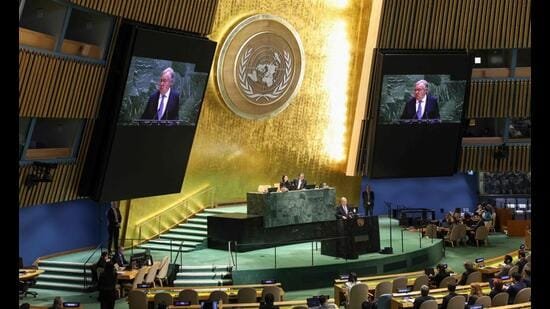
Shirley Hazzard’s iconic novel, The Great Firedescribes international law as a “beautiful racket”. Set in post-war Japan, soon after the framing of the UN Charter in 1945, the book explores the dire moral consequences of conflict.

The analysis, damning as it was, has also proven prescient. Today, it is difficult to avoid the question of whether international law still matters. Normative issues on what the law should comprise — the dense body of treaties, custom, and principles that regulate how states must behave — remain important. But the more conceptual issue, that is, whether international law is genuinely law, has become even more salient.
It’s striking how even as the world failed to react to the US’s recent military intervention in Venezuela, America’s defense barely gestured at traditional legal justifications. In its place, it invoked an anachronism of the country’s own making, the Monroe Doctrine, showing how precarious the idea of a global legal order has become.
There is no doubt that the intervention was illegal. It involved a large-scale military attack across Venezuela. There were strikes on Caracas and other places to suppress air defenses, before special units raided the presidential compound. Lives were lost, and ultimately, President Nicolás Maduro was captured and flown to the US.
The law on the use of force rests on two foundations: Treaty and custom. Treaty law is anchored in the UN Charter, to which the US is a founding party. Customary international law, by contrast, emerges from the consistent practice of states, undertaken under a belief that such conduct is legally required. Article 2(4) of the UN Charter obliges members to refrain from the “threat or use of force against the territorial integrity or political independence of any state”. Therefore, a cross-border attack is presumptively illegal unless it falls within the narrowest of exceptions recognized by the Charter.
These standards have been seen by the International Court of Justice as constituting jus cogens norms —that is, principles so peremptory that no deviation is permitted from them. The only exception is contained in Article 51 of the Charter, which preserves a state’s inherent right to individual or collective self-defense in the event of an armed attack. But defensive action must be reported immediately to the UN Security Council and remains subject to its authority.
Much as Article 51 has been stretched over time to justify a range of unlawful acts, it’s scarcely controversial to assert that America’s intervention violated its narrow license. In this case, the use of force did not respond to any imminent threat. No credible legal defense was mounted, and no sanction was sought from the Security Council.
For the US, in particular, departures from norms of this kind are not unprecedented. Indeed, they form a broader pattern that includes prolonged military engagements without declarations of war and sustained support, notably in recent times, for Israel’s genocidal campaign in Gaza. With Venezuela, though, what’s different is not just the absence of justification but the alacrity with which it appears to have been accepted. There appears to be a growing comfort with a form of coercion that is entirely untethered from the law.
When President James Monroe articulated the Monroe Doctrine in 1823, it was framed as a principle of defense. Its stated aim was to deter European colonial expansion in the Americas. But by 1904, under President Theodore Roosevelt, it became a doctrine of intervention. The US began to claim the right to interfere in Latin America whenever its own interests were at stake. In other words, its say-so was all that mattered.
Over time, the doctrine receded from official rhetoric. It stopped appearing in official justifications to such an extent that, in 2013, secretary of State John Kerry declared that the “era of the Monroe Doctrine is over”. But now, President Donald Trump’s secretary of defense, Pete Hegseth, has announced that the doctrine is “back and in full effect”.
But its revival is not cloaked in any principled language. It is plainly a crude assertion of power. And its rebirth signals an abandonment not just of international law, but also of its very vocabulary. Treating Venezuela as an isolated episode or casting Trump as an aberration misses the larger picture. He is hardly the first American president to authorize force abroad in circumstances falling well short of self-defense. But the difference now is that unilateralism has been made unexceptional.
A beautiful racket is precisely what this is. Or, as Perry Anderson put it, “wars waged by the liberal powers dominating the system” are seen as “selfless police actions upholding international law. Wars waged by anyone else” are seen as “criminal enterprises violating international law.”
To be sure, even beyond the application of constraints on the use of force, the international legal order is in crisis. The World Trade Organization — another institution flawed at its conception — is paralyzed. Efforts to reform investment law have stalled. The modest demands of the Paris climate framework have remained fragile. And even Canadian Prime Minister Mark Carney’s seemingly brave speech at Davos was drowning, as the writer Luke Savage observed, in “conservative realpolitik”.
Does this moment then call for resignation? It may be true that international law bears the imprint of western power, shaped more by self-interest than by principle. It may also be, as Samuel Moyn has argued, little more than a “collective delusion”. Still, the alternative cannot be realism that rejects restraint altogether.
Reasserting the prohibition against the use of force has never been more urgent. We cannot forsake international law as a project altogether.
To do so would be to acquiesce to a world where violence becomes the default language of life. But for now, international law resembles what Mahatma Gandhi once said of western civilization: “It sounds like a good idea.”
Suhrith Parthasarathy is a lawyer. The views expressed are personal