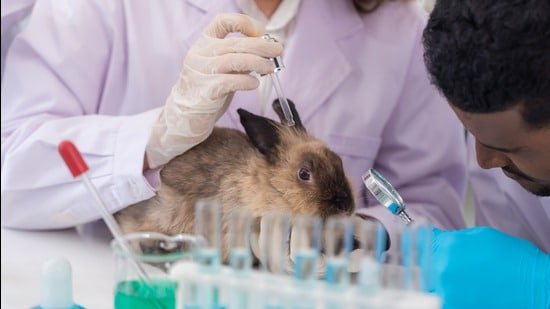
The arguments to end animal testing include ethical concerns around animal cruelty, poor predictive value of safety and efficacy in humans, and a sense of its redundancy in the 21st century. This underscores the need to shift from traditional animal testing to modern non-animal methods (NAMs) grounded in human biology, including human organs-on-chips and organoids, AI-driven modelling, and other computational platforms. India must fast-track novel, human-based approaches to reduce drug discovery costs, time and failure rates, and unnecessary animal suffering.

India has already banned animal testing for cosmetics and introduced the New Drugs and Clinical Trials (Amendment) Rules, 2023, to further incorporate NAMs. With the release of the US Food and Drug Administration roadmap for phasing out animal testing for drug development and the US National Institutes of Health’s plan to not fund studies based only on animals, India should consider such transformative shifts too.
India presents a favorable climate for NAMs with policies such as the Amendment to Clinical Trials and Drugs Rules, 2019 and revisions in the Guidance Document on Toxicology for Registration of Chemical Pesticides, and the presence of a growing number of laboratories in this field. However, to become a leader for humane technologies, India will need bold investments, global alliances, and strengthened participant engagement.
First, India would benefit greatly from pushing for standardization of global policies, especially on the implementation of NAMs for drug development as well as chemicals. The Animal Free Safety Assessment (AFSA) Collaboration, to illustrate, brings together regulatory authorities, industry representatives, technology developers and NGOs to support, brainstorm, and provide expertise to transition to NAMs. The Union government’s participation will bolster such initiatives and expedite the transition. India must also facilitate multiparty interactions with other global agencies such as International Council for Harmonization of Technical Requirements for Pharmaceuticals for Human Use and Organization for Economic Co-operation and Development to leverage current regulations and avoid duplication of efforts.
Second, accelerating NAM adoption in contract testing needs intensive training programs and strategic partnerships. Lack of awareness, cost factors, outdated guidance and inflexible or ill-defined regulatory requirements based on animal tests remain barriers to this. Contract research organizations (CROs) present a ready opportunity. Global players such as Emulate, InSphero and Mattek can form strategic collaborations with key companies and CROs in India to initiate training programs. Subsequently, with adequate market development and awareness, these players can establish their own manufacturing facilities in the country.
Third, India must facilitate development of indigenous and affordable NAMs. There is an urgent need for the government and industry to invest in NAM infrastructure and validation. Launching sustainable funding programs with strong investments, like the US’s NIH Complement-Animal Research in Education program, will be key to developing viable products. Public-private collaboration is also vital; launching multiple Centers of Excellence (CoEs) could fast-track this development.
The principal scientific advisor (PSA)-led Manthan platform can catalyse accelerated adoption of NAMs by bringing together the demand side and the supply side into a structured, demand-driven ecosystem. The platform helps bridge gaps between industry demands, regulatory requirements, and research on human-relevant technologies. It allows biopharma companies to post their problem statements and solicit innovative solutions from top-tier academic institutes, research institutes, and innovators. Manthan can enable end-to-end NAM pipelines, for organ-on-chips, AI-driven predictive models, and human-cell-based assays. The platform is also designed to accelerate the development of CoEs dedicated to frontier technologies. For NAMs, it will provide specialized hubs that can validate and scale organoid-based or chip-based systems. Such CoEs, facilitated through Manthan, can help India build strength in this field while keeping pace with global standards. This will make drug and chemical testing more reliable, affordable, and rooted in ethics.
With strategic investments, policy leadership and coordinated efforts, India can claim a leadership role and establish a progressive and humane global benchmark for innovation.
Sapna Poti is director, division of strategic alliances, office of the principal scientific advisor, Government of India, and Harshita Mittal is senior manager, strategy & public policy, Humane World for Animals India.The views expressed are personal