The Union Budget has sent a strong signal to global technology firms — build your cloud infrastructure in India and you can operate tax-free until 2047. A 21-year tax holiday for foreign companies providing global cloud services through Indian data centers is among the most ambitious long-horizon incentives the country has ever offered. For hyperscalers and AI majors deciding where to anchor their next generation of compute, this degree of policy certainty is unusually attractive. Yet beneath the optimism lies a more difficult question that has received far less attention: How will all this computing be powered, and at what environmental cost?

Data centers are energy-intensive industrial facilities that operate continuously, with little tolerance for interruption. Hyperscale AI data centers often exceed 100 MW of capacity and consume electricity equivalent to that demanded by an average of over 350,000 electric cars. On the positive side, India’s installed non-fossil capacity has crossed 260 GW, led by solar and wind.
Renewable tariffs are among the lowest in the world and project pipelines continue to deepen.
Yet coal still supplies roughly three-quarters of actual electricity generation. This is not a policy anomaly so much as a reflection of system realities. Coal plants provide firm, dispatchable power while solar and wind do not, unless paired with storage or other clean firm resources that are only beginning to scale.
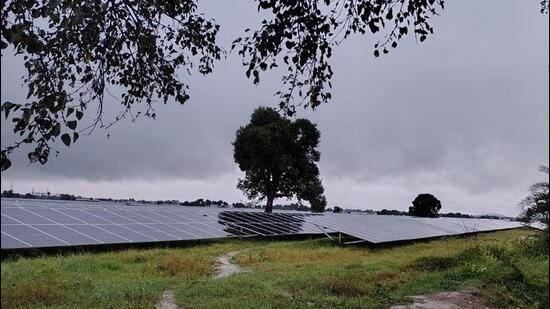
For data centers, reliability is non-negotiable. Even brief outages can cascade into large operational losses. Most facilities today rely on grid electricity that remains predominantly coal-based, backed up by diesel generators. Many operators also purchase renewable energy certificates or short-term green tariffs, which help meet corporate sustainability targets. But these instruments rarely deliver additional clean capacity for the incremental load created by data centers. A more sustainable pathway lies in captive energy models, where operators directly develop or contract dedicated renewable and hybrid assets, including solar-wind projects bundled with battery storage, located on-site or in close proximity to data center campuses. Without this shift, facilities risk appearing green on paper while continuing to draw fossil-heavy power in real time.
Furthermore, while India’s transmission infrastructure has expanded, congestion remains common, especially during peak renewable generation hours, and large parts of the distribution network continue to require significant modernization and capacity upgrades. In the absence of coordinated planning, large new loads risk stressing local grids and diverting clean power that could otherwise serve households or small enterprises. Water stress is also a growing concern as the same energy-intensive 100 MW hyperscale AI data center can consume around 2 million liters per day. As climate variability increases, this challenge will become harder to ignore.
If India is serious about aligning its cloud ambitions with its climate commitments, the tax holiday cannot function as a standalone fiscal incentive. It must be embedded within a broader clean power compact.
First, access to the 21-year concession should be explicitly linked to long-term clean electricity procurement. Foreign cloud providers benefiting from the incentive should be required to contract new renewable capacity under 10 to 15 year power purchase agreements, increasingly through captive or co-located generation, bundled with battery storage or other firming solutions. Crucially, these arrangements must demonstrate additionality, meaning they finance projects built specifically to meet data center demand rather than reallocating existing green supply.
Second, India needs deliberate spatial planning for digital infrastructure with designated green data center corridors where renewable generation, captive clean power, storage capacity and evacuation infrastructure are planned together. Pre-approved zones with assured access to firm low-carbon power would reduce project risk and avoid ad hoc siting that locks facilities into carbon-intensive grids.
Third, market instruments require reform. Renewable energy certificates and open-access green tariffs should evolve to reflect time-of-day and location, while captive clean generation should be actively prioritized for large, continuous loads such as data centres. A megawatt-hour of solar power at noon is not equivalent to firm clean electricity at midnight, yet current frameworks often treat them as interchangeable.
Beyond renewables and storage, India should also begin planning for nuclear-backed firm supply as part of the Nuclear Energy Mission. As small modular reactors eventually mature toward commercial deployment, they could be sited near major data center clusters or industrial corridors. For compute infrastructure that requires uninterrupted power at scale, nuclear energy offers a credible pathway to long-duration, zero-carbon firmness.
If designed well, the data center push can catalyse investment not only in renewables but also in captive hybrid systems, batteries, nuclear supply chains, advanced grid management systems and domestic manufacturing of critical power equipment. Cloud infrastructure could become an anchor customer for the next phase of India’s energy transition, accelerating learning curves and lowering costs across multiple clean technologies.
If cloud growth is guided by disciplined regulation and coordinated planning, it can strengthen energy security, accelerate grid modernization and reinforce India’s credibility as a climate leader, while building resilient digital infrastructure for the next generation of innovation.
Amitabh Kant is chairman, Fairfax Center for Free Enterprise, Ex-G20 Sherpa & Ex -CEO, Niti Aayog and Adil Rana Chhina is a climate and energy policy specialist. The views expressed are personal