The India-Bangladesh relationship is experienced before it is debated — in bus routes and border queues, in families crossing for treatment, and in markets stocked with goods that travel a few hundred kilometers rather than across oceans. It is rooted in shared history, language, and geography, and something rarer, fighting together for an outcome that reshaped the region. In 1971, India’s support for Bangladesh’s Liberation War became a foundational reference point in New Delhi’s neighborhood diplomacy. That legacy matters, but it cannot manage today’s expectations.

More than five decades of Indo-Bangla relations show a recurring pattern. After Independence, early alignment with India was closely associated with Sheikh Mujibur Rahman. The rupture of 1975, following Mujib’s assassination, changed the rhythm of relations. Under Ziaur Rahman (mid-1970s to 1981), Bangladesh pursued a diversified foreign policy, seeking wider strategic space, not hostility toward India, but less of the post-1971 intimacy.
Then, under the military ruler, general Hussain Muhammad Ershad (1982–1990), an alumnus of India’s National Defense College, ties were steadied through pragmatic engagement. His ouster in 1990 ushered in parliamentary democracy in 1991, but politics thereafter in Bangladesh became dominated by intolerant rivalry and recurring disputes over electoral credibility. As successive governments recalibrated foreign policy, relations with India increasingly became entangled in domestic political contestation.
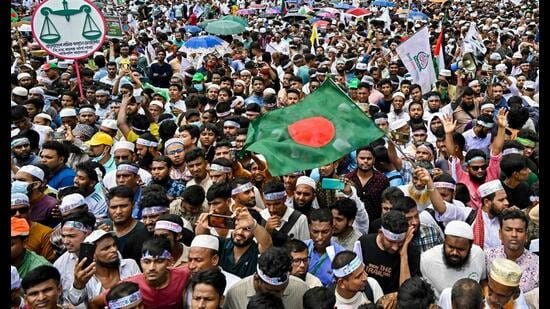
India often read the Sheikh Hasina-era as a predictable period of stability, particularly on security. However, many in Bangladesh felt that India’s comfort with one person and one party came at the expense of their country. After the upheaval of 2024, that narrative turned combustible, illustrating how ties anchored to a party rather than to the people can become vulnerable to regime change, street anger, and misinformation. When Dhaka’s politics become a zero-sum contest where “pro-India” and “anti-India” labels replace policy debate, bilateral relations tend to harden along partisan lines. Closeness to one regime is followed by strained ties under another.
Bangladesh will vote in a crucial election today. With the Awami League banned from contesting the elections, it is likely that either the Bangladesh Nationalist Party (BNP) led by Tarique Rahman — the son of the recently deceased former PM, Khaleda Zia — or the Jamaat-e-Islami, led by Shafiqur Rahman, is likely to lead the next government in Dhaka. The former is a more liberal, progressive, and centrist party, while the latter leans more to the right, with a compass of “Islamic values” and a controversial history of opposing the War of Liberation in 1971.
A new government with a credible mandate, irrespective of identity and ideology, gives New Delhi a unique opportunity to reboot relations and start working towards a new era whereby relations are anchored in the people and policies as opposed to a person and one party.
Continuity in cooperation is a must to keep borders safe and secure. The Bay of Bengal and Northeast connectivity agendas should not become hostage to partisan swings. While a pragmatic, policy-focused nationalism can strengthen bargaining on both sides, both must refrain from grievance-based rhetoric that can turn diplomacy into permanent theatre.
While India has been emphasizing “free, fair, inclusive and credible elections” in Bangladesh, many in Dhaka question New Delhi’s stance during elections of 2014, 2018 and 2024, which were widely criticized for being rigged, and were boycotted by the major Opposition parties. India’s framing of these polls and the attendant tensions as Bangladesh’s “internal” affair and endorsement of Sheikh Hasina’s unchallenged, undemocratic rule spanning more than one-and-a-half decades, have left a poor imprint on the minds of the Bangladeshis who were deprived of their democratic rights in the period. Addressing that perception does not require megaphone diplomacy but even-handedness.
Ties need to be rebuilt once elections are over. The stakes are visible in everyday economics: Bilateral trade was about $13.51 billion in FY24, with India exporting $11.3 billion to Bangladesh. That interdependence is reflected in the shared infrastructure — the rail links and passenger trains, bus services, inland waterways, and port arrangements that route cargo via Chittagong and Mongla, between India’s Northeast and the rest of its territory.
Energy is another backbone of India-Bangladesh ties, with the latter importing about 1,160 MW of electricity from India. Bilateral connectivity has also expanded with restored and newly launched cross-border rail services such as the Maitree, Bandhan, and Mitali Express trains, additional freight rail routes, and strengthened inland water transit and road links — developments that have deepened economic integration and strengthened people-to-people ties.
The same is true of the service sector, especially health care, which makes the relationship important for many Bangladeshi families. In 2024, around 482,000 Bangladeshis traveled to India for medical treatment, accounting for an estimated 50–60% of India’s medical tourism inflow. This is a win-win: Bangladeshi families get access to care and services, while India gains revenue and demand for its hospitals, hotels, and local businesses.
A sustainable reset is not about Bangladesh being “friendly” or India being “generous”. It is about insulating cooperation from partisan cycles and investing in the everyday networks of trade, transit, energy, and people that keep the relationship running. The election will decide who governs, but the harder test is what kind of relationship evolves in the morning after.
Neighbors sharing a 4,000-kilometre border cannot choose each other, they can only decide on the language of engagement. If New Delhi wants a partnership that does not sway with a change of government, it must invest where it lasts longest and put into practice what Indian officials have repeatedly underlined: “People are the main stakeholders” in India-Bangladesh ties.
Syed Munir Khasru, based in Dhaka, is senior director, IPAG India, a think tank. The views expressed are personal