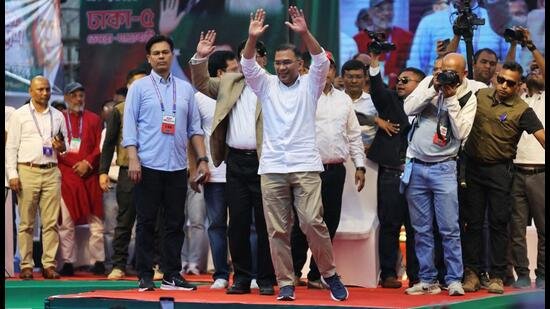
Thursday’s election in Bangladesh has been a consequential one for the country. In the first place, the vote put paid to all doubts as to whether the election would be held at all, with speculations till the last moment pointing to a deferment or even cancellation of the exercise.

Second, there is the uncomfortable reality of the Awami League, the country’s oldest political party, which powered Bangladesh to freedom 54 years ago, being forced by the interim regime headed by Muhammad Yunus to stay out of the election, owing to the ban imposed on it following the questionable removal of the government it led between 2009 and 2024.
Now that the election is over, the unmissable fact is that in the absence of the Awami League, it has been a non-inclusive exercise, which raises a very fundamental question of credibility. The Election Commission has claimed a turnout close to 60%, but it is a fact that a large number of voters, traditionally inclined to vote for Sheikh Hasina and the Awami League, stayed away.
There is thus a huge shadow looming over the election and its outcome, one that will dog those who have made it to Parliament and are now poised to inaugurate a new phase of democratic politics in Bangladesh. The satisfaction, though, is that for Bangladesh’s people, the sweeping victory of the Bangladesh Nationalist Party (BNP) at the polls has had the nation breathing a little easier, given that the results have been a firm repudiation of the Jamaat-e-Islami.
In a country where Islamist extremism has not only been growing over the years but has also been actively promoted or condoned by the unconstitutional Yunus regime, the victory of the BNP convinces Bangladeshis that they have spared the dark possibility of being governed by a party whose espousal of communal politics as well as collaboration with the Pakistani occupation army in 1971 remains ingrained in the public consciousness.
And yet one understands well that the BNP’s landslide is no guarantee that it will have a comfortable time administering the country. For one thing, the Jamaat, which has already demanded a vote recount in 150 of the 299 seats where elections were held (voting did not take place in one seat due to the death of a candidate), will not give the BNP an easy time.
For another, the BNP, which was last in office in 2001-2006, will need to relearn the norms of governance, especially given the slide in the economy. The Yunus regime, during the 18 months it held office, demonstrated a high level of incompetence in handling the economy.
Unemployment is up sharply, with thousands of garment factories closing down as a result of the anarchy that the interim government was unable, or unwilling, to put a leash on. Prices of essential commodities have spiked, causing serious levels of discontent among the middle and poor classes. In other words, the Yunus dispensation effectively rolled back the economic stability that was the hallmark of the Hasina government. It will now be the BNP’s unenviable task to pull Bangladesh back from the abyss it has been pushed into since August 2024.
The BNP will need to tread carefully and judiciously. Tarique Rahman, now poised to take charge as Bangladesh’s prime minister, should engage in accommodative politics by reaching out to the Awami League and ensuring that the nation’s fresh attempt to fashion a landscape of political pluralism does not fall by the wayside. The BNP is aware of the dangers inherent in ignoring a party that continues to command the support of a large section of Bangladesh’s population. A first step could be to reconsider the arbitrary ban on the League.
The BNP government will also be called upon to shape a foreign policy that will have to repair the damage done by the Yunus regime. Foremost among the priorities will be putting Bangladesh on course to friendly and productive ties with India, ties that Yunus and his cohorts effectively undermined in the last 18 months. With Pakistan, the new government should reflect on the uncomfortable embrace that Yunus and Pakistan’s Shehbaz Sharif have been in since August 2024. It will be in Bangladesh’s national interest for the BNP to be skeptical about the ties between Dhaka and Islamabad.
The plate will be full for the incoming government. The first step will be to press for a speedy transfer of power, to be followed by a detailed examination of the deals the Yunus regime made in major areas of the economy with overseas firms and governments. The new government’s broad responsibility will also be to preserve and uphold the country’s constitution. Yunus and his band of followers have been clamoring for wholesale changes to the constitution adopted in 1972. The referendum, which, alongside the election, was a part of the exercise on Thursday, can become an albatross around the BNP government’s neck unless the new Parliament throws it out.
Rahman and his colleagues will have to hit the ground running so that Bangladesh is back on the path to social peace and high economic growth.
Syed Badrul Ahsan is a Bangladeshi journalist and author. The views expressed are personal