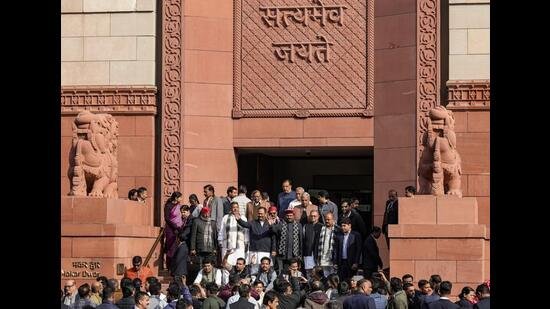
Last Thursday, when the Leader of Opposition in the Lok Sabha, Rahul Gandhi, was criticizing the government in Parliament, I was reminded of Manmohan Singh’s historic 1991 reforms budget speech. It was July 24. Singh, introducing the budget, said, “Time has come for India to rise as a great economic power”. His concluding statement was, “No power on Earth can stop an idea whose time has come”.

Singh was trying to rouse hope among the people, who were apprehensive as the doors of the economy — shut for decades — were being unlocked. The mood in Parliament was pessimistic. Two months earlier, the government led by Prime Minister (PM) Chandra Shekhar had sold 20 tonnes of gold to the Union Bank of Switzerland with a buy-back pledge. Then, upon assuming charge, the government led by PV Narasimha Rao mortgaged 47 tonnes to the Bank of England. The news had dampened the spirits of ordinary Indians.
Many sections within the political spectrum and the public were uncomfortable with the reforms. Some thought India would decline the way Mikhail Gorbachev’s glasnost and perestroika led to the dissolution of the Soviet Union. But, the last 35 years are testimony of the success of these reforms — India has become economically so strong that, in 2009, we bought 200 tonnes of gold from the International Monetary Fund (IMF). Today, our country is one of the biggest buyers of gold in the world. Atal Bihari Vajpayee, who succeeded Narasimha Rao after two years of political instability, not only persisted with the reforms but also gave a big push to it. Economists call it India’s economic continuity.
Thanks to the 1991 budget, many Indian companies emerged as global conglomerates. Competition grew within the country and trade, long deemed a no-go zone, became the go-to vocation for a large number of the country’s youth. Now, the Modi government has brought a unique balance between vision, speed and execution. As a result, India is now the fourth-largest economy in the world.
Bitterness and toxicity returned in 2008 — India had signed a nuclear deal with the US, and the Left parties withdrew their support to the ruling coalition. But within hours, Mulayam Singh Yadav came to the beleaguered government’s rescue. At that time, Communist Party of India (Marxist) leader Prakash Karat bristled, “We won’t let India be subservient to US imperialism. This deal links India’s foreign policy to the US military interests.” The BJP’s Lal Krishna Advani echoed his sentiments. He said, “This deal will make India US’s junior partner. We can’t leave our strategic interest at the mercy of Washington.” But Singh remained unfazed. He said in Parliament, “I am not here to sell my country. This deal will end India’s nuclear isolation and provide us with clean energy”. He wasn’t wrong, and the biggest proof is the current government’s fresh nuclear energy deal with the US.
Since the India-US trade deal was inked, the same stale arguments are floating in the national discourse that have been debunked earlier. The Lok Sabha adjournment on Friday is a testimony to the fact. Between 1991 and 2008, we saw many such showdowns. The only difference was the ones who were accusing are the ones in power and those who were being judged now sit in judgment as opposition.
The basic trade framework decided with the US has been elaborated point by point by commerce minister Piyush Goyal. The PM and other senior members of the cabinet have made it clear that no compromise has been made and the interests of the farmers, laborers and Indian traders are protected. Still, the day continues.
One should never assess a sovereign country on the basis of personal like or dislike towards its current ruling dispensation. There are still hundreds of thousands of people alive in our country who were forced to eat tasteless PL-480 wheat during 1965-66 that was used as poultry feed in the US. The same generation undertook the Green Revolution to restore the nation’s self-respect. Similarly, when the foreign banks came to India and foreign car brands appeared on Indian roads, the same arguments were given by the naysayers. Indian banks did not shut down. Nor did Indian car-makers go bankrupt.
We Indians have been working towards reclaiming our lost glory from the time India won independence. There have been numerous failures but, equally, there are hundreds of things to be proud of. Before slipping into a slanging match, we must not forget that we the people of India are the source of our government’s strength.
Shashi Shekhar is editor-in-chief, Hindustan. The views expressed are personal