The February 2026 election in Bangladesh will go down in history as one of the most consequential for many reasons, but one among them will be the absence of the Awami League in it. The election was free and fair, but not inclusive. While the Awami League is to blame for its predicament, it is for the people to pronounce their verdict on its record, and the democratic way to do this is through the ballot. The decision to keep the Awami League out was taken by a cabal of individuals lacking constitutional authority. The disenfranchisement of the party in this round does not mean its demise, just as the problems faced by the Bangladesh Nationalist Party (BNP) and Jamaat-e-Islami in the past did not lead to theirs.

Having said this, we also need to accept that the best is the enemy of the good. In a perfect world, Bangladesh would not have come to this pass. Its record of holding, or rather lack of, regular, free, credible and inclusive elections and constitutional transfer of power, is well known. All parties are guilty of repeated assaults on democratic institutions and norms. Accusing India of being responsible for Sheikh Hasina’s excesses may be expedient politics, but it does not solve the problem. In fact, the implications of such assertions are even more disturbing from a Bangladeshi point of view. Is it the suggestion that Dhaka can be run from New Delhi? Or is it being suggested that India should intervene in the internal affairs of Bangladesh? It is for Bangladesh, and Bangladesh alone, to come to terms with its past and deal with it.
It is no surprise that the idea of reform was central to the run-up and during the election. The BNP has a new face. So does the Jamaat. The students emerged as a new political force. The Awami League is under pressure to reform. The July Charter and the referendum contain a detailed package of constitutional reforms. All this is good and welcome. Yet the road ahead is uphill and laden with the baggage of history. India can and should assist in this journey in any way it can, given the high stakes involved.
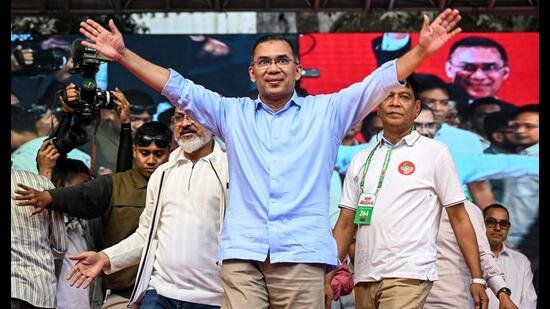
BNP leader Tarique Rahman has to prove that his 17 years in London have made him a changed man. The onus lies on the BNP to show that it has moved beyond the kleptocracy and sponsorship of ISI-backed terrorism, insurgency and extremism of the past. Will one dynastic culture be replaced by the deification and perpetuation of another dynasty? How will the political opposition be treated, even if it is the Awami League? These are some of the questions that will determine whether the break from the past is real this time.
The good news about the Jamaat is that it too felt the need to distance itself from the ignominy of its role in the 1971 Liberation War. Even though its core hardline, fundamentalist ideology remains intact, the arrival of a new leadership is noteworthy. The reform of institutions will only be as successful as the parties want and allow them to be. Given the nature of the electoral verdict and the legal authority that has come with it, the ruling party will have its own views about which constitutional reforms it will push. These will be different from the opposition Jamaat, which will take a long-term view to advance its prospects, which it sees as bright.
The BNP’s strong showing, after having been in the political wilderness, with a leadership under siege, and cadres in disarray, pitted against a well-oiled Jamaat machine, backed by Muhammad Yunus and the West, is significant. Its filling of the political vacuum created by the Awami League’s absence is a testament to the nature of Bangladeshi society, and particularly of the young voter. It is an assertion of Bangladeshi nationalism. If this is a step towards resolving the identity debate within the country, this is good news for Bangladesh and for India. It is equally significant that despite a most favorable atmosphere, the Jamaat was not able to secure a majority. Its vote share is estimated at 32%, which is significant but not what could have been. It has, of course, won the highest number of seats since 1971. The Yunus-backed National Citizen Party was expectedly swept away.
The BNP’s tasks are cut out. It will be faced with strong opposition inside Parliament and the Awami League outside.
Where does this leave India and its relations with Bangladesh? India has critical interests in Bangladesh. The elections have opened the door for rebooting of the relationship and picking up the threads from we left off. It is most significant that the official Indian reaction to the BNP victory was swift and unreservedly positive, with direct involvement of the Prime Minister. This signals intent. We can expect India to work with the Tarique Rahman government to restore the relationship that was broken under Yunus. The issues ahead are challenging, as are the spoilers. But that has always been the case, including during the Hasina period. India’s redlines are well known to those who matter in Dhaka. Within those, there is ample room for ambition and advancement of the bilateral relationship. The India-Bangladesh relationship is a saga with no full stops.
India has been dexterous in managing political transitions in Afghanistan, the Maldives and Sri Lanka. After Bangladesh, the next test for India’s neighborhood diplomacy will be Nepal, which goes to the polls on the back of the Gen Z revolution. The new alignments are an opportunity for India to reclaim its rightful primacy in the region, which is, at the very least, driven by the reality of geography.
Pankaj Saran is convenor, NatStrat, former deputy national security adviser, and former Indian high commissioner to Bangladesh. The views expressed are personal