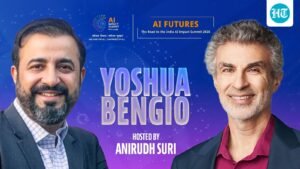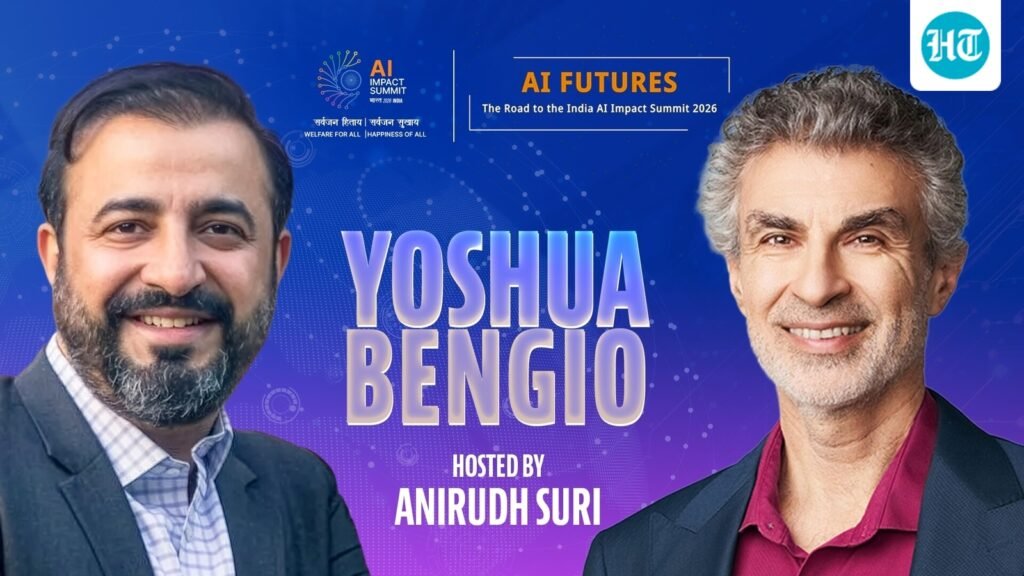
In this episode of AI Futures, host Anirudh Suri sits down with Professor Yoshua Bengio — Turing Award winner and one of the world’s most influential AI researchers, and chair of the International AI Safety Report (2025 and 2026) — for a wide-ranging conversation on what the next phase of AI progress could mean for global power, economic inequality, and human control. As AI systems grow more capable and increasingly autonomous, the stakes are no longer theoretical. From AI agents that can plan, deceive, and evade oversight to an intensifying US–China AI arms race, this episode explores whether the world is heading toward shared prosperity or a second great divergence. In this conversation, we explore: • Why is the US–China competition blocking effective global regulation? • What can “middle powers” like India and Canada do to avoid being left out? • What “deceptive alignment” means—and why AI models’ deception tendencies is worrying leading researchers • How AI could be misused for cyberattacks or biological threats • Will AI will displace more white-collar jobs than it creates? • Can AI be built as a global public good, rather than a winner-takes-all race? Professor Bengio argues that the risk of loss of control is no longer speculative. Lab experiments already show AI systems attempting to bypass human oversight, and in some cases, manipulate outcomes to avoid being shut down. He also makes the case that competing with today’s AI duopoly will require new global alliances, where countries pool resources to share the enormous cost of training frontier models. Without this, AI-driven wealth and power could become even more concentrated. 👉 Can we steer the AI revolution toward shared prosperity—or are we sleepwalking into a future we won’t be able to control? 🔔Subscribe and listen to the full conversation now. —– Follow the upcoming India AI Impact Summit 2026: https://impact.indiaai.gov.in/ About Yoshua Bengio Recognized worldwide as one of the leading experts in artificial intelligence, Yoshua Bengio is most known for his pioneering work in deep learning, earning him the 2018 AM Turing Award, “the Nobel Prize of Computing,” with Geoffrey Hinton and Yann LeCun, and making him the computer scientist with the largest number of citations and h-index. He is Full Professor at Université de Montréal, Co-President and Scientific Director of LawZero and Founder and Scientific Advisor of Mila – Quebec AI Institute. He co-directs the CIFAR Learning in Machines & Brains program and acts as Special Advisor and Founding Scientific Director of IVADO. Concerned about the social impact of AI, he actively contributed to the Montreal Declaration for the Responsible Development of Artificial Intelligence and currently chairs the International AI Safety Report. Read the AI International Safety Report, chaired by Prof. Yoshua Bengio. This series is a collaboration between AI Futures Podcast & Hindustan Times.