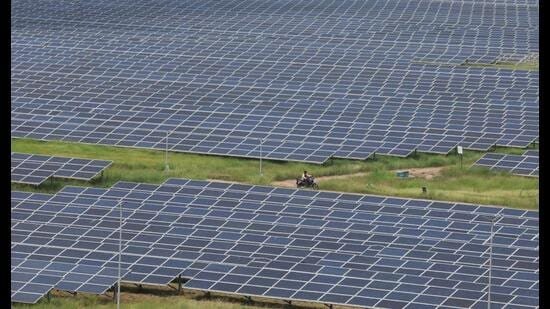
The world today is increasingly getting split into two kinds of countries. The first group, which features the US, among others, has abundant oil and gas and is happy to continue with that energy model. The second group, which features India, does not. So, for us, clean energy is not just about climate — it is about affordability, resilience, and security. That is why the clean energy transition matters so profoundly here.

For two centuries, industrialization everywhere was powered by fossil fuels. India is now taking a different path — industrialising on the back of cheap solar power and batteries instead of fossil fuels.
And yet, this is not fully and widely appreciated. Let us consider income-level comparisons to get some perspective. In 2012, at per capita income levels mirroring India’s current levels, China had almost no solar, and its coal demand kept rising. India, in 2025, used one-fourth of the coal per person that China used and is now approaching a coal-generation peak, with rapid deployment of renewables. When China crossed the 1,500 kWh per capita consumption benchmark, coal was cheaper than solar; today, in India, solar-plus-storage costs about half as much as new coal. The economics have flipped decisively.
Electrification reinforces this shift. Electricity now accounts for nearly 20% of India’s final energy use, matching China at similar income levels. And as the share of the economy running on electricity grows, a cleaner grid helps the whole country lower its emissions and become healthier and cheaper to run.
Three transformations are now converging:
From deployment of renewables to building a system around them:It’s no longer just about setting up solar and wind plants. It is about ensuring we can actually use all that clean energy — by storing it, carrying it across strong transmission lines, and balancing supply and demand when the weather changes. This shift from addition to integration is a priority for the next few years for renewables to acquire real scale.
From an RE deployment superpower to a clean energy manufacturing superpower: India’s electronics industry has grown nearly six times in a decade, to $130 billion, enabling spillovers into solar, batteries, and electric vehicles (EVs). Solar module manufacturing has reached 120 GW, and solar cell production nearly 18 GW, enough for India to compete globally. We are preparing not just to deploy clean tech, but to sell it to the world.
From clean electricity for the power sector to clean energy for the whole economy: We’ve cleaned up electricity to some extent, but now we must clean up everything else — steel, cement, and chemical factories, etc. Doing so reduces oil and coal imports, strengthens self-reliance, and keeps Indian exports competitive. Increasingly, climate policy is becoming trade policy. To keep exporting a wide range of industrial goods, India must be ready.
This industrial moment aligns with a favorable trade environment. The India–EU trade agreement offers more than mere tariff cuts — it offers market access at scale, consistent regulations, and a huge opportunity for MSMEs and manufacturing clusters to integrate into global value chains. It is also a strategic move. Europe wants clean, diversified supply chains and is increasingly hesitant to rely on China. India brings scale, manufacturing capability, and one of the world’s fastest-growing clean-energy markets.
The India-US interim deal strengthens this further. Under this, the US lowers tariffs on Indian goods relative to competitors such as China and Vietnam, giving India a significant advantage just as America is rapidly expanding its electricity grids and energy production to meet the soaring demand from data centers and new manufacturing investments. This opens a massive opportunity for India to supply power electronics, grid hardware, transformers, and EV-related technologies — areas where our strengths are rising.
Together, these trade deals expand India’s export runway. But they won’t deliver outcomes automatically; they will reward us only if we can manufacture at scale, meet standards, and innovate fast. Our clean energy manufacturing ecosystem is scaling, but has some distance to go before we can truly turn it into a competitive advantage.
The budget for the coming fiscal year helps build on this momentum. The push to carbon capture, utilization and storage, power storage, green hydrogen and cleaner transmission underlines the recognition that India’s competitiveness will depend on decarbonising not just electricity but the industries that shape the real economy.
If India gets this right, it will build jobs, exports, and strategic resilience — using trade partnerships to scale manufacturing, using innovation to move up the value chain, and using clean electricity to keep growth affordable. The inflection point is here. The next phase is execution.
Sumant Sinha is founder, chairman, and CEO, ReNew. The views expressed are personal