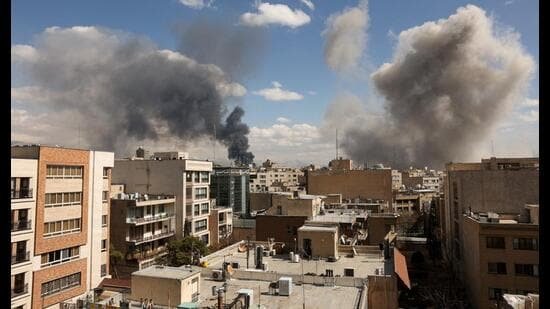
On the morning of February 28, India woke up to two raging wars on the western frontier. Pakistan and Afghanistan are in an open war along the Durand Line, with Pakistani jets striking Kabul and the Taliban launching retaliatory operations across the border. Further to the west, US and Israeli warplanes were conducting what Washington is calling “major combat operations” against Iran, with air strikes across Tehran and other cities. Tehran has confirmed that Iran’s Supreme Leader Ayatollah Ali Khamenei was killed in the US-Israeli strikes on Saturday.

India has friendly relations — of varying depth — with most parties to these conflicts except, of course, Pakistan. Prime Minister Narendra Modi returned from Israel just a few days ago, having stated in the Israeli Knesset that India stands with Israel “with full conviction”. India has also maintained careful ties with Iran despite consistent American pressure. Delhi’s relationship with Washington has been strained over the past year, but it remains vital. Iran’s neighbors that it is targeting today are also India’s friends and partners.
Closer home, India’s relations with the Taliban have dramatically improved since 2021. And Pakistan, despite all its inherent hostility, remains the neighbor India must eventually find a non-escalatory equilibrium with. New Delhi would not want either of these wars to lead to a larger regional spillover, humanitarian or kinetic. In short, this is what New Delhi has on its hands now: two raging wars, one long frontier, and no good options to choose from.
On a positive note, however, despite the mutual defense agreement between Pakistan and Saudi Arabia, neither Pakistan turned up to defend the Saudis nor the Saudis turned up to support Pakistan against the Taliban. But that was expected.
There will be those in New Delhi’s strategic community who see in Pakistan’s Taliban predicament an unexpected gift. For, after all, Pakistan is simultaneously managing its post-Sindoor military posture with India, dealing with a weak economy, a Baloch insurgency it is struggling to contain, and now an open war with Afghanistan. The temptation to lean in, directly or indirectly, will be strong in New Delhi. But that should be firmly resisted. Fishing in the Durand Line’s troubled waters is a temptation filled with shortlived geopolitical pleasure with little positive strategic outcome.
History is a good place to look for some lessons. When the Taliban first grabbed control of Kabul in 1996, India firmly backed the Northern Alliance against what it rightly saw as a Pakistani proxy set to wreak havoc in the region. When the Taliban was overthrown by the American forces in 2001, India returned to Kabul with nearly $3 billion in development assistance, hospitals, roads, parliament building, even as Pakistan kept strengthening the Taliban that eventually took control of Kabul again in 2021 — except this time Pakistan overplayed its hand catastrophically with the Taliban turning against it.
India has condemned the Pakistani strikes, expressing support for Afghan sovereignty. But let’s be clear: This is not India’s war. The Pakistan-Taliban conflict is the result of decades of Pakistani strategic miscalculation, a disputed Durand Line, refugees, terrorism and so on — not an opportunity for New Delhi to fan the fire. The Taliban government does not have a full diplomatic relationship with India, let alone a strategic partnership. For sure, a weakened Pakistan is a structural dividend for India. Delhi does not need to do anything dramatic to reap that dividend: It must issue measured statements about Afghanistan’s sovereignty and regional instability — and nothing more. Don’t bring the war home.
The US-Israeli strikes on Iran, and the latter’s response — attacking non-belligerents in the region — are a different matter entirely. While the Pakistan-Afghanistan conflict is a border war between two weakened States, the US-Israeli campaign against Iran is a great power playbook with the explicit objective of regime change in Tehran.
India’s exposure to the war is deep and comes from several sources.
First, the energy factor: The Strait of Hormuz, through which a critical share of India’s oil imports passes, sits at the edge of an active war zone. A prolonged US-Iran military conflict will undoubtedly disrupt the Gulf energy markets severely, potentially spiking prices to levels that can affect India’s otherwise positive economic forecast in the first quarter, especially coming after Delhi had to cut down on cheap Russian oil.
Second, the diaspora: The lives and livelihoods of millions of Indian workers in Saudi Arabia, the UAE, Qatar, Kuwait, and Bahrain will be affected, as will the billions in remittances they send, especially if Tehran can achieve its regional military objectives. These countries are now in the line of Iranian retaliation.
Third, a potential civil war in Iran followed by regime change: What a post-Islamic Republic Iran will look like is a question India, like everyone else, has a vital interest in and very little ability to shape.
Fourth, and most importantly, the China factor: Beijing is Iran’s largest trading partner, diplomatic protector. Both Beijing and its strategic partner Moscow view Tehran to be a key actor in their greater West Asia strategy. So the ongoing US campaign aimed at regime change in Tehran chokes a key node of Sino-Russian positioning in West Asia. So, in a sense, how Beijing and Moscow respond will shape the post-war regional order and deeply impact India.
Despite all these implications, New Delhi won’t be able to take sides in the Iran war. Supporting the US-Israeli operation would rupture its ties with the current regime in Tehran if indeed it survives, inflame domestic sensitivities, and potentially create a rupture between Russian and Indian interests in the region. On the other hand, condemning the strikes would antagonize the US and Israel from which it draws critical defense technology.
While a clear non-response beyond the usual diplomatese is New Delhi’s best option vis-à-vis Iran while the war plays itself out, anything beyond verbal support for Afghanistan’s territorial sovereignty might be unwise in the other war. On Pakistan-Afghanistan, India should hold back because it has little to gain and more to lose by involving itself in it. On Iran, India must hold back because the stakes are too high, the actors too powerful, and the consequences too uncertain for any other Indian response to be useful. This is one of those occasions when a non-response is the best response.
Happymon Jacob is distinguished visiting professor, Shiv Nadar University, and editor, INDIA’S WORLD magazine. The views expressed are personal