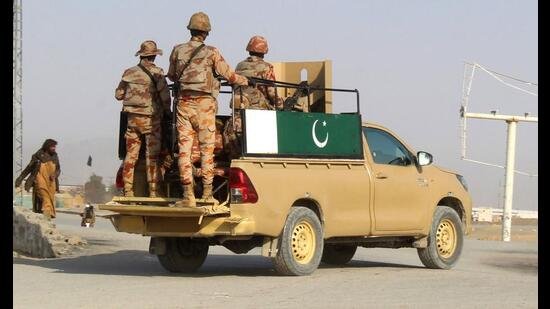
As Pakistan’s air attacks against Afghanistan intensify, criticism is also rising. Former secretary of state Mike Pompeo recently pointed out that decades of support for the Taliban had finally come home to roost. Social media is awash with images of Kabul burning, and live fire across the border, even as the Afghans claimed their own air strikes. All this hardly comes out of the blue. The Pakistan defense minister Khwaja Asif had warned of air strikes against Afghanistan, as the Tehrik-e-Taliban Pakistan (TTP) waged a relentless war against Pakistani forces. What was worrying was the minister’s warning in the same breath of a “strong possibility” of an India-Pakistan war, apparently due to India’s support for the Taliban in a proxy war. The minister rambled on, and didn’t give a single fact to support his contention, but in the world of diplomacy, these are fighting words. It needs to be examined carefully.

First, the critical aspects of Operation Ghazab lil-Haq. It hit Kabul, Kandahar, and a row of targets next to the central section of the border from Angoor Adda to Bajaur. In other words, other than a “punishing” attack on the capital, the whole frenzy seems to have hit refugee camps along the border, which in all probability also houses “terrorists”. Rawalpindi should know. It created both. The first category was created in 1974, when Pakistan first started its proxy war against Afghanistan, long before the US or the Soviets came into the picture. Subsequently, they were called mujahideenthen Taliban, and now apparently, they are Fitna al Khawarij, coined by Field Marshal Asim Munir himself, referring to a sect that rebelled against the fourth caliph Hazrat Ali (RA) and thus, place them as unjust of Islam. That’s ironic. After all, thousands upon thousands of Afghans died violently during the 40 years. Their relatives are unlikely to need any prodding to hate Pakistan.
Then, in an interview with a French news channel, where Khwaja Asif incredibly referred to nine, 10 and now 11 Indian aircraft shot down, quoting President Trump, concluding that the Indian “proxy war” arose from “defeat” in Operation Sindoor. A clearly skeptical anchor asked for evidence, which the minister sidestepped, complaining instead that various capitals he had complained to, including Istanbul and Doha, had not responded. In short, no one is buying it. Kabul, meanwhile, apparently said, while the TTP were there, they had no control on them. That statement should not surprise the minister. For decades, Pakistan’s proxy war was waged from these very border areas, and since October 2023, a forcible deportation programme, sending 5.4 million people to these very areas, as noted by a recent UN report. Unsurprisingly, these are major TTP launch pads, and the same areas that are being bombed. Call it cause and effect.
Then there’s the serious disgruntlement in Pashtun areas. The chief minister of Khyber Pakhtunkhwa, Sohail Afridi, has consistently appealed for a comprehensive and “inclusive” policy that engages locals instead of military operations. No one’s listening. In fact, his comments sparked outrage among mainland politicians, even though he declared total support for Pakistan even after the air strikes. But then, all Pashtuns and tribals alike are labeled “terrorists”, with another 60,000 people displaced in Tirah Valley as the military geared up for operations. In sum, terrorism arises from Pakistan’s inability to assure its own population. After all, TTP’s ranks are overwhelmingly Pashtun. This is exactly what Kabul is saying, asking Rawalpindi to get its own house in order before blaming others.
But then, Pakistan has always claimed victimhood. Khwaja Asif amazingly blamed the US for using Pakistan as toilet paper for decades, forgetting that the country got more than $32 billion for Afghan operations. That sum is being sorely missed, especially since much of it was diverted to Pakistan’s ministry of finance, according to the US audit, not to mention dodgy billing by the military heads involved.
With Pakistan now in the chair of the UN’s 1988 Afghanistan Sanctions Committee that oversees all matters Taliban, which interestingly also supports the 1267 Al-Qaeda Sanctions Committee, a strong diplomatic shift is evident to completely change the narrative on Afghanistan. A February 2026 report of the first committee, while condemning terrorist presence, ignores earlier reports that acknowledged the Taliban battling the Islamic State. A key finding of both committees is that TTP is “linked” to Al-Qaeda, making it a regional or global threat, as are Baloch groups. Neither of these is true in the least, but this internationalisation is classic Pakistan diplomacy. The result is that US diplomats expressed support for Pakistan in its attacks. Washington has always had a conveniently short memory. As Iran heats up, it doesn’t want Pakistan destabilised.
In sum, the whole sorry Afghan adventure arises from Pakistan’s vicious counter terrorism operations, creating a well of hatred that provides cadres for terror groups. Weapons are available in plenty from Pakistan’s 40-year war, and US weapons left behind. But for India, it is Asif’s threat of war against India that’s worrisome. An apparent Islamic State attack against India will certainly invite strong retaliation. The problem is this is exactly what Pakistan wants, as it struggles with multiple crises, including the rage over Imran Khan’s mistreatment. As the war rages in West Asia and Afghanistan burns, a certain general is making his complicated plans. For Delhi, the starter’s pistol has already been fired.
Tara Kartha is a former director, National Security Council Secretariat. The views expressed are personal