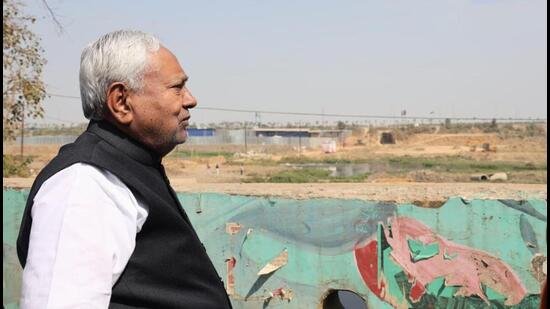
For a man destined to become one of India’s most-storied politicians, Nitish Kumar had a rather bumpy electoral start. Swept up in the post-Emergency fervour in 1977, Kumar, then 26, decided to take the electoral plunge from Harnaut — a region roiled at the time by clashes between Dalit farmhands demanding better wages, working conditions and land rights, and their landlords who hailed from the same caste as Kumar.

By then, Indira Gandhi had been deposed in the general elections. Facing him was another Kurmi, Bhola Singh — a family acquaintance who had driven Kumar and his new bride during their wedding in his Fiat four years before. Kumar’s spirits were high. He had the Janata’s endorsement. Singh was an independent candidate.
Weeks before the June assembly polls, though, the calculations changed. Around 11 am one May day, a Kurmi strongman landlord and 60 of his associates marched into a Dalit hamlet, hunted down the leader of the peasant mobilization, rounded up 11 men, tied them up and chucked them into a pyre.
The massacre made Belchi a national name and catalysed the return of Indira Gandhi from the political wilderness. But it also sang Kumar. Facing a storm of condemnation, Kurmis coalesced into a defensive group, looking for a candidate who’d defend the perpetrators of the atrocity. The socialist Kumar hesitated even as Singh embraced the mantle, and won.
The 1977 polls in Bihar were hailed as the harbinger of a social justice revolution. Karpoori Thakur became the chief minister (CM) and a year later, introduced a layered 26% reservation system for backward classes in jobs that pre-empted debates half a century later around sub-categorisation. Yet, Kumar’s debacle in Harnaut — he would lose the 1980 assembly polls from the seat again, this time, to an accused in the Belchi massacre — shows that ground realities were far removed from the brand of social justice hung around the government of the day. It would take another five years, and the fervour of Belchi to wilt, before Kumar scored his first, and only, assembly election victory in 1985. In fact, many of the communities that would go on to agitate for greater representation and rights didn’t dither in being ruthless to those more vulnerable than them in the caste hierarchy.
It was this contradiction between ideology and reality that became the hallmark of the so-called Mandal years, and its two tallest acolytes — Nitish Kumar and his friend-turned-foe-turned-friend-turned-foe-turned-friend-turned-foe Lalu Prasad.
The two men came up with contrasting responses to square this contradiction. Prasad built on his swashbuckling rustic image, focused on dismantling the upper-caste stranglehold on the bureaucracy and police, and inverted the social logic of shame around the naked exercise of power. But his measures were punitive and focused on corralling largesse for his socially numerous community, and his disdain for modernity created a false dichotomy between governance and dignity.
Kumar built on his weaknesses. Lacking a dominant community backing him, he built a coalition of extremes where he outsourced the task of wooing upper-castes to ally BJP while he stitched together a base of less-dominant backward groups smarting from the rise of the Yadavs. He correctly diagnosed rule of law as a key confidence booster for vulnerable communities and tried to bypass caste strongmen leaders in entrusting governance to bureaucrats. Yet, he was less than successful in reversing entrenched caste power, appeared more interested in his own hold on the CM’s position, and “Naya Bihar” failed to expand the pie beyond a point, resulting in the crisis of economic migration or choked aspiration of millions of young people.
For 35 years, Bihar swung between these two men. That era is over. With the imminent ascension of the BJP in the only heartland state that had eluded it, the socialist strain of politics that came to characterize Bihar, separated it from its more communally charged neighbor to the north, and made successive rulers in Delhi a junior partner to the Mandal brothers, is fading.
Ruling a state that acted as the cradle of both anti-Delhi and caste politics is both an instrumental and symbolic victory for the BJP. With the Janata Dal (United) weakened, the party can start injecting its ideology into a province that largely resisted it, finally change its nature in the one state where it is still perceived as a party of the upper-castes, and implement its brand of welfare-plus-Hindutva without the stature of Kumar standing in the way. Unless the Rashtriya Janata Dal steps up, Bihar — a state that introduced OBC quotas nearly two decades before Mandal — could well become the BJP’s backward classes laboratory, especially on the thorny question of sub-categorisation, and after the historic caste census concludes in 2027.
The transition comes precisely at the moment the nature of caste politics is mutating in the hinterland. As communities get more fragmented, welfare deliveries more targeted, and private enterprises expand, the old Mandal models are fraying. Despite the rhetoric around dignity, Mandal’s power lay in the emancipation of the numerically significant communities who had no interest in empowering those more vulnerable.
This is why neither Kumar nor Prasad pushed a single case of caste massacre to justice or nurture any marginalized caste leader worth their salt. Their pursuit of power for themselves ironically reflected the limits of socialist politics, and showed why the sudden uncritical valourisation of Mandal is ahistoric.
With modernity and capital, the material reality of caste is bound to transform – thereby changing politics. But this is also a generational moment. The first generation of backward leaders such as Thakur pushed against caste vicissitudes, thought creatively about quotas and emancipation, and grabbed power at a time when caste elites held a vice-grip on the levers of state power. The second generation of leaders such as Kumar or Prasad –— for all their faults — expanded on their vision, empowered hundreds of thousands who had never been to a city or a school, fused ideology with cunning to deliver tangible benefits to their genuinely under-served constituents, and were unwavering in their faith in a brand of secularism that made Bihar safer than many of its heartland counterparts for minorities. “Personally, I also felt we had to snatch leadership away for a younger generation of politicians, our own generation,” Kumar once told journalist Sankarshan Thakur, when asked why he canvassed for Prasad in 1989-90.
What will the next generation of leaders do? What do they stand for? What is their ideology? What is their plan to help their constituents squeezed between shrinking government jobs and poor education rendering them unemployable? Will they bring Mandal into the 21st century and move away from its male-dominated chauvinism? Will they work to resolve its contradictions or cynically exploit its gaps for power brokering? Will they help build on Bihar’s 60-year-long legacy of backward classes reform, or forever stand in the shadow of their predecessors? A cacophony of questions fills the vacuum left behind by Kumar’s exit from Bihar.
The views expressed are personal