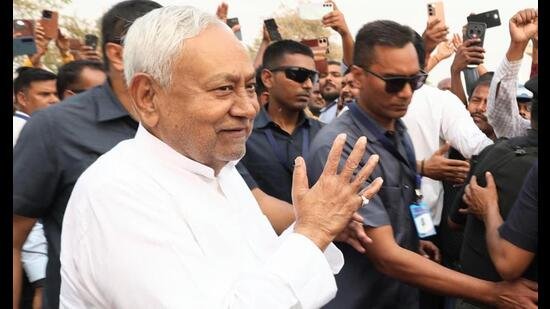
In March 2000, Nitish Kumar, chief minister (CM) for seven days, was facing a trust vote in the Bihar legislative assembly. He needed a minimum of 12 legislators to prove his majority on the floor of the house. Had it been today, with 20 independents and 23 Congress MLAs, it would have been a cake walk. But those were different times.

At that time, Lalu Prasad’s RJD with 124 members was the single largest political party in the assembly. Nitish’s Samata Party had only 34 seats. Supported by the BJP, he had the backing of 151 MLAs. This support was the key factor that influenced the governor to ask him to stake a claim to form the government. Since Nitish became the CM, rumors were rife that Lalu’s associate Shahabuddin had ringfenced 23 Congress MLAs. Nitish was helpless. In a decade of his rule, Lalu had uniquely modified the Bihar administration. It was impossible to root out the “system” in just seven days.
Nitish bowed out after an emotional speech. “Bihar’s public is witnessing how democracy is being held hostage. A majority attained by threatening legislators and holding them hostage in hotels doesn’t last long. Do we want to offer such politics to Bihar where even the public representatives aren’t free to move about?” he asked.
After this dramatic event, Rabri Devi, Lalu’s wife with no formal experience in politics, was made the CM. Lalu could not risk offering the CM’s post to any outsider — he feared that the party could break. The same game is being played today, albeit with different players. Since his decided to leave 1, Ane Marg, Nitish has sought to induct his reluctant son, Nishant Kumar, into politics. There’s no other way to save the party.
But can Nishant fill the vacuum? He will have to work hard and show exceptional wisdom. His major rival, Tejashvi Yadav, hasn’t been able to replicate the charisma of his father despite working extremely hard.
The other question is who would control the government in Bihar? If the BJP misses the chance to occupy the CM’s office, the party will regret it. Despite consistently winning more seats than JDU, the highest they have ever aspired for was the deputy CM’s post. And, the late Sushil Modi’s long and successful tenure as the Bihar deputy CM stifled the growth of other big state leaders in the BJP. The BJP has tried to fill this gap by making Nitin Nabin the BJP party president.
There’s a big section in Bihar that feels Nitish’s third and fourth terms weren’t that great. There are rumors about his health. Politics and time have an interesting relationship, and today, this political personality is being humbled by time. At such a juncture, Nitish’s decision to move to the Rajya Sabha is a reflection of his political maturity.
Whoever replaces Nitish as the CM will take a very long time to match his stature. Nitish worked hard to end “the jungle raj” in Bihar. As a journalist, I have witnessed the sorry state of roads, the decline of institutions, and the shabby state of police stations in the state. Once, I asked Nitish how he turned Bihar around. He said when he won office the second time (the seven-day government was his first term), he found that the police stations had vehicles but no fuel, and people had to bring paper to lodge a complaint. Similarly, untarred roads and potholes were synonymous with Bihar. People wouldn’t let their daughters go to study in other villages out of fear for their safety. It was impossible to spot a woman on the streets after sunset.
Nitish changed all that. His cycle scheme gave wings to the girl child. Today, women form 35% of the Bihar police force. There has been a phenomenal change in government offices and schools. He also made some harsh decisions. Prohibition was one of them. He solidified his women’s vote bank but also opened the floodgates to the illicit and spurious liquor trade. Thousands of people were jailed. The fall in revenue affected the exchequer.
The new CM will have a tough challenge in fighting the shadow of a leader who straddled Bihar’s political arena like a colossus for two decades and will deal with the wave of expectations the last elections have raised.
Shashi Shekhar is editor-in-chief, Hindustan. The views expressed are personal