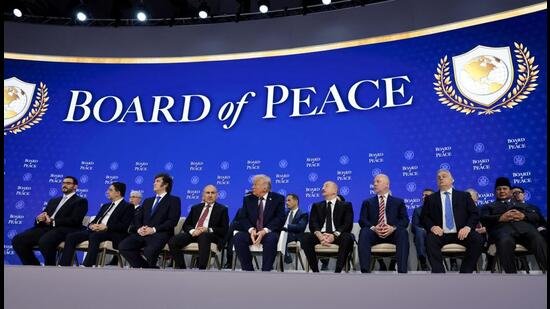
US President Donald Trump’s proposal for a “Board of Peace” has presented a revealing challenge for Indian foreign policy. India, as a country that takes pride in strictly abiding by the tenets of international law — which, in many instances, it has helped shape — must counterpose this with the expediency of joining a new, unilaterally determined framework set to be dominated by a single personality. For a nation whose rising global stature also requires strategic consistency, India’s response must be driven not only by the allure of a permanent seat on the Board, but also by the principles and core national interests that have long guided New Delhi’s global engagement.

As a founding UN member, India has worked to change a stagnant status quo, hoping to contribute to it alongside other countries as an architect-reformer, as a rule-shaper. India not only championed the UN Charter’s core tenets through eight terms on the Security Council and extensive peacekeeping, but also drove tangible institutional innovation — co-founding the UN Democracy Fund, establishing the UN Peacebuilding Commission, and crafting a new UN Human Rights Council.
Our persistent advocacy for a more representative and effective UN Security Council draws from the belief that institutions must evolve to retain legitimacy. Yet, such evolution must reinforce the UN Charter’s pillars of sovereign equality and collective decision-making.
The Board of Peace does not represent a reform of this system. Its charter centralises and sharply concentrates unbridled power, commercialises influence by linking permanent membership to a mandatory contribution of a billion US dollars, and is designed to favor unilateral leadership over negotiated consensus. This structurally flawed design weakens the very foundations India has sought to strengthen.
The Board has come into force, with its inauguration on the sidelines of the Davos Summit. India did not rush to sign up, which was entirely in order. The issue of how it would function in parallel with the UN Security Council remains quite unclear. Questioned by the media whether the Board was meant to ultimately replace the UN, Trump deliberately left the door wide open by replying “maybe it might”, later adding that the two would “work together”.
In responding, New Delhi must bear in mind that the Board is the brainchild of Trump, who has personally invited Prime Minister Narendra Modi to join it. Non-acceptance would have its costs, especially where a president as mercurial as Trump is concerned. Viewed bilaterally, India seeks to strengthen its comprehensive strategic partnership with the US based on mutual respect and shared interests. Yet, at this moment, several recent US actions, including the unfair imposition of massive unilateral tariffs on Indian exports, have been harmful and seem hardly that of a country which sees India as a friend, let alone a strategic partner.
India’s response must emanate from a clear-eyed assessment of whether the Board aligns with our core national interests. If we lend our voice and add to its legitimacy, we should be acutely aware of the potential for its misuse. While its initial focus is Gaza, the Board’s broader remit for “conflict-affected areas” creates the possibility that it could, over time, be mischievously invoked to spotlight and internationalise other issues that India regards as strictly bilateral. Let’s not forget Trump’s repeated voicing of how he “mediated” between India and Pakistan at the time of Operation Sindoor. India’s security sensitivities are non-negotiable, and our diplomatic posture must account for this strategic reality.
India’s foreign policy path has been illuminated by an eight-decade record of principled action in defense of sovereignty, equity and genuine multilateralism. New Delhi was a founding voice of the Non-Aligned Movement, not to hide from global responsibility, but to preserve our independence of judgment and action. It rejected the discriminatory Non-Proliferation Treaty that perpetuated a hierarchy of nuclear haves and have-nots. It insisted on the principle of “common but differentiated responsibilities and respective capabilities” for all climate action and a global response that takes into account historical responsibility. It consistently backed the sovereign right of States over their natural resources in international forestry and biodiversity negotiations.
Despite intense pressure at the highest levels, India sensibly did not accept a US invitation in 2003 to join the Coalition of the Willing and deploy a military contingent in the Kurdish region of Iraq. It joined the consensus-based Shanghai Cooperation Organisation, yet rejected endorsement of the Belt and Road Initiative at its 2017 Summit due to sovereignty concerns over the China-Pakistan Economic Corridor illegally traversing Indian territory. These are examples of strategic autonomy in action: Engagement with eyes wide open, and cooperation without succumbing to coercion.
The present choice before India transcends the Board of Peace. It also concerns the kind of world order India seeks to build. Shouldn’t adhere to Everyone’s time, Everyone’s Development, Everyone’s wishes guide our global approach, just as it does domestically? In the spirit of humble karma (selfless action), India’s duty lies in steadily advancing a stable, peaceful world governed by fair, inclusive norms, and the rule of international law — not in promoting a unilaterally determined framework that may well be used to undermine it.
India’s decision should be guided by a clear-eyed strategic calculus of the consequences of accepting or ignoring Board membership. An India First approach to such membership represents no retreat from global partnership. Rather, it reflects adherence to the principles of sovereign equality, justice, and cooperative autonomy that define India as a responsible power and authentic voice of the Global South. India must support the rebuilding of Gaza, but joining the Board at this stage does not serve India’s larger national interests.
Ajai Malhotra is a former Indian ambassador and former chairperson of the UN Human Rights Council Advisory Committee. The views expressed are personal