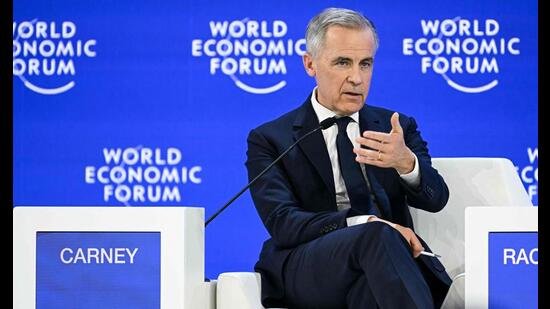
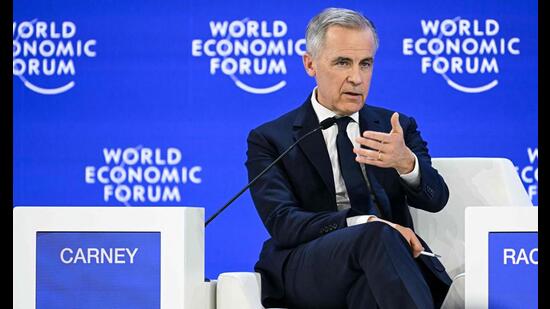
Canadian Prime Minister (PM) Mark Carney’s recent World Economic Forum speech has been widely praised as courageous — bringing much-needed candour about the “rules-based international order”. He invoked the metaphor of Vaclav Havel’s greengrocer — the ordinary figure who quietly endured an oppressive system until he and others found the collective courage to improve their lives. It is an evocative image. This is also completely wrong.
Canada was never the greengrocer. Canada was one of the mall owners. It helped design the building, sat on the management committee, enforced the rules, collected rents, and benefited from the security, financial architecture. It was embedded in Nato’s security umbrella, the dollar-anchored financial system, western trade regimes, development institutions, and the rule-writing bodies of global governance. By Carney’s own admission, Canada prospered under this order. It did not suffer silently. It accumulated.
The greengrocer changed because he discovered agency. Canada is changing because it lost power. Because the articles of association have been rewritten, US President Donald Trump did not merely introduce unpredictability; he revealed dependence. Tariffs, alliance conditionality, transactional diplomacy, weaponised finance, and open contempt for multilateral etiquette demonstrated that the protections Canada assumed were institutional were, in fact, discretionary. Middle powers did not own the order; they were licensed to it.
This is not moral awakening. It is just a loss of franchise.
Carney’s tone is that of someone finally brave enough to “tell the truth”. There is an unspoken hypocrisy in this posture. He steps forward in moral armour, presenting realism as courage and necessity as virtue. But he wasn’t resisting the system when it rewarded him. His country was a well-paid mercenary of the old regime.
Moral courage is not acknowledging the limits of an order when its benefits weaken. Carney describes the old order not only as a fiction, but as a “bargain”. That word deserves scrutiny. A bargain implies a trade-off: Gain in exchange for pain. So what exactly was Canada’s bargain? There was clearly gain, as Carney admits — “We prospered.” Where, then, was the pain? What material sacrifice did Canada bear?
The trade-offs existed. They were not borne by Canada, but by societies whose development paths were narrowed by trade and intellectual-property regimes. By countries disciplined through debt, conditionality, and sanctions. By regions destabilized through proxy wars and regime change. By populations subjected to selective humanitarianism and uneven application of international law.
For much of the Global South, there was indeed a bargain — growth traded for dependency, sovereignty traded for liquidity, stability traded for policy autonomy. Canada paid none of this price. Other countries did.
Carney repeatedly invokes “values,” as though the term itself carries moral substance. Values functioned less as governing principles and more as aesthetic language — the legitimizing grammar of a power system. They did not constrain the order. They gave it a moral texture that allowed its beneficiaries to see themselves as stewards rather than winners.
This is why “values” were rarely required to be specified. Democracy, freedom, human rights, and the rule of law floated as self-evident universals when spoken from western capitals. If India today speaks of civilizational values, dharmasocial harmony, spiritual humanism, organic community, plural sacred geographies, and duties preceding rights — would these be accepted as benign universalism? Or would they be met with suspicion, scrutiny, and demands for translation into Enlightenment vocabulary? One vocabulary is presumed neutral and universal. Another is presumed suspect.
If we are entering a genuinely plural world, this cannot continue. “Values” can no longer operate as an unexamined moral shorthand. Any society that invokes them must now specify what it means, how those values arbitrate real trade-offs, and how they function in a world of civilizational diversity, inequality, and competing historical experiences.
Carney suggests that middle powers must now coordinate around shared interests in a more openly transactional world. But this immediately exposes a contradiction he does not address. What happens when other middle powers pursue their own interests in ways that diverge from expectations of western “values”? Consider India’s decision to continue purchasing Russian oil after the Ukraine war began. From India’s standpoint, this was not ideological. It was developmental. India remains a lower-middle-income country with vast energy dependence.
Discounted Russian crude materially reduced inflationary pressure, protected fiscal stability, and supported poverty-reduction objectives. Is this legitimate self-interest? Or does it violate the “values-based” order Carney still gestures toward? If middle powers are now to act out of interest, who adjudicates which interests are acceptable? Would Canada’s strategic adaptation count as prudence, while India’s counts as moral failure? If so, then nothing substantive has changed. Only the rhetoric.
A plural world cannot operate on a moral gradient where Western self-interest is framed as stability and non-Western self-interest as deviance. What Carney’s speech actually signals is not the end of hypocrisy. This is the end of oligopoly. The old order’s moral language was viable as long as institutional authority, economic leverage, and narrative power were concentrated. As those diffuse, moral vocabulary is giving way to strategic vocabulary — resilience, hedging, diversification, autonomy, national capacity.
A genuinely post-hegemonic world will not be built merely by admitting the old order was imperfect. It will require confronting where it was extractive, who it constrained, and which civilizational assumptions it universalised. It will require opening institutional design to non-Western moral, metaphysical, and social frameworks — as foundational principles. That work has not begun. What we are witnessing instead is narrower: One of the mall owners discovering that he lost his lease. That may be prudent. It may even be necessary. But it is not moral courage. Moral courage would have been to say this when Canada was still writing the bylaws.
Swati Ramanathan and Ramesh Ramanathan are co-founders of Jana Group. The views expressed are personal