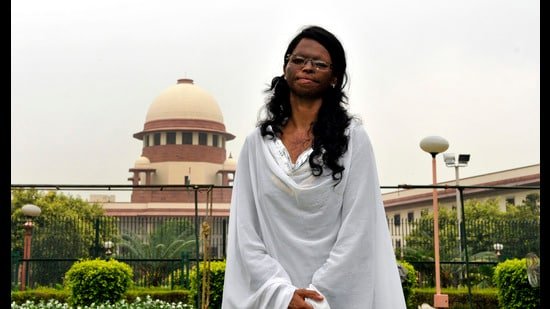
For 16 years after being attacked by acid, after losing sight in one eye and after 25 surgeries, Shaheen Malik did not lose hope. There was heartbreak when a trial court in December last year acquitted the three adult conspirators — the minor who did the job of actually dousing her with acid spent three years in jail, the most the law allows for juveniles. Then, she filed an appeal.

This week, she was in the Supreme Court in a separate public interest litigation filed by her for victims forced to ingest acid, causing unseen but devastating damage. “I spent the prime of my life pursuing the case,” the now 42-year-old told a Supreme Court bench about her own case. “I have not lost hope.”
I’ve been thinking a lot about hope and what it looks like for women who face horrific gender-based violence. Acid attacks, as we know, overwhelmingly target women, a majority from marginalized backgrounds. Shoddy police investigation, trials that drag on for years, endless appeals — and there is still no certainty of justice. National Crime Records Bureau data reveals 735 acid attack cases were slated for trial in 2023; of these, 649 had been carried forward from previous years. That year, there were just 16 convictions and 27 acquittals.
As justice moves at its leisurely pace, society — and that includes the police — scrutinise not perpetrators but survivors of violence. In 2019, for instance, police asked Rashmi Bhatia if she had really been forced to consume acid by her violent husband as she alleged or whether she had chosen to consume it? The husband was eventually arrested, but nine months later was out on bail. Six years later, Rashmi was still to complete her testimony, reported ThePrint in December.
Acid violence is one of the most heinous attacks where survivors live with disfigurement and pain for the rest of their lives. A 2011 report by Cornell University argues that the intention is not to kill but to make the person suffer for life — very often by some man furious that a woman has dared reject his advances. In Shaheen’s case, her lawyer Madiah Shahjar says, she was being propositioned by her married boss. When she turned him down, he engineered a terrible vengeance.
In a society where women are judged by the way they look, social ostracisation is common. Shaheen tells me of one survivor who was made to sit on the floor and not on her allotted seat during a train journey. Another woman was told by a stranger on the Delhi metro to cover her face. Jobs are nearly impossible to come by.
Families who believe their daughters belong to their husbands’ home, don’t want the financial burden of girls saddled with lifelong medical bills. Tucked out of sight, often rejected by their families, they are left to fend for themselves. Perpetrators, on the other hand, serve out their sentences — if convicted — and then carry on with their lives.
In 2013, based on a petition filed by another acid attack survivor Laxmi, the Supreme Court issued a slew of orders, including the regulation of acid sales and treatment in private hospitals. But, on the ground, this is rarely implemented, say activists.
Despite the odds, Shaheen has not lost hope. Three years ago, she set up an NGO, Brave Souls, that runs two shelter homes — one in Delhi and the other in West Bengal. It has so far counseled 400 survivors through legal advice, medical treatment, therapy and skill development.
So, what gives her hope? The fact, she says, that, “It’s not my fight alone. I am fighting for every woman and girl who has faced injustice.”
Namita Bhandare writes on gender. The views expressed are personal