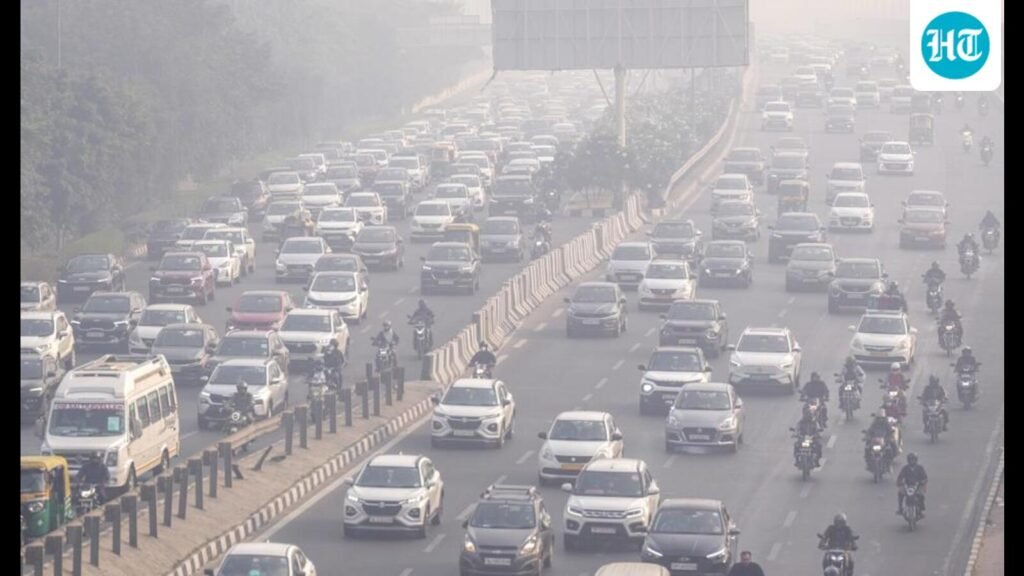
For Delhi to tackle its rapidly deteriorating air quality, citizens and policymakers must tackle one of the biggest sources of pollution within its borders: Transport, which alone accounts for nearly 50% of all air pollution within Delhi in the winter months.

There are 53 lakh active vehicles registered in Delhi; new sales deepen transport’s impact on air pollution further every day. By 2030, Delhi is expected to see a 20% rise in on-road vehicles, resulting in more congestion and rising exhaust and non-exhaust emissions. But this can, and must, be turned around. Through targeted action on BS-IV and older vehicles, and electrification of commercial vehicles, Delhi can reduce its pollution by at least 20% by 2028. This will help the Capital’s air quality reach “moderate” levels, from its current average of “poor”.
Delhi is not new to transport reforms — in fact, it is often the policy laboratory for the country. It was the first Indian state to transition its commercial passenger and freight fleet to CNG over two decades ago. In 2014, the National Green Tribunal (NGT) established an exemplary policy for phasing out older, polluting vehicles in NCR under the end-of-life (EOL) regulation. In 2018, Delhi leapfrogged to BS-VI fuel, much ahead of India. Further, Delhi’s generous EV subsidies have helped it become one of the top three Indian cities with the largest EV fleets.
However, there is a caveat. Delhi cannot act alone. Air pollution is an air shed problem. Smoke from vehicles in Gurugram, Noida, Faridabad, or Ghaziabad drifts across borders just as Delhi’s own emissions affect them. Tackling transport pollution in isolation will always fall short. New strategies or expensive ones may need a phased approach. Any action must first be planned in Delhi and five nearby high-vehicle-density districts (covering 65% of NCR fleets) — Gurugram, Noida, Ghaziabad, Faridabad, and Sonipat. The next phase could cover the wider National Capital Region, ensuring harmonized rules stop polluting vehicles from traveling to nearby districts.
Here’s a four-step strategy to tackle Delhi’s transport pollution in the next few years.
First, phase out the old and dirty vehicles (BS IV and older) by the end of 2026.The End-of-Life (EoL) vehicles removal regulation must be reinstated at the earliest. Contrary to popular belief, the regulation has been effective for the last 10 years since NGT and the Supreme Court upheld it in 2018, and has substantially reduced local emissions. Older vehicles emit several times more pollutants than newer BS-VI variants.
It’s a myth that about half of the on-road fleet in Delhi is older or illegal EOL vehicles. Studies and data from automatic number-plate recognition cameras estimate illegal EOL vehicles at a mere 83,000-2.5 lakh within the overall fleet size of about 53 lakh vehicles. Yet, these illegal EOL vehicles contribute 7-15% of PM2.5 pollution in the transport sector — resulting in disproportionately high negative health contributions. The regulation, now under hold, must be reinstated at the earliest.
Second, restrict BS IV vehicles for the next three winters. BS-IV vehicles emit up to eight times more pollutants than BS-VI variants. In winter, when PM emissions spike nearly 2.5 times, a temporary restriction of BS IV and older vehicles — similar to the transport component of GRAP-IV — could provide relief. This restriction would apply annually from mid-October to mid-February, until 2028.
From 2026, the CAQM should announce such a restriction in advance — preferably in January — to allow commuters and businesses to get used to it and manage suitable alternatives. Adequate infrastructure has been developed by the Delhi government to implement and monitor such mandates.
Third, aggressively electrify commercial fleets by 2030. Analysis by the Council on Energy, Environment and Water (CEEW) finds that nearly two-thirds of commercial vehicles in Delhi operate through aggregators in passenger and delivery services. The Delhi Aggregator Policy mandates 100% fleet electrification by 2030. We estimate that it will reduce 17% of emissions from the 2030 baseline, ensuring long-term emission reductions from highly used commercial fleets such as Uber, Ola, Porter, and Rapido. We recommend expanding the EV mandate to the entire set of commercial vehicles.
Lastly, in the long term, reducing personal vehicle use is critical. By 2030-32, most BS-IV vehicles will already be phased out. At that point, BS-VI personal vehicles will account for 100% of emissions from the sector. We recommend reducing private/personal vehicle usage and actively nudging a shift to public transport. Delhi’s two-wheeler and car fleet will only grow, increasing congestion and brake and tire dust. Sub-optimal speeds due to congestion and vehicle idling will further yield higher emissions.
Delhi is already investing heavily in rapid-rail transit corridors, expansion of metro and e-buses, green auto-rickshaws, taxis and other shared modes. Its goal of 80% public transport modal share by 2040 gives it a roadmap.
However, global experience suggests a modal shift from personal vehicles to public transport requires active nudges. These strategies — collectively known as travel demand management (TDM) measures — range from increasing the cost of owning a personal vehicle through higher registration and road taxes, to ensuring adequate parking prices. Over time, they can also evolve into congestion pricing and more restrictive approaches, such as establishing zero-emission zones in select areas.
Early action in Delhi and nearby high vehicle density districts will yield faster results, setting the approach for the rest of NCR — a clear direction of travel is needed, rather than jerks and brakes on a sustainable transport roadmap. For a city suffering the consequences of poor air quality every day, the choice is stark: Piecemeal fixes that delay change, or a bold mobility vision that delivers cleaner air, healthier lives, and a world-class livable city.
Himani Jain is fellow and Arunabha Ghosh is CEO, Council on Energy, Environment and Water (CEEW), and member (NGO), CAQM. The views expressed are personal