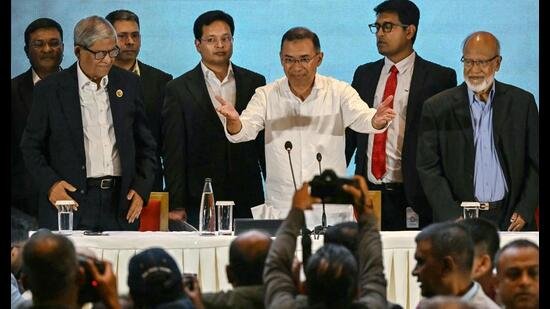
The Bangladesh Nationalist Party (BNP)’s landslide victory, coupled with its diplomatic overtures towards India, gives New Delhi an important strategic opening to reset ties with Dhaka, shed the historical baggage of the previous decade, and recalibrate India’s broader neighborhood policy.

Unburdening our relationship with Dhaka from the ghosts of the past is a strategic must. While the Awami League regime under former Prime Minister (PM) Sheikh Hasina was clearly tilted in favor of India, that tilt came at a huge price — the alienation of Dhaka’s opposition and a bilateral relationship tainted by association with deeply unpopular rule. Given that past, engaging the new BNP-led government that has signaled a desire for stable ties is an important opening for a structural reset. PM Narendra Modi’s congratulatory message to Tariq Rahman has set the ball rolling. Dhaka invited PM Modi to attend the swearing in ceremony of Rahman, but in view of his prior appointments, Speaker OM Birla is representing India at the event. Here are six steps to reset relations with the new Bangladesh.
First, economic stability will be the new regime’s priority. The 2024 uprising and the interim administration’s suboptimal performance left the economy in a fragile state, marked by sluggish growth, high unemployment, and a troubled industrial sector. To restore investor confidence and stabilize fiscal health, Bangladesh will need to deepen its economic integration with India. New Delhi must leverage this mutual need for stability and show openness to create a balanced and predictable bilateral framework.
Two, New Delhi must ignore the peripheral noise from both sides of the border: Foreign policy cannot be held hostage to social media outrage. The political hot potato is already on the table — the BNP’s renewed demand for the extradition of Sheikh Hasina following her death sentence. in absentia. While Dhaka views this as the process of justice, for New Delhi, it is a complex legal and humanitarian dilemma. Navigating this will require quiet diplomacy and a solution that satisfies Dhaka’s political optics without compromising New Delhi’s principled stand.
New Delhi has already signaled its pragmatic pivot by recognizing the BNP’s democratic mandate. By congratulating Rahman on his “decisive victory”, PM Modi has effectively de-linked India’s Bangladesh policy from the Awami League’s political fate. This outreach serves as a quiet but firm rebuttal to Sheikh Hasina’s claims from exile that the 2026 polls were a “voterless farce”. While India is unlikely to extradite Hasina to face a death sentence, the message is clear: New Delhi’s bilateral ties will no longer be held hostage to her personal political preferences. The ball is now in Dhaka’s court; the new regime must look past the “extradition card” and recognize that New Delhi is ready for a partnership based on current realities, not historical loyalties.
Three, stabilizing relations with Dhaka is crucial for India’s broader neighborhood strategy. An antagonistic Bangladesh — as witnessed during the recent interim administration — creates a strategic opportunity for regional rivals such as China and Pakistan, and even extra-regional players such as Turkey. The real risk is a pincer dynamic where New Delhi’s periphery becomes a theater for coordinated geopolitical encroachment by its rivals.
While the rise of the Jamaat-e-Islami and its historical affinity for Islamabad is a cause for worry, the most consequential challenge India faces today is not the anti-India slogans on the streets of Bangladesh; it is the structural transformation of the region’s geopolitics. Therefore, New Delhi must remain focused on the principal strategic equations in the region.
Four, once the new government settles down to get the economy back on track, it will have to deal with more consequential and substantive issues with India such as water, connectivity, border management and trade. These may be less emotional issues but not without their ability to flare up tensions if not handled carefully. To ensure the early momentum isn’t squandered, both capitals must institutionalise sustained, high-level dialogues. Proactive diplomacy on the 2026 Ganga Water Treaty renewal and an arrangement regarding border management will be essential if this reset is to survive the initial euphoria.
Five, New Delhi must build a broader coalition of like-minded States to secure its interests in Dhaka. While India and the US share broader goals in the Indo-Pacific, their approaches to Bangladesh have often been at cross-purposes. To manage this friction and counter the challenge of an anti-India axis, India must court neutral development partners like Japan, South Korea, and the EU.
Finally, the radical changes in Bangladesh’s politics from August 2024 to February 2026 offers a sobering lesson for Indian statecraft. Playing favorites in our neighbourhood, tying our national interests to the survival of specific regimes or dynasties in the region is counterproductive. When a friendly regime falls, India’s strategic interests take a hit. The coldest dictum of international relations — there are no permanent friends, only permanent interests — must be the guide here. New Delhi’s pragmatic outreach to the Taliban in Kabul in 2021 and the military junta in Naypyidaw demonstrates an evolving capacity for foreign policy pragmatism. While it took us some time to reconcile with a post-Hasina Dhaka, the precedent the government sets is clear: Bilateral engagement cannot be a prisoner of moral or ideological preferences. In a region undergoing profound geopolitical transformations, sentiment is a strategic liability.
Dealing with an increasingly contested and restive South Asia will be New Delhi’s most important challenge going forward. While India remains the structural hegemon of the region, that hegemony must be exercised with far greater sophistication and subtlety. We must become a smart power that secures its interests through institutional depth, economic integration, and a clear-eyed realism that is able to look beyond the rise and fall of individual regimes.
Happymon Jacob is distinguished visiting professor, School of Humanities and Social Science, Shiv Nadar University, and editor, INDIA’S WORLD. The views expressed are personal