As the year draws to a close, reflection comes as a duty, a ledger of triumphs tallied against the unyielding march of time. My recent immersion in Nagaland, surrounded by the energy of the 26th Hornbill Festival, crystallized the truth I have carried since assuming charge: The blueprint for Viksit Bharat blooms defiantly in the emerald folds of the country’s frontiers, where Prime Minister (PM) Narendra Modi’s vision of the Northeast as Bharat’s Ashtalakshmi states becomes real. The region’s wealth of natural reserves, spiritual heritage, sports, skills, ecotourism, food and agriculture, and cultural vibrancy is not rhetoric, rather it is lived every day. If the Northeast is my second home, Nagaland is the warm seat by the fire. It is a connection forged through the raw, unfiltered kinship I feel with its people with their guardianship of 17 vibrant tribes’ legacies, their unbowed resilience amid historical tempests, and their fierce embrace of progress.

Touching down in Kohima, I was enveloped by a spectacle that felt scripted by the gods themselves: The hills ablaze in the fleeting pink of wild cherry blossoms, a rare December bloom against an unyielding azure sky, as if the land itself had unfurled a crimson carpet for the Hornbill’s grand unveiling. My journey began at the Kohima War Cemetery, perched on the very terraces where, in 1944, 10,000 Allied troops (1,420 of whom rest eternally here) halted the Japanese advance in one of World War II’s fiercest sieges. The Battle of Kohima was the forge where our Naga community stood shoulder-to-shoulder with the Indian jawans. The epitaph pierced me anew: “When you go home, tell them of us and say, ‘For your tomorrow, we gave our today’.” I also felt history close like a circle: The very Chindits who turned the tide here in 1944 had trained and been headquartered in my ancestral land of Gwalior, at the Grand Hotel built by my great-grandfather Maharaja Madho Rao Scindia, their Sunderland flying boats resting on our lake en route to battle. Alongside these brave Allied commandos, Naga scouts bled the Japanese dry on every ridge; together they saved Kohima, halted the invasion that could have reached Calcutta, and bound my ancestral legacy forever to these sacred hills.
Later that evening, from the vantage of Garrison Hill Center & Café, nursing a steaming mug of Naga Arabica, I gazed over the timeless sky. This coffee — from Nagaland’s 20,000-plus hectares under cultivation, yielding 15,000 tonnes annually and bearing the prestigious GI tag as Naga Coffee — is the economic alchemy that empowers 50,000 tribal farmers, fuels exports to over 20 countries, and spotlights specialty brews that rival global elites. As we scale production to 25,000 tonnes by 2030 under the Act East Policy, every sip salutes a shift — from isolation to global acclaim.
Dawn broke over Tuophema village, chief minister (CM) Neiphiu Rio’s ancestral home with a ritual that seared itself into my soul — the Angami Naga’s stone-pulling ceremony. Clad in the vibrant black-and-red shawls of the tribe, I joined nearly 1,000 villagers from Naga communities as they harnessed ropes to drag a 30-tonne monolith across rutted earth, their chants rising like thunder of “ho-e-ho-e-ho-o”. I believe when hundreds of hands pull a stone across winding paths, something remarkable happens. Across the world, communities search for symbols that bind people together. Some use art, some use ritual, some use monuments. What we witness in Tuophema village carries all three at once. The stone moves through the village like a traveling testament of shared purpose, the village becomes one body. The people become one heartbeat. It is a reminder that collective strength becomes a form of timeless poetry when people choose to pull in the same direction. In a time when nations are rediscovering the value of cultural identity, this ceremony stands as a pioneering example of unity shaped by tradition and mirrors PM Modi’s mantra of “Development as well as inheritance” (development entwined with heritage).
At the Regional Craft and Resource Centre, I threaded looms with women weavers, each motif a saga of migration and myth while designer Margherita, in her studio alive with silk swatches, confided, “These aren’t fabrics; they are our revolutions in the making”. Nagaland’s vibrant artisanal legacy also came alive through its intricate gems and jewellery, the uniquely GI-tagged bamboo fabric, the iconic Naga Dao knives, and masterfully crafted wooden products. Meeting entrepreneurs such as Margherita or the coffee brewers Vitoswu and Meyievino, I realized they are spinning the economic destiny of the Northeast. Yet, vision demands the vertebrae of infrastructure. For decades, the Northeast languished as India’s “distant frontier”. No more. Guided by PM Modi’s Act East beacon unleashing $10 billion in Asean trade corridors, Nagaland surges as the dawn-lit vanguard. These aren’t bricks, they’re lifelines, arteries pumping prosperity to a region whose GDP has quadrupled since 2014. As I departed, I carried with me a profound sense of gratitude. The “today” that the soldiers gave in 1944 has indeed secured a glorious “tomorrow”. The Northeast is the face of a new, confident India. Like the monolith of Tuophema, we have pulled the weight of the past together, and now, we move forward with a strong resolve, towards a horizon bright with promise. Having dressed in the traditional attire and partaken in the Angami dance and music, a few fleeting moments where I truly felt I belonged to the very soil, I realized the depth of the celebration that was about to unfold. Nagaland does not just celebrate; it embodies celebration, truly justifying why it is called the Land of Festivals.
The Hornbill Festival at Kisama was a kaleidoscope of the human spirit and a masterful convergence of the ancient and the contemporary, where the day featured the traditional songs and dances of the 17 tribes and the evenings came alive with contemporary culture. The energy was palpable, with the Hornbill International Rock Contest drawing talented bands from across India and abroad. My visit to the Angami, Chakhesang, and Konyak morungs was especially enlightening, offering a firsthand look into the unique architecture, history, and customs that define each tribe. The culinary offerings were a feast for the senses, showcasing the incredible diversity of Naga food, a vibrant expression of the region’s organic produce and rich tribal cooking traditions. Framed by those surreal sakura blossoms, the festival felt like a bridge spanning continents. With partners like the UK, Ireland, Switzerland, Austria, France, and Malta joining the celebration, the world is now finding a home in our Northeast. This was reflected as Switzerland’s alpine yodellers, Ireland’s Celtic fiddles and the UK’s Morris dancers bridged the worlds in celebration. Amid the throng, I was proud of 7-year-old Nurile Chizo from Phek district, her voice, a crystalline soprano, cleaving the arena with a folk ballad on hornbills and hill winds, earning roars from thousands of spectators. Nearby, at the Hornbill Crafts Market were buzzing stalls where hundreds of women entrepreneurs hawked bamboo jewelry, baskets, chilli pickles, looms and beyond. As the saying rings true: “When women advance, villages thrive, nations soar.” Their stalls, grossing millions last festival, are building self-reliance each year.
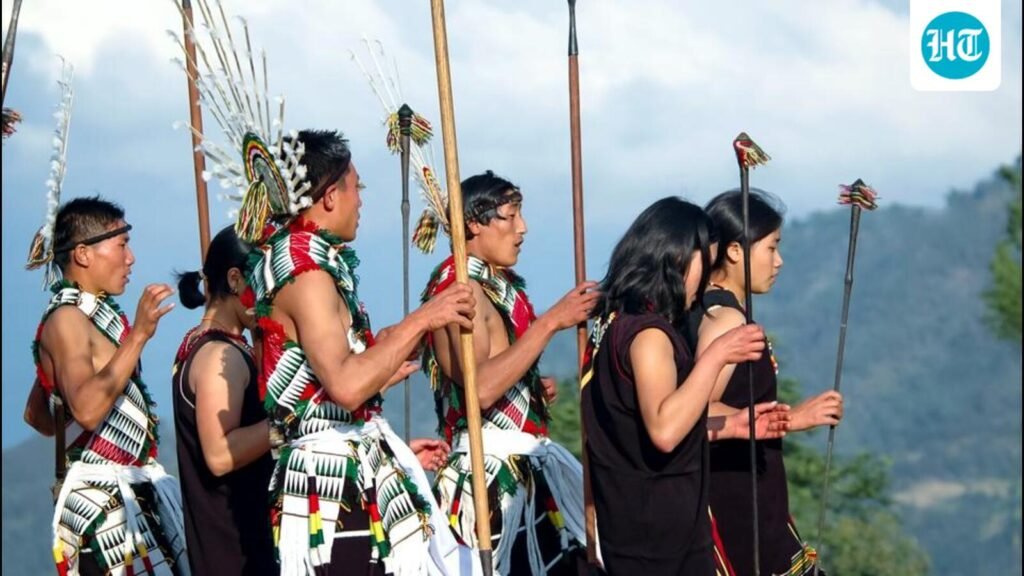
That day, I slipped off my shoes, draped the Angami black-and-red shawl over my shoulders, tied on the hornbill-feathered headgear, and stepped straight into the circle of warriors. The log drums hit like heartbeats; the bamboo flutes wailed like mountain winds. I matched the dancers, arms slicing the sky in eagle arcs, feet stamping the red earth in perfect unison with men whose grandfathers once laid the legacy, who now carry dreams. In that circle, I felt the pulse of 17 tribes thunder through my chest, and I understood why the PM insists our country will rise only when its Northeast shines.
Moments later, I walked to the dais and unveiled 645 crore of projects, alongside CM Rio whose forebears and mine share threads of freedom’s weave and selfless jan seva, 202 crore inaugurated, including upgraded health hubs serving remote population; 443 crore foundations laid, including for the 72.59-crore Kohima Multi-Disciplinary Sports Centre, solar grids powering 10,000 off-grid homes, and 200 km of blacktopped roads knitting 50 villages. Heritage and progress did not stand apart; they moved as one, exactly as PM Modi has always said they must.
Jyotiraditya Scindia is minister of communications and development of the North Eastern Region. The views expressed are personal