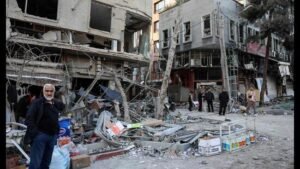
The blast at Red Fort that injured scores and killed at least 12 persons, brought back terrorism to Delhi, which, since 2011, has been spared of any major terrorist strike. Back in 2011, a bomb exploded near the Delhi high court, killing 15 persons. Pakistan-based Harkat-ul-Jihad-al-Islami (HuJI), a group known to have a spider-web of affiliations with extremist groups, had claimed responsibility for it.

Investigations into the November blast have revealed a network of actors involved in terror and extremism that managed to penetrate the security walls of the national Capital, built meticulously over the decades. Terrorism in India has often been subsumed within the rubric of international terrorism. Many in the international community to this day do not remember that barely three months after the 9/11 attacks against the US, which re-shaped and re-ordered the global security landscape, the Indian Parliament was attacked by the Pakistan-backed Jaish-e-Mohammed (JeM). The symbolism for India, a strike against the institution representing Indian democracy, was stark. Much like 9/11 changed the world, the Parliament attack also changed India, but barely dented the international narrative.
The post 9/11 counter-terror mechanisms were dictated by American power and interests. Power and money flew out of the US unquestioned and unabated to take on Al Qaeda and Islamist extremism associated with it, on a global scale. Countries were expected to bend to the US’s demands, and they did, including China and Russia. Some did so under pressure, while others saw an opportunity to get into Washington’s good books.
India, despite being at the receiving end of many terror attacks, has had domestic success regarding the same that do not find mention in the prevailing global counter-terror discourse. Over the years, for example, India has successfully dismantled groups such as the Indian Mujahideen (IM) and the Students Islamic Movement of India (SIMI). The declared objects of the likes of IM and SIMI were perceptually different from Pakistan-backed terror groups such as Lashkar-e-Taiba (the group behind Mumbai’s 26/11 terror attacks) and JeM. Both IM and SIMI were a part of the global Salafist movements against democracy, pluralism, secularism, and non-Islamic countries and governments.
This was the ideological anchoring of groups such as IM and SIMI. The top leadership of such groups always had clarity about who to take support from and who not to. Both JeM and LeT are Islamist organizations, but their radical agenda is first and foremost against India and focused on Kashmir, and less about a universal promotion of an Islamic ummahThis is precisely why such groups have often been criticized by other extremist organizations such as the Islamic State (or ISIS), which ideologically looks at wars in the name of Islam, In simpler terms, nationalist wars are not being fought for religion, but for the myopic needs of power for a few, These definitional aberrations are becoming more common in South Asia today, particularly in India’s neighbourhood, where the Afghan Taliban is practically in an undeclared war with its own founding fathers in the Pakistan military; in places like Bangladesh, the seeds of Pakistan’s ideological exports seem to be slowly sprouting,
While much of the world’s attention is focused on other areas of conflict, such as those in West Asia or the Russia–Ukraine war, South Asia itself may be on a very delicate pedestal when it comes to both terrorism and counterterrorism. The fact that Pakistan is unable to control many of its proxies has emboldened Pakistan army chief Asim Munir to forge a pathway like that of Zia-ul-Haq, mixing ideology, politics, military prowess, and control of nuclear weapons to grab executive power and diluting the vestiges of democratic norms in that country. Meanwhile, in Afghanistan as well, the Taliban, now almost half a decade into controlling Kabul, is much closer to its original iteration in the 1990s. Kandahar, by most accounts, is the de facto capital today, under an emboldened emir Hibatullah Akhundzada.
While big-ticket counter-terror operations such as Balakot and Operation Sindoor do work well in delivering both kinetic escalations and setting new operational standards for tackling future threats, long-term investments towards a brick-by-brick dismantling of extremism are also needed. Indian agencies did this with SIMI and IM. On the other side of the spectrum, lessons from anti-Maoist counter-insurgency operations of the past few years could help in weeding out extremist ideologies at the source itself.
Finally, India, with its vast experience of both successes and failures alike in countering terror, needs to forge its own unique path, beginning with internal security and futureproofing its security institutions. Homegrown blueprints, not imported ones, should be prioritized for the long term, and that is where the needle must now point.
Kabir Taneja is deputy director and fellow, strategic studies programme, Observer Research Foundation. The views expressed are personal