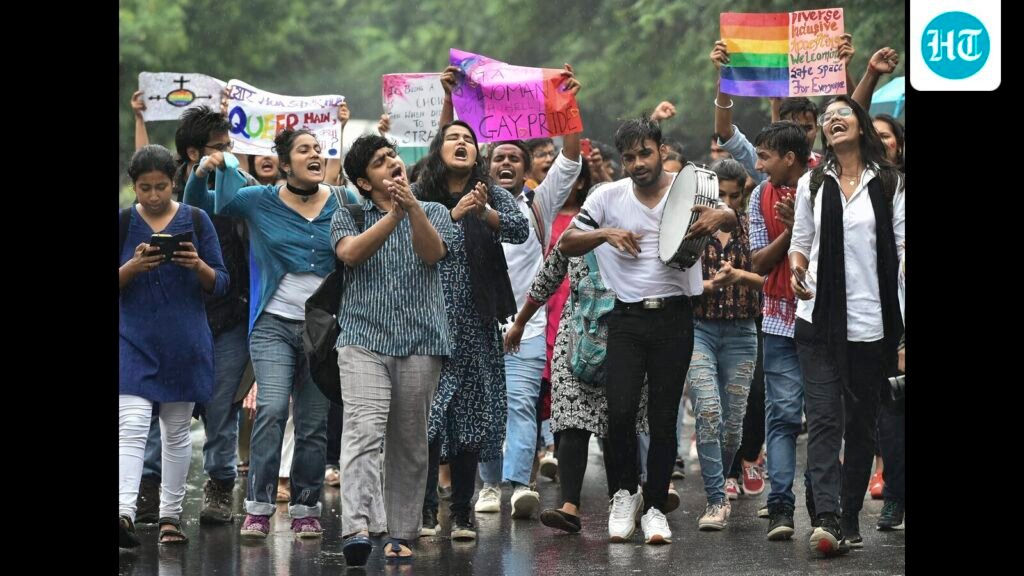
Even in 2025, educational spaces remain alien to queer lives. In 2022, a trans student was forced to drop out because of incessant bullying. A study reveals the heightened fear of harassment, outing, and erasure experienced by queer students. The government has not followed the mandate laid out in Supriyo v. Union of India, to assess and redress discrimination faced by queer persons in different facets of life.

While there have been no legislative developments, incremental progress has emerged through judicial precedents and state-level policies. In Society for Enlightenment and Voluntary Action v. Union of India, the Supreme Court advocated for a more holistic discourse on sex education which fosters empathy and reduces exploitative behaviour.
Meanwhile, Tamil Nadu’s State Policy for Transgender Persons, 2025 calls for inclusive admission procedures and the appointment of nodal officers in educational institutions. It also articulates a “right to representation” for transgender persons in education. However, it stops short of clarifying whether horizontal reservations will be provided, which has been a strong demand from many members of the community.
Despite these initiatives, progress remains piecemeal. A structural response is necessary to dismantle institutional queerphobia. Three moves are needed: Stronger anti-ragging and anti-bullying mandates, reservations for trans students, and sustained sensitization of educators and peers.
First, the UGC’s anti-ragging regulations currently extend protection only to “students of homosexual orientation” in colleges and universities. They fail to recognize the harms faced by non-binary, genderqueer, trans, and other gender-diverse students. The rules also lack mechanisms to address insidious harms such as involuntary outing, persistent misgendering, and social exclusion. Institutional anti-sexual-harassment policies suffer from a similar flaw. Clear mechanisms are needed to address bullying on the grounds of gender and sexuality. Further, queer-affirmative mental-health services should be set up to support students.
Second, equal participation in education requires affirmative representation. Despite NALSA emphasizing reservations for trans persons, implementation remains uneven. Under Section 12(1)(c) of the Right to Education Act, 2009, 25% of seats are reserved in schools for children from disadvantaged groups. Only a few states like Delhi have included transgender children within this category. On the higher education front, Kerala has issued a government order reserving seats for transgender students in arts and science colleges. The Karnataka high court has directed the National Law School of India University, Bengaluru to reserve 0.5% of seats for trans individuals. The Telangana high court has urged reservation of seats in postgraduate admissions. However, the promise of NALSA must be realized through consistent application of reservations across all states and levels of education.
Third, inclusion must extend beyond access, to affirm queer students’ belonging. True inclusion has to reflect not only in formal policies but also in everyday interactions. When teachers remain unaware or indifferent to queer experiences, they create unsafe environments. Their silence normalises exclusion and emboldens peers to replicate hostility. Sensitisation, therefore, must become a central component of institutional reform.
We need a multi-faceted approach to build educational spaces that are truly queer-inclusive, affirming, and safe: Where every student can learn, thrive, and belong.
Jwalika Balaji is a research fellow at the Vidhi Center for Legal Policy and Mandar Prakhar is an associate fellow at the Vidhi Center for Legal Policy. The views expressed are personal