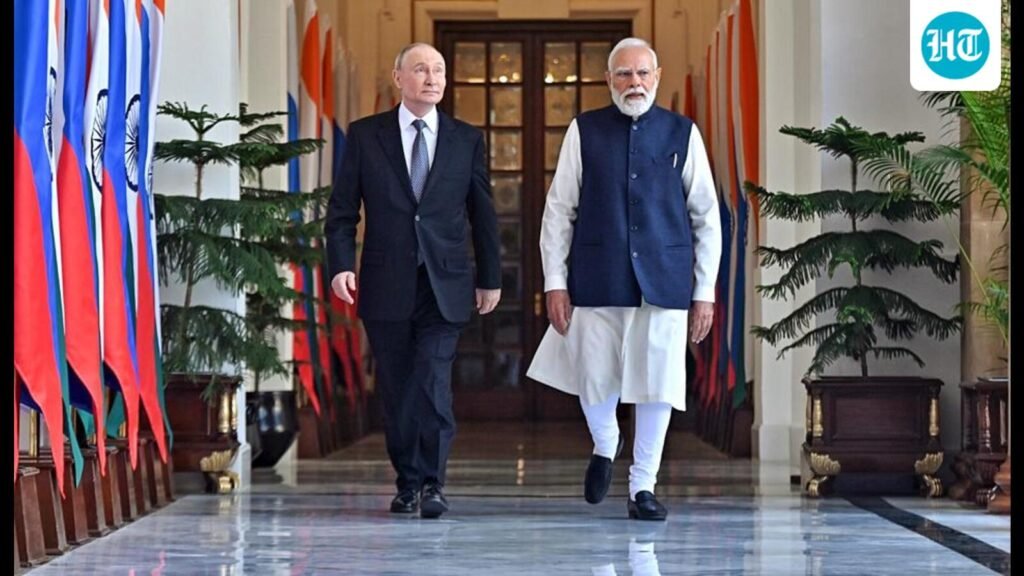
Measured by the metric of tightrope walks, it was a virtuoso performance. Prime Minister Narendra Modi finessed Russian President Vladimir Putin’s State visit to India and showed the world that the old Russia-India partnership not only had a lot of life left in it but was perhaps headed for even better days.

This was, at one level, a routine visit — the 23rd in a series of annual summits between the two countries. But, given the current global juncture, this was no ordinary summit. Putin’s aim was to show the world, especially onlookers in the West, that he remained a global leader who was received with great warmth and ceremony by one of the major world powers. Modi’s goal was to reassert India’s strategic autonomy in a year that has seen it shaken by the new Trump dispensation in Washington.
There were no showy outcomes, but a reiteration of ongoing projects and goals, and the setting up of new targets. These relate to a labor mobility agreement, their important defence, space and energy partnership, as well as efforts to set their trade relationship on an even level and boost it to $100 billion by 2030. Trade is a sensitive issue, since it is severely unbalanced, with India importing some $68 billion, mainly oil, and exporting just $5 billion worth of consumer and electronic products. But there have been several signals, including the large business delegation accompanying Putin, that Russia is serious about promoting imports from India.
Crude oil imports are at the center of India-US tensions. But while New Delhi has sharply reduced imports, foreign secretary Vikram Misri told the media that Indian public and private sector companies will make their decisions “on the basis of evolving market dynamics”. But energy in another form remains an important component of the relationship — this is nuclear power. The Russians are expanding the Kudankulam power plant to its maximum capacity and are also possibly setting up another plant. In his remarks, Putin has mooted the sale of small modular nuclear reactors, an area where he says Russia has developed special expertise.
The two sides signed several agreements and MoUs outlining the shape of their future relationship. This included one on labor mobility to let Indian professionals work in Russia. Perhaps the most important element here is the older connectivity projects whose relevance has been underscored by Europe-Russia tensions. These are the International North-South Transportation Corridor (INSTC) via Iran and the Vladivostok-Chennai maritime corridor. The INSTC has been around for the past quarter century, but only now is it gaining relevance with Russia seeking to push its trade downwards and completing the rail links that assist this.
A day before the Modi-Putin summit, the two sides held the 22nd India-Russia Inter-Governmental commission on military cooperation. But little has been made public of this meeting, except to note that New Delhi and Moscow are reorienting their defense ties to make collaboration the new paradigm.
This could benefit projects to make the Pantsir and Verba air defense systems for its army, as well as the Voronezh long-range radar, which will provide protection against ballistic missiles. India already makes Russian products such as Su-30 MKI fighters, T-90 tanks and AK-203 assault rifles under license, but the aim now is to take up future projects for fighters, aero-engines, marine engines, radars and missiles in the co-development and co-production mode. Russia has also been the key consultant in India’s nuclear-propelled ballistic missile project, which has seen the launch of three vessels — INS Arihant, Arighat and Aridhaman.
The collaboration is ongoing. Earlier this year, the sixth and last of the Russian-made Krivak III class frigates joined the Indian Navy. But there has been a delay in the supply of two S-400 batteries even as India is seeking an additional five units. Delay has also hit a 2019 deal worth $3 billion for the 10-year lease of a nuclear-propelled attack submarine.
The Russians would have also mooted the future sales of Su-57 fighters, the S-500 anti-missile system, and the Zircon hypersonic missile technology as the basis of Brahmos-II. But, for the present, India has yet to decide on them.
Since the 1950s, the US, Russia and China have moved on an enemy-friend-enemy trajectory. But the Russia-India connection has remained constant because ties have had an identity of interests all through. Moscow has not only backed India on Kashmir, but also in its South Asia policy. In turn, India has chosen to adopt a “Russia-leaning” neutrality in Moscow’s imperial ventures, be it Hungary in 1956, Afghanistan in 1979 or Ukraine in 2022. The issue of Ukraine was an important one in the conversation between the two leaders. Modi carefully nuanced his approach by telling Putin that “India is not neutral, India is on the side of peace (on the matter of Ukraine)”.
In the current era, both feel the pull of other relationships — India with the US and Russia with China. But as Putin emphasized, India and China were Russia’s closest friends, “but I do not believe we have the right to interfere in your bilateral relations”. But ongoing developments are altering the template of the relationship. On the day of the Modi-Putin summit, the Trump administration released its new National Security Strategy (NSS). It was difficult not to escape the impression that India had been downgraded in US priorities, as compared to the first Trump NSS of 2017 that had welcomed “India’s emergence as a leading global power”.
Taken together, the visit and its outcome are a testament to India’s ability to walk the rocky road towards becoming a great power. Such a path is always littered by jealous neighbours, over-solicitous uncles, nervous rivals and friends of the moment, but it is essentially a lonely one. But it is one that India has learned to walk on.
Manoj Joshi is a distinguished fellow, Observer Research Foundation, New Delhi. The views expressed are personal