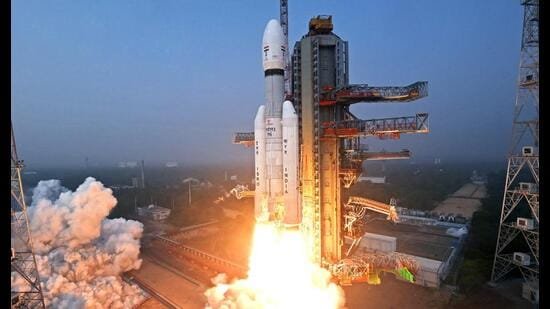
A decade ago, India’s ambitions in space rested mostly on Indian Space Research Organization (ISRO)’s shoulders. Today, the landscape has transformed. The space sector now buzzes with founders, investors, and new policies. What began as a government-driven project has exploded into an entrepreneurial revolution of chasing the stars with business plans. This is indeed most desirable; With an expanding ambit of action, ISRO can’t be expected to do everything without faltering. The Polar Satellite Launch Vehicle (PSLV)-C62 launch failing recently, among other things, underscores the dangers of spreading the space agency’s capabilities too thin.

The change from a lone Isro handling all to private space-tech players joining the game didn’t happen by chance. Three forces collided: Isro’s technical excellence, smart policy reforms that opened doors for private players, and a wave of entrepreneurs eager to turn rocket science into a practical and profitable engineering.
Between 2020 and 2023, policy architects rebuilt India’s space playground. NewSpace India Ltd (NSIL), IN-SPACe, and a fresh Space Policy together laid out clear rules, inviting private companies to build, test, and commercialize. What was once “mission control” is now “mission possible”.
India’s space economy, now valued at around $8 billion, is set for liftoff. It is projected to touch $40 billion by 2040. Fueled by over $350 million in private capital raised in the last few years, more than 420 space-tech startups dot the map, almost double the count from only four years ago. Walk through a tech conference in Bengaluru or Hyderabad and you’ll overhear conversations about turbopumps, cryogenic engines, and 3D-printed nozzles. The new space entrepreneurs look different from the older generation of scientists, and they operate with a different zest. Skyroot Aerospace became the first private Indian company to launch a rocket when its Vikram-S mission took flight in 2022. Skyroot is now racing towards Vikram-I, a commercial orbital launcher built with carbon-composite stages and rapid manufacturing in mind. Agnikul Cosmos’s Agnibaan rocket runs on the world’s first fully 3D-printed single-piece engine, built in Chennai. With India’s first privately operated launchpad at Sriharikota, Agnikul is positioning itself as an on-demand launch service for the small-satellite market.
Pixxel is pushing India into the global downstream economy with one of the world’s first hyperspectral imaging constellations. They are capturing rich spectral data for agriculture, climate modelling, ESG monitoring, and pollution tracking. It has already partnered with NASA for future hosted payload missions. Dhruva Space has emerged as a robust hardware and mission-integration player, building modular satellite buses, deployers, on-board computers, offering support through in-orbit demonstration missions.
These companies are stitching an industrial stack that spans launch, satellites, propulsion, ground systems, and space-data intelligence: a stack that didn’t exist a decade ago but now feels inevitable. Indian startups are revolutionizing the way space is accessed by managing costs frugally, accelerating timelines, and pushing the boundaries of innovation.
Space is a general-purpose technology, like Artificial Intelligence (AI) or semiconductors. It spills into every sector. Better satellite imagery can transform farming and disaster response. Cheaper launch services can create new global markets for small satellites. Downstream space-data analytics can power insurance, logistics, and climate modeling.
If India plays this hand wisely, the rewards will echo for generations: more high-skill jobs, world-class intellectual property, deeper supply chains, stronger national security, and a true export engine built in orbit. India’s leap from a software powerhouse to a deep-tech leader in space can be accelerated by some key initiatives.
Need a National Space Innovation Fund:A ₹3,000–5,000 crore blended fund, combining sovereign and private capital, can de-risk deep-tech investments and accelerate startup growth. Hardware-heavy startups cannot thrive on traditional venture capital (VC) timelines. With Indian space startups drawing over $350 million in capital in recent years, a larger fund will help them scale technologies that will fuel the projected fivefold growth for the sector.
Build shared infrastructureAccess to testing facilities, vacuum chambers, labs, clean rooms, and integration facilities remains a bottleneck for private players. IN-SPACe is stepping up as the space sector’s unified gateway for testing and building. Transparent, time-bound access to these critical resources will level the playing field and help new ideas soar into market-ready products.
Create a National Space Data Exchange: India is generating petabytes of climate, farm, and urban data from over 50 satellites, but siloed access across agencies limits its economic potential. An API-enabled, unified space data platform can unlock efficiencies for downstream sectors, enabling innovators to build apps for smart farming, logistics, or disaster response by using real-time space data. Aggregating these datasets could spark a wave of private analytics and AI-driven solutions with varied applications.
These focused steps will foster innovation and set India on a trajectory towards global leadership in new-space industries. ISRO gave India the confidence to dream in kilometers per second. But it is entrepreneurs who will turn those dreams into globally competitive products and commercial opportunities. If India moves decisively, it can become one of the top three space-faring entrepreneurial nations in the world. The global space economy is accelerating toward a trillion-dollar horizon. In this surge, India’s ambition to capture a $40 billion slice by 2040 will represent just 4% of the pie. That number is a reminder that our current trajectory, while steep, is still a modest share of what the future holds. There is no reason we cannot aim higher.
The race to a trillion dollars, the target sum of the global space economy in 10 years, is not a zero-sum game. For India, global collaborations will be an essential ingredient. Indian astronomers and engineers, working with local industry, have launched world-leading space telescopes and have built unique payloads for Chandrayaan and Mangalyaan. Indian startups are partnering in supplying propulsion systems, hyperspectral imaging, and AI-powered analytics to global missions. Products born of Indian intellectual property orbit the globe, embedded in multinational missions, but carrying the spirit and stamp of “Made in India”. This internationalism amplifies the core virtues of Indian innovation — ingenuity, frugality, and a distinctive leanspark (the ability to do more with less, and faster).
This is India’s moonshot moment. With a reform-ready State, a research-ready university system, and a risk-ready private sector, the stars are aligning. The next phase of space innovation will be powered by innovation, patient capital, and a national ambition that aims higher than ever before.
Priyank Narayan is director, Center for Entrepreneurship, Ashoka University and co-author of Leanspark, and Somak Raychaudhury is vice-chancellor, Ashoka University. The views expressed are personal