1. “Hey, it’s so good to see you after so long!”

2. “What time is your session today/tomorrow?”
3. “Oh, I’ll have to miss it because it’s clashing with another one I’m attending. But have a fantastic one!”
A dear friend’s husband, the enviable speaker’s companion, concluded at a table roaring with laughter that the above three sentences summarize all interactions in the authors’ lounge of the juggernaut called the Jaipur Literature Festival. The vacuousness of performative collegiality.
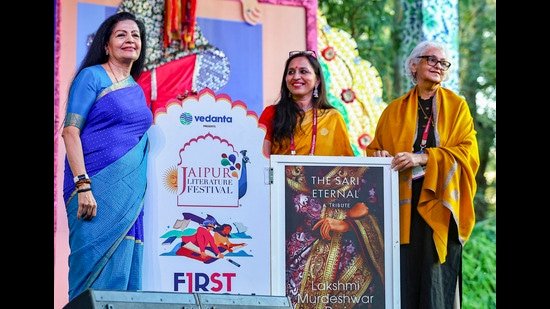
JLF, as it is lovingly called by authors and readers and everyone in between, is one of my favorite “spaces” to be in, year after year. I’ve inhabited it in various capacities — normal attendee, a professor accompanying a bunch of her students, member of foreign press, part of the sponsor’s team, Indian press member, panel moderator, author, and speaker companion. Each time, I took back experiences that cannot be replicated in any other space or time.
What has stayed with me, however, is the idea of liminal loneliness in the midst of a madding crowd, far from the madding crowd. Within sociological and cultural theory, festivals like the JLF are often framed as antidotes to alienation: moments in which individuals dissolve into a participatory whole. Yet this dominant narrative obscures another mode of being that the festival enables and, paradoxically, renders suspect: the state of being alone without being lonely.
Sociologist Erving Goffman’s concept of social performance is useful here. Festivals amplify the everyday demand to manage impressions, turning affect itself into a public obligation. Smiles, chants, shared rituals, and even fatigue become performative signals of belonging. Within this framework, detachment can appear antisocial or even suspicious, as if enjoyment that is not outwardly expressed were illegitimate. The witty speaker companion mentioned earlier just hit the bull’s eye there. Many of us feel compelled to express our enthusiasm around people we have no intention of even looking at, forget attending their sessions.
It’s a rare person who admits to pulling all possible strings to not be on the same flight as someone they cannot stand. This resistance opens the space for critique. It’s naive to assume that everyone gets along with everyone else, even in the most chummy environments. Then why do most people make the effort of mouthing polite inanities that are patently inauthentic? Is it to establish credentials of being clubbable?
I had the pleasure of being placed next to an immensely insightful older woman from London at a sit-down dinner hosted by one of my publishers. “With the exception of the rare working-class author making inroads into the writer’s club, Nishtha, the traditional writing cohorts have almost always been about the right kind of banter. There is a festival personality. There is the charm of clubbability. Do people want to sit next to you at a dinner like this? Do you bring effervescence to the community?” I tip my hat at her clarity. Coincidentally, she also happened to be a speaker’s companion!
This takes me to Georg Simmel’s notion of the “stranger,” a figure who is simultaneously inside and outside a social group. The stranger’s partial distance affords a clarity of perception unavailable to those fully immersed. Detached observation of companion speakers illuminates how inclusion is conditional upon adopting sanctioned modes of enjoyment. In this sense, the solitary presence of the somewhat baffled companion becomes an ethical position: It refuses to equate value with volume or belonging with mimicry. By not performing togetherness, the observer highlights its constructed nature. Authors need visibility; their companions do not, and this frees the latter.
Far from representing a failure of engagement, such detachment constitutes an intellectual and ethical luxury. I’m sure, I’m not the only one in admiring and envying the status of the speaker companion, the solitary looking person in lounges and parties, but fully immersed during the sessions, often occupying a seat in the first two rows at any venue to maximize their experience of what the festival is ultimately all about: Mikhail Bakhtin’s idea of the carnival, a meeting point for multiple ideas and voices.
Kudos to Namita Gokhale, Sanjoy Roy, and William Dalrymple for being able to continue to serve this feast for the soul called Jaipur Literature Festival, year after year. The literary world would be starved without it. (And the dear companion speaker, often sage-like, non-existent.)
Nishtha Gautam is an author and academician. The views expressed are personal