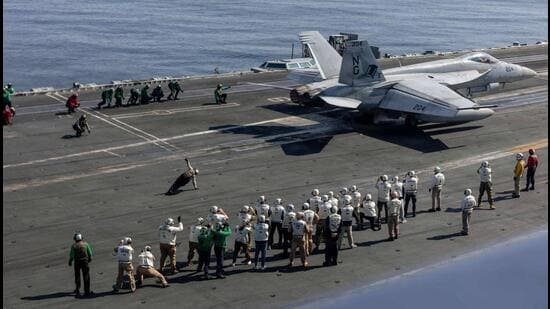
Since late January, when the USS Abraham Lincoln carrier strike group arrived in the Arabian Sea, Washington has maintained readiness for military operations targeting Iran. Faced with internal fragility and the threat of US military action, the Iranian government has sharpened its deterrence signaling. Iran’s supreme leader, Ayatollah Khamenei, termed the nation-wide protests as a US-backed coup plot and warned that any attack on Iran would result in a “regional war”.

Iran places national independence and resistance to the US at the core of its self-image. While the US calculates that a weaker Iran must make concessions beyond the enrichment issue, including on the range and size of its missile program and support for regional groups, Tehran prefers confrontation to what it sees as strategic surrender. Before Tehran agreed to resume indirect talks in Oman, Iran’s refusal to accept the regional format of negotiations in Istanbul, involving Turkey, Saudi Arabia, Qatar, Egypt, Oman, and Pakistan, and a nuclear-issue-plus agenda indicates that it will not recalibrate its strategic posture under pressure.
Tehran’s defense doctrine, shaped by decades of confrontation and hybrid war with a conventionally superior US and Israel, leverages Iran’s asymmetrical military capabilities and controlled escalation to raise the costs for adversaries. However, to deter a US intervention aimed at regime change, Iran has signaled its willingness to take pre-emptive action and to escalate horizontally against Israel and US military bases in the Gulf. The objective is to deny Trump the opportunity to replicate a Venezuela-style low-cost, high-impact operation against Iran. Tehran has, therefore, recalibrated its posture from strategic patience, which meant absorbing losses inflicted by Israel on its regional allies and telegraphing retaliatory strikes on US bases, to one that guarantees overwhelming retaliation, regardless of whether the US engages in a surgical or broad-based operation against Iran.
The Trump administration, however, seeks to use its military power to achieve outcomes it can brand as success. But US regional allies, except for Israel, no longer see it as the guarantor of their security or regional stability. They remember the destabilizing effects of the US invasion of Iraq and are alarmed by Israel’s rise as the pre-eminent military power. Regional countries, including Turkey, Egypt, Qatar, and Oman, have supported diplomatic efforts to avoid an all-out US-Iran confrontation that might trigger a regional war or an internal collapse in Iran. They have set aside past rivalries in favor of greater defense cooperation to hedge against a disruptive US and assertive Israel.
Following the initial meeting in Muscat, the future of diplomacy and war hinges on whether Trump can back down from his maximalist demands on Iran, the level of pragmatism Tehran exercises, and the extent to which Israeli Prime Minister Benjamin Netanyahu can influence the US approach to the issue. Given that Tehran has continued to coordinate its negotiating positions with Moscow and Beijing and the stakes that Iran’s neighbors have in a negotiated solution, Tehran will show flexibility on the safety of the 400 kg stockpile of near-weapon-grade enriched uranium in its possession and on the enrichment level.
Tehran will resist US demands on its missile programme, which is seen as a pillar of its deterrence and defense strategy. Therefore, solutions such as a non-aggression pact among the US, Iran, and their respective allies, is more likely to succeed. The question remains whether Trump is pursuing coercive diplomacy with the Islamic Republic or will align with Israel’s objectives of regime change.
Deepika Saraswat is an associate fellow at Manohar Parrikar Institute for Defense Studies and Analyses. The views expressed are personal