Chhattisgarh’s creation 25 years ago rested on a simple premise: A smaller state would listen better, govern closer to the ground, and respond faster to its people. As my government completes two years in office, coinciding with the state’s silver jubilee, the real question is not how much has been announced, but how much confidence has been rebuilt. Guided by the Prime Minister’s emphasis on transparent and accountable governance, these two years have focused on ste correctionady — not disruption for its own sake, but repair.
That effort necessarily began with governance itself. Chhattisgarh did not lack policies. What it needed was clarity in process and discipline in delivery. Over the past two years, more than 400 administrative reforms have been undertaken across departments, simplifying procedures, fixing timelines, and reducing discretionary touchpoints. The e-Office system was adopted to accelerate decision-making, streamline institutional processes, and strengthen public confidence in administration.
Integrity, too, was central to this effort. Action against wrongdoing, recovery of public funds, and cooperation with investigative agencies were pursued without regard to position or affiliation. Governance acquires moral authority only when accountability is visible and consistent.
Social policy was shaped around four groups that define Chhattisgarh’s present and future — the poor, farmers, youth, and women. On the very next day after the formation of the government, approval was granted for the construction of more than 18 lakh houses under the Pradhan Mantri Awas Yojana, reflecting the priority according to shelter and security for economically weaker families. Acceleration of housing construction, particularly for the lower income groups and those affected by LWE conflict, has been paired with stronger delivery of ration supplies and welfare benefits.
Farmers remain the backbone of Chhattisgarh’s rural economy. Over the past two years, procurement systems were stabilized, input support reinforced, and irrigation projects expanded to lower risk. These measures have benefited farmers by improving payment timelines and building greater confidence. Last year, this translated into the procurement of 149 million tonnes of paddy from 25.49 lakh farmers.
For young people, opportunity must feel local and attainable. Recruitment processes were made more transparent, age-related constraints rationalized, and skill development widened through ITIs, training centres, and sports academies. An annual calendar for competitive examinations was introduced, age limits were relaxed, and recruitment has commenced for more than 32,000 posts. Nalanda Library has been established as a dedicated academic support center to assist youth preparing for competitive examinations, reinforcing fairness and institutional credibility.
Women’s participation has been strengthened through financial inclusion, nutrition, health, and livelihood programs. Direct benefit transfers, support to self-help groups, and focused maternal and child health initiatives have strengthened household stability and economic participation. Through the Mahtari Vandan Yojana, nearly seven million women now receive direct benefits. To further strengthen this commitment, the upcoming year has been declared Mahtari Gaurav Varsh, placing women at the center of all major government schemes and programmes.
Steady infrastructure development has reinforced social progress. Roads connecting remote villages, expansion of power supply, improved rail connectivity, and irrigation projects have reduced physical isolation. Railway projects worth over 47,000 crore are underway, 37 national highway projects valued at more than 18,000 crore are under development, and work on expressways connecting Visakhapatnam and Ranchi is progressing, strengthening logistics and regional integration. The real value of infrastructure lies in enabling a teacher to reach a school on time, a patient to find health care, and a farmer to access the market. Yet access alone is not sufficient to correct inequality; it has to reach and empower those left at the margins.
Under focused initiatives such as the PM-Janman Yojana and the Dharti Aaba Janjatiya Gram Utkarsh Abhiyan, efforts are being made to ensure comprehensive development of tribal and Scheduled Caste communities through improved access to housing, health services, education, and livelihood support, while strengthening the role of Gram Sabhas in local decision-making. Development cannot be sustained if it ignores history or deepens imbalance.
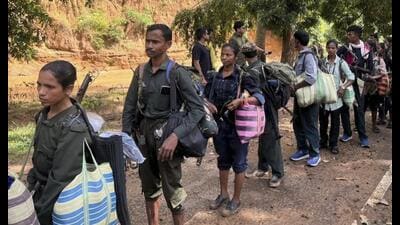
No reflection on Chhattisgarh is complete without addressing Bastar. For years, the region was defined nationally by violence alone. Our approach has been to change that reality through security, surrender, and development, pursued together with an aim to end Left-wing extremism by March next year. A revised surrender and rehabilitation policy offers former Maoists a clear route back to civilian life, with assured financial assistance, housing, skill training, livelihood opportunities, enhanced security, and the promise of a dignified future. Villages that step away from violence are prioritized for development works.
Security camps, once seen only as symbols of control, now function as access points for health care, documentation, welfare schemes, and connectivity.
Through initiatives such as Niyad Nella Nar, essential services have reached over 400 villages in Bastar, benefiting tens of thousands of residents. These efforts signal the return of the State as a partner in daily life. The objective is clear — a Chhattisgarh free from Left-wing extremism, where governance replaces fear and participation replaces isolation.
As the state marks its silver jubilee, it must also look ahead to 2047, when India completes 100 years of Independence. With governance reforms, welfare delivery, and infrastructure investments already touching our people’s lives, the task ahead is durability rather than expansion alone.
Chhattisgarh’s role in that journey will depend on sustaining growth without social fracture, preserving tribal heritage alongside modern opportunity, and keeping institutions credible and accessible.
In the years ahead, Chhattisgarh will continue to grow, not only in numbers, but in trust.
Vishnu Deo Sai is chief minister of Chhattisgarh. The views expressed are personal