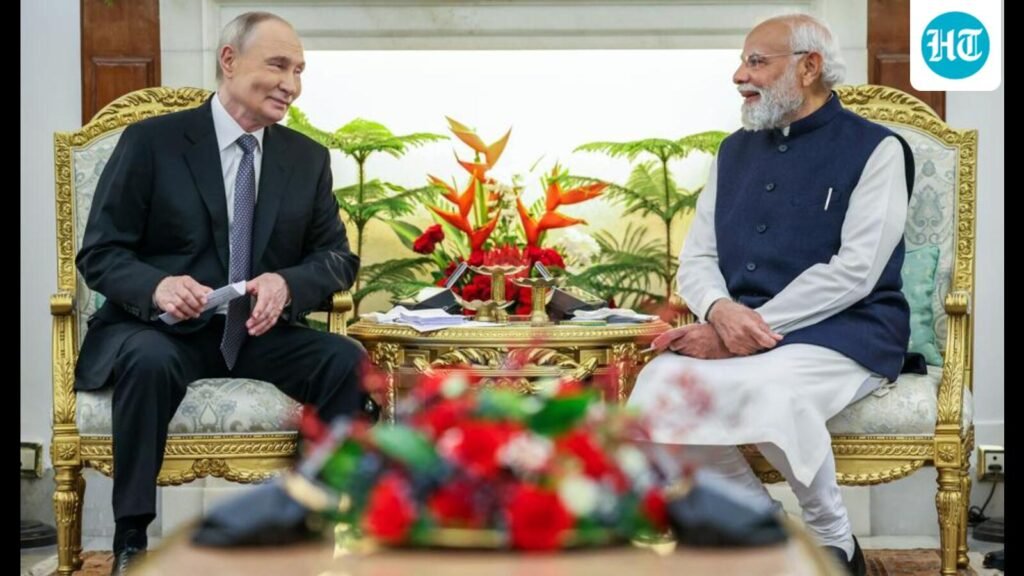
The just-concluded summit between Prime Minister (PM) Narendra Modi and Russian President Vladimir Putin, while highlighting the determination of both countries to pursue their national interest despite geopolitical pressures, also marked a fundamental restructuring of bilateral ties.

The realignment is prompted by the understanding that, while the two countries share a common political vision of a multipolar Asia, bilateral trade has to diversify beyond defense and energy, to create a robust economic environment that would be a solid foundation for a sustainable relationship.
This explains why there were no announcements of big defense or energy contracts. This led to some commentaries hastily declaring that the summit was devoid of substance and was essentially an exercise in creating the right optics for domestic audiences — for Putin to show that the West has failed to isolate Russia, and for India to show that pressure from third countries would not determine its foreign policy. The superficiality of such analysis becomes evident if one looks back at previous summits and compares them to the latest one. First, defense deals are usually not announced during summits. Second, the previous meetings focused primarily on specific areas and produced big results in these areas. This time, however, there is an attempt to create an integrated ecosystem that adds to the traditional sectors of defense, hydrocarbons and nuclear energy, and looks at technology, agriculture, pharmaceuticals, shipbuilding, cooperation in the Arctic, labor mobility, and connectivity. The importance of the labor mobility agreement cannot be overemphasized as this is the first such agreement that addresses both Russia’s demographic weaknesses and India’s demographic strengths. The absence of defense or energy deals, however, doesn’t signify lack of serious discussions on cooperation in these areas.
All this is packed in the Economic Cooperation Program 2030, which sets the aim of pushing bilateral trade to $100 billion by 2030, while addressing the issue of imbalance in trade by boosting Indian exports to Russia. The program looks at how Russia can contribute to Atmanirbhar Bharat, including in defence, and create industrial interdependencies such as the setting up of a joint venture factory in Russia that will produce fertilizers for India.
If the leadership of the two countries maintain focus on implementing the Economic Cooperation Program 2030, this will create a new architecture for economic ties that is resilient to sanctions and supply-chain disruptions and also guarantees the longevity of bilateral economic ties. The creation of a monitoring mechanism can ensure vested interests in both countries do not disturb established plans.
While economics appeared to dominate the summit deliberations, geopolitics couldn’t have been absent given the summit was preceded by the December 2 discussion on Ukraine between Putin and US interlocutors — Steve Witkoff and Jared Kushner — as well as the December 4 release of the new US National Security Strategy. The war in Ukraine, Russia’s relations with the US and China, India’s ties with these powers, Eurasian geopolitics, particularly West and Central Asia, would have been discussed between PM Modi and President Putin.
The Ukraine conflict has been a bugbear for India because it strained India’s ties with Russia, the US, and Europe. India welcomes the efforts by the US to end the conflict and hopes that this happens at the earliest because now it seems as if India is singled out by western sanctions and tariffs while other recipients of Russian energy are getting away scot-free.
Another area of concern for India is Russia’s relationship with China, which intensified after the Ukraine war, although, of late, there seem to be some strains developing on economic matters. While Russia is too big a power to be China’s “junior partner”, India would have sought assurances that Moscow’s ties with Beijing would not be strategically detrimental to New Delhi and that Russia’s support for India in international forums will continue, particularly on issues like Kashmir and UN reform. Nevertheless, India should carefully assess these words of assurance against the joint activities of Russia and China before arriving at any conclusions. Similarly, Russia would have sought assurances about India’s ties with the US and will carefully weigh words against deeds. (Amidst the saturation coverage of the summit, a Quad meeting on counterterrorism was barely noticed. But its timing was intriguing indeed — imagine India’s reaction if Russia held a meeting with China or Pakistan during a visit of the Indian PM.)
India-Russia ties, like all relationships, have their hiccups, but the two sides have learned over decades how to avoid disruptions in the relationship. The 2025 Putin-Modi Summit reinforces this uniqueness of India-Russia ties. It believes Tolstoy’s immortal words — “All happy families are alike; each unhappy family is unhappy in its own way” — by being happy in its own way.
Nandan Unnikrishnan is distinguished fellow, Observer Research Foundation (ORF). The views expressed are personal