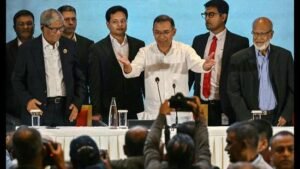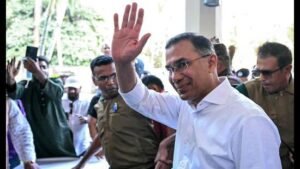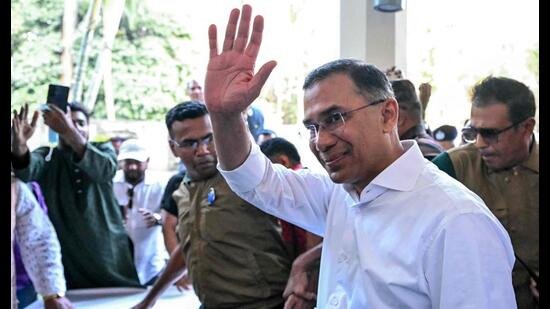
Months of speculation have finally been put to rest after the Bangladesh Nationalist Party (BNP), which was out of power for nearly two decades, won office in Dhaka in the recent parliamentary elections. Tarique Rahman, son of former president and military strongman General Ziaur Rahman, and erstwhile prime minister (PM) Khaleda Zia, and currently head of the BNP, took oath as the PM of Bangladesh on Tuesday.

Ever since Sheikh Hasina exited Bangladesh in August 2024, Bangladesh has been in a state of uncertainty, political turbulence, wanton violence and complete lawlessness. With a new regime in place, the hope is that a new and stable Bangladesh will emerge.
The significant aspect of the poll result is that the BNP won an absolute majority (216 seats). It implies that the BNP will not require any other party’s support, more specifically, of the Jamaat-e-Islami (JeI), which, incidentally, has done well to secure 76 seats. This will boost the morale of the JeI cadre. The gains also offer space to further reinforce its ideology. The JeI was an active partner in the governance of the BNP-led regime under Khaleda Zia during 2001–2006, and two senior Jamaat leaders held important minister-level positions. This time, Jamaat may not be in the government, but expect the party to step up its rhetoric on the floor of the parliament and, in all likelihood, hassle the BNP government by drawing attention to issues such as corruption and nepotism. Judging by Jamaat’s body language, it is likely to bring in other Islamic parties under its umbrella to proliferate Islamic fundamentalism. In other words, the party is unlikely to let the BNP breathe easy. A politically empowered JeI will also steadily intensify its tirade against former PM Sheikh Hasina: Many of its leaders were put on trial and hanged to death by the Hasina government for collaboration with Pakistan in the 1971 Liberation War.
On Tariq Rahman’s part, he is saddled with numerous challenges. First and foremost is the restoration of law and order in the country. During the Yunus regime, Bangladesh saw numerous political killings, the vandalisation of buildings and memorials, including Sheikh Mujibur Rahman’s house, attacks on places of worship of Hindus, the freeing of criminals from prisons, and the looting of the armouries. The police were reluctant to use force to maintain public order. Rehman has no direct experience in administration, though he was known as the conscious keeper of his mother, Khaleda Zia, during her two terms as PM (1991–1996 and 2001–2006). Further, Rahman has been out of Bangladesh for the last 17 years. He will need help from party veterans, who may be committed to the party ideology, but lack the administrative acumen or charisma to back Rahman. He also has to restore the confidence of the much despised and isolated Hindu minority. Reining in communal forces and religious extremists should figure high in Rehman’s “to do list”.
Pakistan has considerably warmed up to Bangladesh during the Yunus rule with high-level exchanges of visits in multiple sectors, including military, science and technology and in other crucial fields. It is highly unlikely that Rahman, who was in exile for many years in the UK, will immediately shelve this developing bonhomie. Pakistan will step up its efforts in a more robust manner to capitalize on Rahman’s victory. The same holds for China, which has always had a cordial relationship with Bangladesh and is expected to further woo Rahman and the BNP, essentially to keep off the growing US sway on Bangladesh. In the very recent past, the Chinese ambassador in Dhaka has said that Beijing will not allow any foreign country to disrupt the China-Bangladesh relationship.
India has played its cards well. Foreign minister S Jaishankar made a trip to Dhaka when Begum Khalida Zia passed away and met Rahman. PM Narendra Modi was quick to congratulate Rahman, and the latter was quick to reciprocate by inviting the Indian PM for his swearing-in ceremony. Importantly, Rahman conspicuously avoided any major anti-India rhetoric during his election campaign.
The past two BNP regimes saw insurgents from India’s Northeast finding a haven in Bangladesh, and Pakistani and Chinese agencies facilitating activities detrimental to Indian security interests. Undesirable commercial deals were also carried out with anti-India hostile elements being the principal benefactors.
Now that the BNP has come to stay and for good, New Delhi must engage the BNP constructively so that India’s security interests are not compromised. Rahman will do well to reciprocate in equal measure. Bangladesh needs India in the larger geopolitical context as a proven and tested ally. Multiple potential areas of bilateral cooperation between the countries may be re-commenced with renewed vigor. It should be part of Bangladesh’s collective political wisdom to start afresh in resetting ties for peace and tranquility in this combustible region.
Shantanu Mukharji, a retired IPS officer, is advisor, NatStrat, and a former National Security Advisor in Mauritius. The views expressed are personal