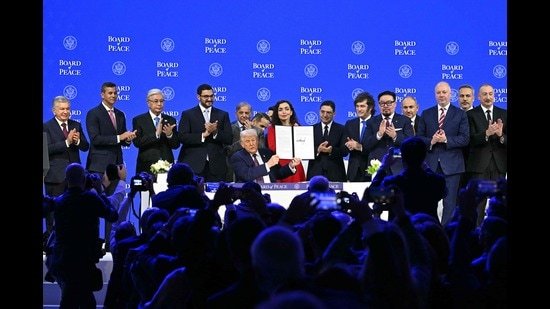
President Trump’s formation of the Board of Peace (BoP) has set the cat among the pigeons. The first meeting is scheduled for February 19. Based on the US proposal, UN Security Council resolution (UNSCR) 2803 approved the setting up of a Board of Peace for overseeing the Gaza Peace Plan. The UNSCR 2803 gives the BoP sweeping powers, including the supervision and implementation of transitional governance administration of a “Palestinian technocratic, apolitical committee of competent Palestinians from the Strip”; undertake reconstruction of Gaza and establish a temporary International Stabilization Force (ISF) in Gaza, “acceptable to the BoP”. In effect, the UN Security Council (UNSC) gave carte blanche to President Trump to set up the BoP as he deems fit. And history has shown us, especially in Israel-Egypt and Israel-Jordan peace treaties, that sustained US involvement, security and economic assurances and close monitoring, are crucial for the success of any plan in West Asia. That’s what BoP aims to do.

But when Trump did set it up, many have accused him of exceeding the mandate given to him by UNSCR 2803. One clear transgression has been that he has extended the mandate of the BoP to cover all conflicts and not just the Gaza Peace Plan. Apart from this, as regards other provisions of keeping the ultimate veto for himself as Chair of the Board, choosing the countries invited and constituting the Executive Board, it is ingenious to argue that he was not authorized to do so when the UNSC gave him carte blanche to do what he wants with the BoP.
On the other hand, India has earlier taken an almost subdued line on the unfolding human and humanitarian tragedy in Gaza. I have consistently advocated a more vocal and proactive stand by India, given our stand against terror, our support for a two-State solution, our proximity to Israel, and our huge interests in West Asia. However, when India’s relations with Trump 2.0 took a hit, along with that, our ability to engage with the US administration on the Gaza conflict also took a hit. In fact, India sent a minister of state to represent India in the Gaza Peace Summit in October 2025, jointly hosted by Egypt and the US.
While Trump’s BoP may seek to cover all conflicts within its ambit, realistically, it will now contend only with the Gaza Peace Process first. Consequently, shorn of an emotional anti-Trump reaction, purely from a geopolitical and strategic standpoint, the invite to BoP gives India yet another opportunity to reach out to the US president on an issue of importance to him (and to us), especially after having declined earlier opportunities to engage at the highest level. The fact that India and the US may have reached a trade deal does not automatically reset the relations to where they were a year ago. India-US relations need more reassurance in a fragmented world. And India joining the BoP is a big deal, and the US knows it. There needs to be a quid pro quo for our acceptance to be on the BoP, and the US may be willing to accommodate India a lot more to have us on board.
There is no doubt that a proactive role of India will help bring balance to the deliberations in BoP. If we do not join, India will be leaving the field open for countries like Turkey, Qatar, Saudi Arabia, Pakistan and others to drive the agenda. Not everyone has India’s interests in mind. Do we need to hesitate because major European countries have declined? Not at all. Their concerns are different — breakdown of the transatlantic alliance, the US coveting Greenland, the weakening of NATO, growing synergy between the US and Russia.
But what if the BoP starts dealing with the India-Pakistan issue? First, it is better to be inside the room when this issue comes up, rather than staying outside. Moreover, India is too big a country to be bullied into accepting such meddling by the BoP. And finally, what Pakistan does or doesn’t do in the BoP should be the last thing that should influence India vis-à-vis our participation. The world knows better than to pander to Pakistan’s anti-India designs.
The other fear expressed is that the BoP may supplant the UN Security Council in dealing with conflicts. First, a non-representative body like the BoP cannot displace a universally representative organization like the UN, which is the only body where more than 100 small States have a collective voice. At best, the BoP may eclipse the UNSC for a short period on Gaza.
As it is, the UNSC is paralyzed thanks to two differing world views of the five permanent members. However, the BoP can become the geopolitical counterpart of another non-representative if influential body, which is the G20, since the US, the current G20 president, wants the G20 to go back to its core focus on economic and financial issues.
The real shelf life of the BoP is probably three years (though UNSCR 2803 says it will need to be reviewed in December 2027). By which time, Trump 2.0 will be over, and India can opt out without having to pay $1 billion. Joining BoP is not like entering Hotel California of The Eagles.
India has just reached out to the Arab world, with which it has the best of relations now, by hosting the second India-Arab foreign ministers meeting in Delhi. All this is part of a careful orchestration where India is poised to play a more active role in Palestine and West Asia, and shrug off its image of not getting involved in world conflicts. These are very positive developments. Joining the BoP will only be a logical culmination of these steps and ensure that India plays the role it was always destined to do — a voice of reason and pragmatism in and for the Global South.
TS Tirumurti is a former Permanent Representative of India to the United Nations, New York and currently chair, Steering Committee, Deccan Center for International Relations, Chennai. The views expressed are personal