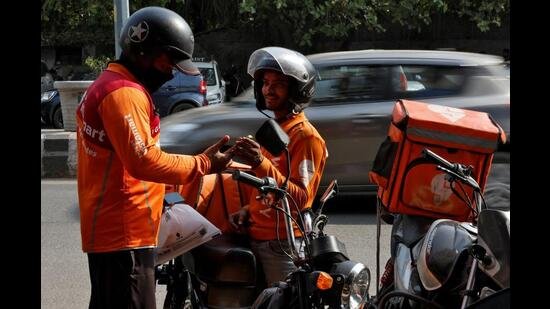
The recent strike by delivery partners of quick-commerce platforms has once again thrust India’s gig economy into the spotlight. What began as a dispute over incentives, payouts and algorithmic transparency has quickly escalated into a larger moral and economic debate: Are digital platforms exploiting workers by transferring all risks onto them, or are critics demanding employment standards that are unrealistic for businesses that are still struggling to become profitable?
As with most polarized debates, the truth lies somewhere in between. And is made more uncomfortable by the contradictions we, as consumers and citizens, often choose to ignore.
On one side are critics who argue that food delivery and e-commerce platforms operate through opaque algorithms that dictate pay, routes, ratings and penalties, leaving delivery workers with little bargaining power. Gig workers bear the costs of fuel, vehicle maintenance, health risks and idle time, while platforms retain flexibility and scale without assuming traditional employer responsibilities. A labor surplus market like India accentuates the power imbalance. In this view, the gig economy is not innovation but a clever reclassification of labor to evade social security obligations.
On the other side are platforms that point out an inconvenient but important fact: Most of India’s gig platforms are still unprofitable. They operate in hyper-competitive markets with thin margins, price-sensitive consumers and relentless investor scrutiny. Expecting them to offer permanent employment, provident fund contributions, health insurance, paid leave and guaranteed minimum hours, while simultaneously demanding ever-lower prices and faster delivery, ignores economic reality. Start-ups are not legacy public sector undertakings or century-old conglomerates; they are fragile experiments still searching for sustainable business models.
Lost in this shouting match is a third party — the consumer — whose role deserves closer examination.
Urban India has enthusiastically embraced the convenience economy. Together with the convenience of UPI, it’s become our favorite brag. We expect groceries in 10 minutes, hot meals in 20, and instant refunds if anything goes wrong. A delayed order is met with angry tweets, app complaints and one-star ratings that directly affect a delivery partner’s earnings. Yet the same consumer is quick to virtue-signal, taking to social media to demand fairness, dignity and equity for gig workers, without pausing to reflect on how their own behavior fuels the very pressures they condemn.
This contradiction sits at the heart of India’s gig economy debate. Speed, convenience and rock-bottom prices are not neutral preferences; they shape algorithms, incentive structures and workplace stress. When consumers reward platforms that promise the fastest delivery, platforms respond by pushing that urgency down the chain — to the rider navigating traffic, weather and safety risks. Moral outrage, when disconnected from personal consumption choices, becomes symbolic.
The government’s recent intervention adds a critical dimension to this debate. On Tuesday, Union labor minister Mansukh Mandaviya asked e-commerce and food delivery platforms to remove the “10-minute delivery” promise, citing concerns of delivery workers and the compromise on safety. It acknowledges that unchecked competition on speed can have human costs, and that the state has a role in setting boundaries where market incentives go too far.
However, regulation alone cannot resolve the structural tensions of the gig economy. Nor can a binary choice be made between “exploitative platforms” and “unsustainable welfare demands”. India needs a middle path — one that recognizes the unique nature of gig work while ensuring basic protections.
First, transparency must become non-negotiable. Platforms should be required to clearly disclose how algorithms allocate work, calculate payouts and penalize behaviour. Workers need predictability and the ability to contest unfair outcomes. Algorithmic opacity may be defensible as intellectual property, but its impact on livelihoods makes a strong case for regulatory oversight.
Second, social security must be delinked from traditional employment status. The future of work — especially in a country as young and informal as India — cannot rely on a binary distinction between “employee” and “independent contractor”. A flexible, platform-agnostic benefits framework funded jointly by platforms, workers, and the state could provide health insurance, accident cover and retirement savings without forcing rigid employment structures onto flexible work.
Third, platforms must recalibrate incentive systems away from extreme speed and toward safety and reliability. The government’s pushback on 10-minute delivery is a step in the right direction, but platforms themselves must recognize that long-term trust is built not just on convenience, but on responsible operations. Sustainable service levels may not win viral headlines, but they reduce churn, accidents and worker dissatisfaction. Good businesses take care of all stakeholders — especially partners.
Fourth, consumers must confront their own role. Ethical consumption cannot stop at hashtags. If we truly value fairness, we must accept slightly higher prices, longer delivery windows and fewer “instant” promises. Convenience has a cost; Pretending otherwise merely shifts that cost onto the most vulnerable link in the chain.
Finally, the State must act as an enabler rather than an adversary. Instead of imposing one-size-fits-all labor laws designed for factory floors, policymakers should work with platforms, unions and civil society to co-create a gig-specific regulatory framework. India has the opportunity to lead globally by designing labor protections suited to the digital age, rather than importing outdated models from industrial economies.
The gig economy is not inherently exploitative, nor is it a panacea for employment challenges. It is a transitional phase in how work is organized, mediated by technology and shaped by societal choices. Strikes like the one involving Zomato delivery partners should not be seen as disruptions to be managed, but as signals, pointing to unresolved tensions that demand thoughtful, collective solutions.
Fairness, efficiency and innovation need not be mutually exclusive. But achieving that balance will require honesty — from platforms about their practices, from governments about trade-offs, and from consumers about the true price of convenience.
Lloyd Mathias is a business strategist and independent director and tweets as @LloydMathias. The views expressed are personal