In December 2022, after considerable effort from a medley of stakeholders, DigiYatra, a new digital service was introduced at a few airports in the country. Since then, the app has changed the way millions of Indians travel through busy airports, making India one of the early movers in this space.
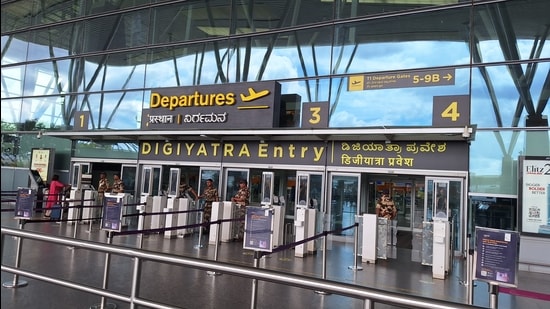
Launched by the civil aviation ministry (MOCA) — and spearheaded by the DigiYatra Foundation — in Bengaluru, Varanasi, and Delhi in 2022, DigiYatra has now been introduced at 24 airports and has a user base of around 19 million who have used the service 75 million times. It is expected to be available at 17 more airports across India, taking the total to around 41, by March 2026.
In a country where around 160 million people fly domestically (2024 recorded 161 million domestic fliers) and airport capacity remains limited, a service like DigiYatra can be a game changer. According to calculations by the foundation, the service has reduced airport entry time from 15-20 seconds to under 5 seconds for a passenger. For manual queues, the waiting time, if there are 10 passengers ahead, is down from 200-plus seconds to less than 50 seconds. The app adds 25,000 new users every day.
Yet while the adoption has been robust, the hard part lies ahead: How does one get the remaining 140-odd million domestic fliers to adopt the app?
The How, When, Why and What
Back in 2015, the team at Bengaluru Airport International Limited (BIAL) was looking at ways to improve convenience for fliers, the airport’s mainstay. How could the experience be better, more seamless, less stressful?
Several ideas were put forward by team members but one stuck. Suresh Khadakbhavi, who was then in the airport’s technology team, suggested a biometrics-based and contactless
boarding experience for fliers, without the trouble of pulling out identity cards at various checkpoints to prove who you are to different stakeholders manning the airport.
The question Khadakbhavi’s paper posed was whether things can be improved and be done in a manner where one could just walk through with virtually no touch points in a safe yet secure manner to make things efficient and less troublesome for all?
This is when the seed of DigiYatra — a contactless process that uses facial recognition to provide a seamless travel experience to domestic passengers — was sown.
An experiment was carried out by the BIAL team with Jet Airways at the terminal for an end-to-end journey experience that would be based on facial recognition and practically contactless, especially for those with only hand luggage. The experiment was duly conducted: Feedback was reassuring as passengers said that they would like to see this scaled up across airports in India.
It was after this first experiment that the idea began to crystallize, strongly endorsed by MOCA, Airports Authority of India (AAI), other private airports and security organizations like CISF and BCAS. Aadhar architect Pramod Verma was pulled in for the project as was Nandan Nilekani, who was the chairman of Unique Identification Authority of India during Prime Minister Manmohan Singh’s regime.
That’s how the DigiYatra foundation was set up in 2019 with 26 percent stake held by AAI and 76% divided between five PPP airports including DIAL, MIAL, BIAL, Hyderabad and Cochin. The initial capital was provided by these shareholders. But as the app spreads across a majority of the airports and usage grows, officials expect a per passenger usage charge to be applicable in due course, paid for by the airport operators.
The challenges ahead
Scaling 19 million users to at least around 100 million is the next big challenge before the foundation.
To do this, the team has launched a series of initiatives in recent months including the “Don’t Know Your Customer” (DKYC) campaign, which tries to allay the fears of fliers who are wary of personal data being made available to anyone, in an era of mistrust and misinformation. The foundation CEO says that the privacy by design ecosystem of DigiYatra is based on no credential storage in any central repository and this is what they have been trying to emphasize.
“In our year end wrap we have stressed these points: we don’t know your favorite airline, which routes you fly on regularly or where or how often. The idea is to drive home the point that at no stage does the DigiYatra system intrude into a passenger’s privacy since by design no data is ever stored in any central repository” explains Khadakbhavi.
Those who fear using the app due to privacy concerns argue that governments globally have been increasingly intruding into the privacy of their citizens, moving uncomfortably towards a surveillance state. The DigiYatra campaign counters this narrative, pointing to the fact that no data at any point is stored with the app and service. However, worries about privacy and misuse of biometric data for other purposes continue to persist. Making matters worse, in April 2025, the private company, which initially built the app for the foundation asked users to re-download the app, which made many even more wary.
A second recent initiative to try and increase the user base is making the app and service available in local languages. The foundation has partnered with Bhashini and the app is now enabled in six languages and will be expanded to 22 languages by March 2026. This, it is hoped, will help those more comfortable in their native language grasp what the app offers and overcome their hesitancy to use it.
The foundation has suggested two other initiatives to expand the number of subscribers.
One is to use the DigiYatra app to validate identity — for instance, during hotel check-ins. “This (the current physical process) is far more intrusive and runs more risks than the self-sovereign identity of DigiYatra,” says Khadakbhavi. So, the idea is to try and convince those who have the app to offer their credentials through DigiYatra than in any paper or physical form as at present.
Lastly, many new services across airports will be made available through the app, allowing users to book a taxi, rent a car or a hotel or avail of any other service at specific airports through the DigiYatra app.
Creating a Borderless World: India Steals a March
Since India has moved faster and is ahead, it is now working with three other countries including the European Union, all of which have embarked on the same journey by partnering and helping share how it managed to roll out and expand the service the way it has. Experiments with biometric based systems are ongoing in various parts of the world and India is assisting wherever it is asked to.
After the pandemic, many countries and the International Air Transport Association (IATA) have been working on similar initiatives to make air travel health risk free and more efficient. IATA has been campaigning for the ‘One ID’ initiative and has produced a document which aims to streamline passenger journey with advance sharing of information and a contactless process at the airport based on biometric-enabled identification.
By obtaining all necessary authorizations and demonstrating admissibility to travel prior to departure, passengers will be ‘Ready to Fly’ before they arrive at the airport. The IATA initiative argues that the travel experience can be further enhanced through digital identity technology, allowing passengers to move through airport touchpoints swiftly without showing physical documents.
An advisory committee was set up by IATA in 2015-16 and India’s DigiYatra foundation became a member of it in 2017. It is working on the recommended practice just like the IATA 792 resolution for boarding passes, which specifies how boarding passes are structured and what information they carry globally. Similarly, the ‘One ID’ initiative will define the standards for countries to adopt with regard to contactless and biometrics-based air travel. Although the ‘One ID’ initiative began before the pandemic, it has gained momentum after the pandemic validated the need for contactless travel.
But the days before one breezes in from one country to the next and clears immigration and other queues in a flash are still a while away although no longer out of grasp.
Anjuli Bhargava writes about governance, infrastructure, and the social sector. The views expressed are personal