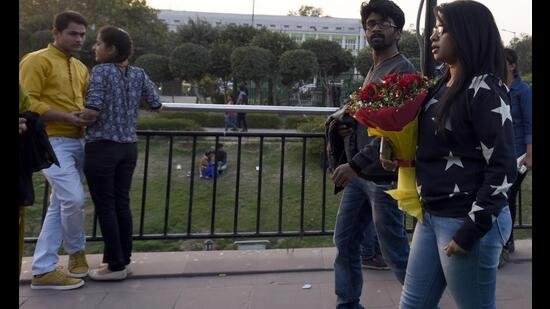
There is no social rebellion bigger than the one nonchalantly mounted by the lovers in a park. Occupying benches, nestled against shady bushes, resting next to archaic trees, lying daringly on the grass, the silhouettes of lovers of diverse ages, socio-economic backgrounds, gender and sexual identities complete the picture of a space and the society inhabiting it. Their fingers, hair, limbs, and breaths intertwined, they map centuries of oppression and resistance. If one looks carefully at them, all pessimism evaporates. At least momentarily.
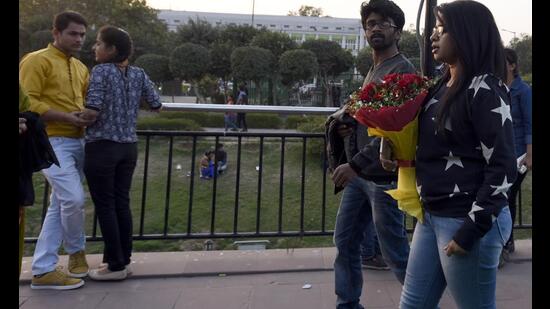
If you want to know about a culture, community, city, country, civilization, or whatever it is that people choose to group themselves as, look at how lovers in a park are treated. Where parks — public green spaces of communion — do not exist, we have problems of another magnitude that lovers cannot take upon themselves to either represent or solve.
What they can do is make a society face its biases and hypocrisies every morning and evening. In most mixed-use parks, such as Sunder Nursery and Lodhi Garden in Delhi, there is a carnival of diverse voices every day. You just have to take your earplugs off to listen to it. Athletes, amateurs, leisure seekers, loners, social butterflies, vendors, et cetera buzz around, crisscrossing the socio-economic hierarchies. Lovers ignore them. Whether lovers are ignored in return is informative.
Parks in the socially conscious parts of the city often allow lovers the luxury of being ignored. Perhaps the proximity to the sights and sounds of political correctness plays a role here. So, Nehru Park, Central Park, or the Kartavya Path green patches, along with the two mentioned earlier, let the lovers be. Move a few kilometers in any direction from here, and there’s a problem. Morality starts murdering modernity, the latter being a source of all evil for some.
In Qudsia Bagh of Civil Lines, one of the most affluent neighborhoods in Delhi, for example, the burly and uncouth “security” man will certainly manhandle the boy while harassing the girl. Even the police constable at the nearby picket won’t understand consent and sided with the goon. Some good people from good families are sure to throw around words like “safety,” “family,” “decency,” while pretending to care for the girl. Far from being ignored, lovers are put in the spotlight that shines our worst biases reflected off their scarred bodies.
Moving towards university campuses and colleges, lovers in parks become de rigeur. They just have to be tolerated. Sometimes, only because the dilapidated houses in the vicinity, converted into hostels and PGs, need them to cough up hefty sums. The owners of these PGs cannot possibly confront them in the parks. Though, no indecent behavior — ranging from cooking regional food to inviting friends or dressing up or getting home late — in the rented out space will go unpunished.
And yet, lovers do not care. Generation after generation. Community after community. Neighborhood after neighbourhood.
Lovers choosing to meet in a park are defying not just the moral certitudes of a society but also the socio-economic stratification that allows no space for the desires of the less fortunate to be expressed. In that sense, a kiss at dusk in a park between a homosexual couple or an interfaith heterosexual couple is a bigger sign of modernity than anything else that would transpire in the backseat of a luxury car at midnight. (Or the front seat for the adventurous.) The privileged can defy social mores and still stay “respectable” through outstation travels, rooms booked under decoys, or men/women smuggled in without being carded. By being in full view, rendering themselves available to the voyeurism of all stripes, the lovers in a park speak courage. They also speak revolution.
Lovers of the present draw strength from the lovers of the past who gallivanted, hand in hand, breath to breath, in the same parks. “Every collective memory unfolds within a spatial framework. . . space is a reality that endures: . . . we can understand how we recapture the past only by understanding how it is, in effect, preserved by our physical surroundings,” wrote Maurice Halbwachs in The Collective Memory. Lovers in the park construct this collective memory of risk and rebellion that sustains every fresh batch, keeping the social churn ongoing.
Those who aren’t afraid of love and all that it entails may want to doff their hat at these social warriors that reclaim equality, one kiss at a time.
Nishtha Gautam is an academician and author. The views expressed are personal