Decades ago, when I went to school in Ajmer, Jaipur was the nearest proper airport (it probably still is) and the nearest big town. There was, we knew, huge tourism potential in Rajasthan, but, frankly, India did not get too many foreign tourists then, and domestic tourism had hardly taken off.

In the decades that followed, much has changed. Jaipur is now a typical North Indian city, full of unplanned development, ugly construction and noisy traffic jams. Unless he or she knows where to look, a visitor to the city might wonder what the fuss is about: Ugliness and chaos are everywhere. (Udaipur is a much lovelier town.)
But Jaipur began to flourish when tourism began to boom. It started in the early 1970s when the Taj group took over the stunning Rambagh Palace, the 20th-century home of the Jaipur royal family, and turned it into a world-famous hotel. Then, in the early 1990s, Biki Oberoi bought a fort near Jaipur and decided to build a new luxury hotel inspired by the history and design of the medieval fort.
Biki had difficulty building it. Parts of the new hotel were built, demolished and rebuilt until he was sure that he had finally got it right. But even when he opened the spectacular Raj Vilas in 1997, the rest of the hotel industry either laughed derisively or began writing obituaries of the Oberoi group. The project had cost too much, it was said. It was much too lavish: Did guests really need private swimming pools? Who was going to pay the room rates that Raj Vilas was charging: The highest in India?
You know the rest of the story. Biki was right. The critics were wrong. Raj Vilas not only began the reinvention of Oberoi Hotels, but it also transformed hoteliering in India. Almost every single luxury resort that has opened in the country in the last 25 years owes something to Biki’s original vision.
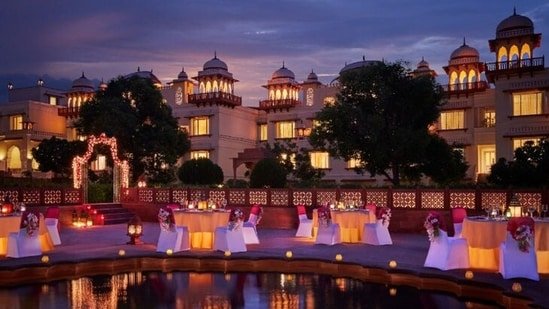
Since then, something new and massively profitable has happened to Jaipur. The city has become the center of the world for the big, fat (not to say vulgar and ostentatious) Indian wedding as that market has exploded. Indian weddings have always been (in my view) somewhat over the top and needlessly extravagant, causing parents to spend far too much money, often much more than they can really afford.
But among the super-rich, the big wedding has become the celebratory phenomenon of the 21st century. It now has very little to do with the bride and groom. Instead, it is all about the parents and how much they want to show off their wealth. Hundreds of guests, many of them distant acquaintances or even virtual strangers (as long as they are rich, famous or powerful), are invited for tamashas that last several days, during which many crores (or hundreds of crores) are spent on conspicuous consumption.
I point all this out not to pass moral judgment: It’s their money, they can do whatever they like with it. I mention it only because it has transformed Jaipur.
Jaipur hotels now cost so much that many Far Eastern destinations, popular with well-heeled Western and Chinese tourists, are much cheaper. And yet, if you try to go on holiday to Jaipur during the season (ie, half the year), you will have difficulty finding a room at a deluxe hotel (even if you can afford it).
This is not because of tourism. Although hotels pretend otherwise, the proportion of profits that come from foreign tourists has declined. The real money comes from Indians who host big weddings.
Ever since the Prime Minister declared, some years ago, that he was not in favor of millionaires hosting weddings abroad, the big weddings have come home: mostly to Rajasthan. It is the most favored wedding destination, and Jaipur is its capital.
The reason tourists and holidaymakers find it difficult to get rooms at Jaipur hotels is that the hotels are all booked out for weddings. And because a big and noisy wedding can cause disruption for other guests, hotels now prefer it if wedding parties take over entire hotels for the duration of the festivities.
The phenomenon of the Wedding Buy-out means that some of India’s loveliest hotels are unavailable to vacationers for part of the year. As none of India’s great hoteliers set out to build glorified shaadi palaces, there was some resistance to too much wedding business. At one stage, the Oberois banned all weddings. The Leela has spoken, more recently, about limiting the number of weddings at its hotels.
But, bit by bit and step by step, most hotels have surrendered. There is just so much money to be made from weddings that it makes no sense to turn away the business.
So, Jaipur now has a new hotel explosion. The big boys are still the Rambagh and Raj Vilas, but the city has seen more luxury openings than any other Indian destination. Because the hotels are built primarily to host weddings, many of the old rules of the hotel business have been thrown out of the window. At one stage, location used to be everything. Hotels were built so that they were near monuments and tourist destinations. Or at the very least, not too far from the airport.
No longer.
Now, luxury hotels are built on the assumption that everyone will be too busy eating, drinking and dancing at the weddings to ever leave the hotel. Earlier, even grand hotels emphasized guest convenience and practicality. Now that doesn’t matter as long as everything looks vulgar and expensive. Earlier, hotels wanted to boast of unique locations. Now people want to build hotels next to existing hotels. That way, if millionaires want to host huge weddings, they can divide their guests between three or four hotels and plan different functions at each property. So, location is less important than cluster.
Hotels are a business like any other, so it’s pointless to be cynical. I went a few years ago to stay at a large hotel run by an international chain far from the center of Jaipur. Not only was it inconveniently located, but it was also designed in really dodgy taste; like a villa built by a halwai. Who, I wondered, would possibly want to stay there?
Lots of people, it turned out. The hotel soon became a shaadi palace and is packed out with wedding traffic in season. What’s more, many new hotels have come up around it, directed also at the shaadi market. It is not my case that Jaipur has suffered from this shaadi surge. I am sure that hundreds of crores are made every year from the business of weddings.
But it does show you how much Jaipur has changed and how little people care about the charm and the history that were once the city’s strongest attractions. And I guess it also shows us how much India is changing. The rich now have enough money to transform the character of what could have been a great international tourist destination. And the poor survive on the crumbs.