Nothing happens by force, it happens only by love.

When Rekha speaks, everyone listens — even when she speaks to undermine speech. Honored at the recently concluded Red Sea International Film Festival, Rekha attended the first overseas screening of Muzaffar Ali’s Umrao sir, where she played the eponymous protagonist. The restored version of the 1981 film was rereleased in theaters in India in July this year.
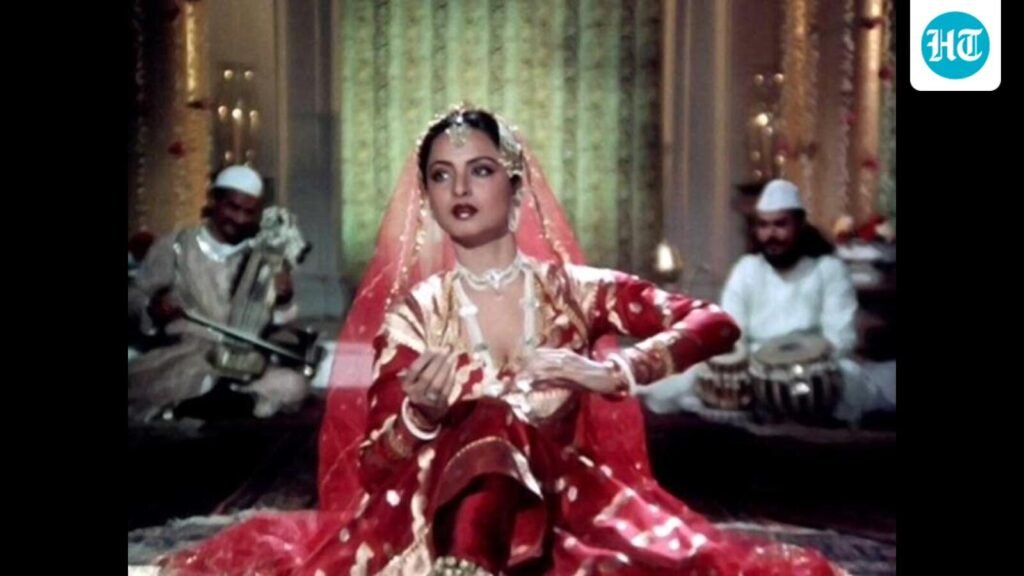
What is it about? Umrao Jaan that has kept it relevant four decades after its initial release? I found some answers while watching it, yet again, as part of homework before a conversation with Ali. Any Indian cinephile would be able to hum the music, any fashionista worth their salt would be able to recall the exact details of many a farshi and dupatta Donated by Rekha. But is Umrao Jaan’s appeal only restricted to its audio-visual extravaganza?
Certainly not. Beyond the obvious is the subtle symphony of technique and sentiment. A lot has been discussed about Muzaffar Ali’s style of recreating the world of Umrao Jaan, the courtesan, through his artistic vision: the sets, the costumes, the poetry, and the music. What is less discussed is his ability to heighten the emotional quotient of this tragic tale of Ameeran, Umrao Jaan’s real name, by upsetting the audience’s expectations. With each watching, there is a new revelation. The last one reminded me of Eric Rohmer.
One of my favorite Rohmer films is Love in the Afternoona film as far removed from Umrao Jaan as possible. Yet, there is an uncanny resemblance in the exploration of the ideas of love, togetherness, and loss. Unlike Hélène, Umrao doesn’t get a happy ending because her circumstances do not permit that. The men she’s in love with keep getting snatched from her. Umrao is not even Chloe because the latter has no emotional demands on her afternoon lover. Umrao yearns and demands but never receives her due. Not just men, any attempt at claiming agency is also thwarted, making Umrao’s life a macro story of loss. Specific instances of unhappiness, lovers leaving and guardians betraying are mere manifestations.
The film uses close-ups and jump cuts to highlight the inner life of Umrao. By applying the techniques popularized by the stalwarts of the French New Wave, like Jean Luc Godard, Francois Truffaut, and Eric Rohmer, Ali intensifies the discontinuities of Umrao’s life. Through this, he also offers the idea of this world being but an imperfect representation of the ‘real’ world, a Sufi-Bhakti idea. Where order prevails, and no Ameeran is kidnapped from her home to be sold into prostitution, no brother rejects his long-lost sister.
Umrao Jaan constantly debated the status of the courtesan in the Awadh society. Was she merely a sex worker or a woman of culture and substance? If the latter, why was she consistently shunned by polite society? If the former, why make any effort to build the kotha as the fulcrum of culture? Why bother with mastering the musical and literary traditions of both Indic and Islamic origins? These are the questions Mirza Hadi Ruswa’s Umrao sir ada, Arguably the Urdu language’s first modern novel, Raised, which Ali rendered cinematically.
Umrao Jaanwhile being a box office disappointment in 1981, is an iconic moment in Indian cinema. By casting Rekha, a popular face in commercial films, as Umrao Jaan, Ali blurred the lines between mainstream and parallel cinema. Ali brought to the fore Rekha’s ability to express a lot through her eyes, thereby launching her as an equally adept arthouse performer. Rekha as Umrao Jaan conveyed on screen that a diva, or a courtesan, is neither devoid of depth nor emotions. Ali’s Umrao Jaan is a diva whose tears sparkle more than the jewels her patrons bestowed on her. The languor of her poetry is more sensual than her classically trained limbs.
Beyond the spectacle of organza, silks, ghunghroosand Hindustani music, Umrao Jaan is like “watching the paint dry” in the style of classic Rohmer. Ali said in a recent interview, “It invites reflection. And that is something we need more of today.” Not everything is for everyone. Some revel in words, some put their passion to action. And some do both with dignity. Like Rekha and Umrao Jaan,
As Umrao mouths Shehryar’s words in what has become a classic,
“I did not make you ashamed, I did not feel ashamed myself.”
“This is the way we perform the ritual of love.”
Nishtha Gautam is an academician and author. The views expressed are personal