French President Emmanuel Macron and Prime Minister Narendra Modi share a strong personal chemistry. As India’s ambassador to France, I was witness to the very first meeting between the newly elected Macron and a Modi who was a political newbie in June 2017. Since then, the two leaders have met 20 times in both bilateral and multilateral formats. But of all the summit-level meetings between the two leaders, this one feels different. Is it because President Macron is on his last lap and wishes to leave a legacy behind? Is it because France and India are two proud middle powers reacting to geopolitical turbulence? Whatever the reasons, the two leaders decided to elevate the Franco-Indian strategic partnership to a “special” and “global” one.

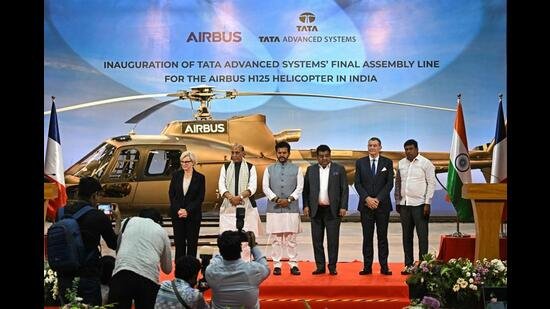
Defense has always been the bulwark of the Franco-Indian relationship. But a systemic shift is on, which entails moving from a buyer-seller relationship to a partnership based on co-design, co-development and co-production of defense platforms and equipment. While the procurement of Rafales will need further commercial negotiations, the bulk of it will be manufactured in India with significant local content requirements. The deals between SAFRAN, DRDO, and Bharat Electronics are also in the vein of Make in India projects. The inauguration of the final assembly line in Karnataka of the Tata-Airbus H125 helicopter is paradigmatic of the shift in Indo-French ties when it comes to defence.
India and France dedicating 2026 as the year of innovation is significant. It will establish close, substantive and irreversible linkages between the start-up and innovation ecosystems of the two countries and provide a common platform for the talent in both countries to come together on critical and emerging technologies, space and civil nuclear energy. The India-France Innovation Network will bring together the innovation ecosystems of France and India through a digital network, by connecting key stakeholders including innovators, start-ups, businesses and incubators of both countries.
President Macron is one of the key leaders at the ongoing India AI summit. France and India hold similar views on seminal issues surrounding AI relating to ethics, trust and inclusion. India, more than anything else, will be keen to avoid the pitfalls of a new divide caused by AI. How India handles the disruption caused by AI and how it disseminates the benefits of AI by scaling it, will hold important lessons for countries of the Global South. France and India have always stood for a third or middle path when it comes to tech and innovation. Against that backdrop, the partnership in AI will be vital for the world at large.
AI will need massive amounts of energy. In this context, cooperation on Small and Advanced Modular Reactors (SMR/AMR) between India and France and the joint commitment to apply the highest standards of safety, security and non-proliferation is important. The two leaders underlined efforts to strengthen cooperation between French start-up companies and relevant Indian companies in this sector. Separately, the two sides also agreed to explore the possibility of establishing cooperation in research and development on SMR/AMR between the French Alternative Energies and Atomic Energy Commission and India’s Department of Atomic Energy.
At a time when much of the world seems to be losing both the political will and the interest in the fight against the climate crisis, it is comforting to see both India and France devote substantial attention to the subject as part of their implementation of the Horizon 2047 road map. The world may lose interest in the matter; but India cannot afford to let up in its fight against the climate crisis. It must join hands with France to make its own cities breathable, liveable and sustainable.
This Macron visit must be situated in the larger context of India’s engagement with the European Union (EU). Indeed, both leaders underlined the importance of strengthening EU-India relations and welcomed not just the free trade agreement but also the security and defense partnership signed between the two sides. The two leaders agreed that this will contribute to the strategic autonomy of the EU and India.
The EU and India fancy themselves as independent poles in a multipolar world. They know that the fate of a genuinely multipolar world and a stable rules-based international order hinges on middle powers such as France and India joining hands. With France chairing the G7 and India leading the BRICS in 2026, there will be ample opportunities for both countries to work together to realize their common strategic objectives.
Mohan Kumar is a former Indian ambassador to France and currently dean/professor at OP Jindal Global University. The views expressed are personal