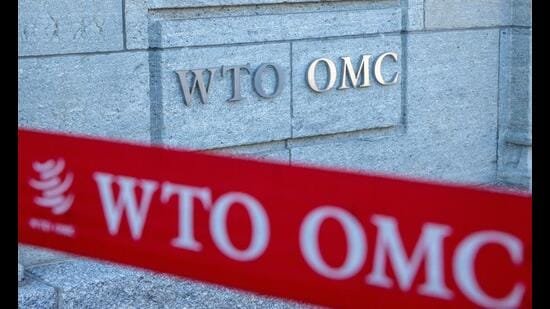
The US, as part of the ongoing discussions on World Trade Organization (WTO) reforms, has made a starting proposal that strikes at the core of the eight-decade-old multilateral trading order. prima faciethe US engagement with the WTO is welcome, given that, in recent years, it had almost abandoned the organization. The US believes that global trade should move away from the most favored nation (MFN) principle, which has been the cornerstone of the multilateral trading system, codified in the General Agreement on Tariffs and Trade (GATT) from 1948 to 1994 and subsequently in the WTO. The core reason for the US to make this argument is that the MFN provision does not fit in the current world, which has diverged from deepening convergence to thickening divergence. This shift, according to Washington, has occurred because some countries (read China) have adamantly adhered to economic systems incompatible with core WTO principles and pursued large trade surpluses. Ironically, the US was the chief architect of the MFN principle in the post-World War II era.

The MFN principle is ubiquitous in GATT and WTO and is a core non-discrimination rule. At the most basic level, it obliges WTO members to ensure that any preferences they grant to one country should be unconditionally and automatically extended to all WTO members. This truly has a multilateralising impact. It obviates the need for countries to negotiate bilateral deals to secure tariff and non-tariff concessions. This works to the advantage of Third World countries, which lack the resources and bargaining power to sign numerous trade agreements. Exclusive trade deals between select WTO members that bestowed concessions on each other are prohibited unless they cover “substantially all trade” between the constituent countries — an MFN exception under Article XXIV of GATT.
There are two ways to interpret the US proposal. One, it is historically consistent with the approach that hegemonic powers adopt toward international law. While at one level, hegemons use international law as an instrument to perpetuate their dominance, they may also withdraw from it or become revisionist — trying to reshape the international norm — in unfavorable circumstances, as legal scholar Nico Krisch has argued. We have several examples of Spain and Britain doing this in the 16th and 19th centuries, respectively, and the US in the 20th century. The hegemon may do so due to shifts in the global power structure. The meteoric rise of China — surely an unfavorable circumstance for the Americans — has led to the redistribution of power in the international legal system. To counter the rising Chinese threat, the US seeks to free itself from the constraints imposed by international law, such as the MFN rule. The absence of MFN would allow the US to impose discriminatory tariffs and non-tariff barriers on Chinese goods without having to justify the deviation from MFN under any GATT exceptions. In one fell swoop, the US seeks to junk the fundamental rule and its exceptions from the WTO rulebook.
The second way to interpret this is linked to the hegemon’s deep-seated hostility to international law. American professor Mark Pollack distinguishes change-agents in international law. Some are traditional, that is, seeking to change the law through legal argumentation, among other actions. Some are hostile change-agents who treat international law with contempt and employ tactics like power-based coercion and endeavor to delegitimise the entire system.
The US has been demonstrating hostility towards international norms since the beginning of 2025. The past year saw the imposition of discriminatory and arbitrary tariffs on all countries — an act that infringes every tenet of WTO law. This weaponisation of tariffs intends to coerce countries into negotiating bilateral agreements with the US. The US launched a program to sign “Agreements on Reciprocal Trade”, under which it has entered into two self-serving and unbalanced agreements with Malaysia and Cambodia, and is negotiating with many countries, including India. But these agreements are legally indefensible. They are discriminatory and, therefore, violate the MFN rule. Given the shallow nature of these agreements, they do not encompass “substantially all trade” and thus do not fall under Article XXIV of GATT.
Notwithstanding hostility toward the WTO, the US recognizes that it can’t overnight create an alternative international trade system. Beyond administering core trade rules, the WTO has numerous institutional processes that facilitate global trade. Additionally, even a hostile change-agent who seeks to preserve its hegemony wants to be perceived as acting lawfully, both domestically and internationally. Thus, the US needs the WTO (the US recently exited 66 international organizations, but not the WTO) sans the MFN rule, thereby legitimizing its ongoing program of discriminatory reciprocal trade agreements.
The ramifications of an MFN-free global trade system are grave. It would distort the level-playing field and production patterns, leading to a shift from efficient locations to inefficient ones and resulting in allocative inefficiency. It would jeopardize the interests of developing countries, who would have to negotiate trade agreements bilaterally to secure market access, while contending with the coercive firepower of stronger nations.
Given the US’s attempts to inflict costs on developing countries as an externality of its great-power rivalry with China, it is incumbent on countries such as India to forge alliances and contest this revisionism of the most foundational rule of the multilateral trade system. History should remember this period as one in which the hegemon failed to reshape an international law norm to serve its interests, due to resistance from the developing world.
Prabhash Ranjan is professor and vice dean (research), Jindal Global Law School. The views expressed are personal